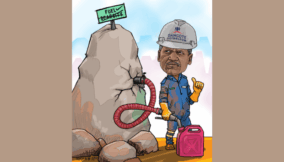
The rusted derrick near the edge of town has not pumped oil in decades. But in the village where Shell geologists struck Nigeria’s first commercial crude in 1956, a quieter energy revolution is reshaping daily life and, with it, the local economy.
A solar-and-battery microgrid installed in 2020 by Atlanta-based Renewvia Energy Corporation now serves roughly 160 households, businesses, schools, and churches in Oloibiri, deep in Bayelsa State’s Ogbia local government area. For a community that once went fifteen years without any electricity after the oil boom moved elsewhere, the shift is proving to be more than a convenience — it is a commercial turning point.
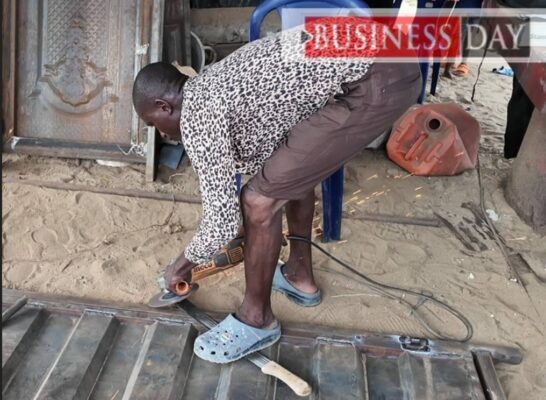
Welding shops are running longer hours. Cold-drink retailers are keeping refrigerators continuously stocked. A dry cleaner no longer budgets around diesel prices. The common thread: predictable, affordable electricity that arrives not from a stuttering generator but from a prepaid meter linked to solar panels and battery storage.
“I have more customers now thanks to solar,” says Sunday Chichi, a welder who operates a repair workshop near the town center. His complaint today — that power cuts off around 10 p.m. — would have seemed almost luxurious against the near-total darkness that defined Oloibiri’s evenings not long ago.
The project was co-financed by Shell’s AllOn impact investment vehicle alongside Nigeria’s federal Nigerian Electrification Project, a World Bank and African Development Bank-backed initiative that has channelled roughly $550 million into off-grid renewable infrastructure since 2018. Performance-based grants, totalling $48 million across eligible developers, rewarded verified connections rather than construction promises, a design intended to attract operators serious about long-term viability.
Renewvia qualified through a four-stage application process and targeted 364 household connections in Oloibiri. Azibasamari Amadi, the company’s on-site manager, followed the installation with community workshops teaching residents to monitor prepaid meters and manage consumption. For many, metered electricity was entirely new.
The economics are accessible by local standards. Lighter users spend N300 to N500 on credit lasting several days. Anthonia Deezua, who runs a provision store selling chilled beverages, pays up to N4,000 monthly, roughly the same amount some households once spent on diesel for the old communal diesel generator that ran, unreliably, for twelve hours a night.
“The noise was unbearable, and I didn’t always run it because fuel was expensive,” Deezua recalls. Her refrigerators now run without interruption, and she describes the current period as the strongest stretch of her business life.
The Renewvia model in Oloibiri attempts to close what developers call a demand gap: rural communities need electricity to grow economically, but minigrids need paying customers to remain financially solvent. Synota, a blockchain-based NGO partnering with Renewvia, operates the Davidson Future AI Lab on-site, offering free computer and artificial intelligence training to residents aged ten to seventeen. The programme builds the technically literate, income-earning workforce that can sustain grid subscriptions over time.
The stakes extend to healthcare. The Oloibiri Health for Life Medical Centre, funded partly by Shell Petroleum Development Company of Nigeria, relies on the microgrid for lighting, diagnostic equipment, and cold-chain vaccine storage, needs that a generator-dependent clinic in post-subsidy-removal Nigeria cannot reliably meet.
At its core, Oloibiri’s solar story is a small one: a few hundred connections, a single clinic, one training lab. Nigeria’s electricity deficit spans tens of millions of people. Yet the Nigerian Electrification Project was specifically designed to prove that community-scale minigrids could break even and replicate, that Oloibiri, if it worked, could become a template.


Join BusinessDay whatsapp Channel, to stay up to date
Open In Whatsapp