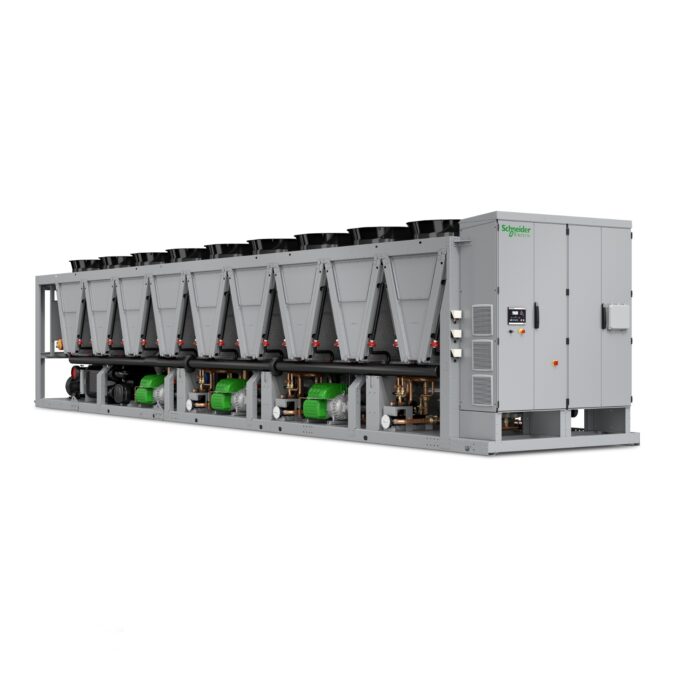
Schneider Electric has unveiled a new series of industrial chillers aimed squarely at the booming market for artificial intelligence infrastructure, where soaring compute densities have turned cooling from a background cost into a front-line engineering problem.
The Paris-based energy technology company launched the Uniflair XCA line, a set of six chiller sizes spanning 1,200 kilowatts to 2,500 kilowatts of cooling capacity. The units are built around oil-free centrifugal compressors with magnetic bearing technology, a design choice that eliminates the lubrication systems found in conventional chillers and that Schneider says can deliver efficiency gains of as much as 25% while cutting maintenance overhead.
The timing is deliberate. Data centres running dense GPU clusters for AI training and inference workloads are generating heat at a scale that conventional air cooling cannot adequately handle, accelerating the shift to liquid cooling. That transition has put chiller manufacturers at the center of an infrastructure buildout that analysts expect to run into hundreds of billions of dollars over the next decade.
“Energy efficiency, adaptability and reliability are essential components of liquid cooling systems for AI-optimised data centres,” said Andrew Bradner, Schneider’s Senior Vice President for Cooling, in a statement accompanying the launch.
The XCA line comes in two variants. The XCAC is a standard air-cooled unit, while the XCAF incorporates free-cooling capability, allowing operators to exploit ambient temperatures to reduce or eliminate mechanical cooling entirely. In moderate climates, Schneider says the free-cooling model can achieve energy savings of up to 60% compared with running mechanical cooling alone — a figure that translates directly into lower power bills and reduced carbon emissions over the life of a facility.
Both variants use refrigerants with low global warming potential, aligning the product with the European Union’s F-Gas Regulation 2024/573, which tightens restrictions on high-GWP refrigerants used in commercial cooling equipment.
Operationally, the units are designed to tolerate elevated water temperatures — outlet temperatures up to 33 degrees Celsius — which expands the window for free cooling and improves compatibility with liquid-cooled server architectures. The chillers can also function across a wide ambient temperature range, from minus 20 degrees Celsius to plus 52 degrees Celsius, a specification that matters for operators building data centers in geographically diverse locations.
Mission-critical reliability features are baked in. The system can restore full operational capacity within three minutes of a power outage, a quick-restart capability that Schneider is marketing to operators who cannot tolerate extended thermal recovery times. Software controls support variable-speed pump algorithms and advanced fan modulation, giving operators tools to balance noise levels, energy consumption, and thermal performance dynamically.
Schneider said the first Uniflair XCA units will begin shipping globally in June 2026, with availability in the United States following in early 2027. The staggered rollout reflects both manufacturing logistics and the regulatory environment for cooling equipment across different markets.
The launch puts Schneider in more direct competition with established chiller makers including Carrier Global Corp. and Trane Technologies PLC, as hyperscalers and colocation providers accelerate their liquid cooling investments. For Schneider, which has long sold power and cooling infrastructure to data centers, the XCA line represents an effort to move further up the value chain as the AI buildout reshapes what buyers actually need from their thermal management vendors.


Join BusinessDay whatsapp Channel, to stay up to date
Open In Whatsapp