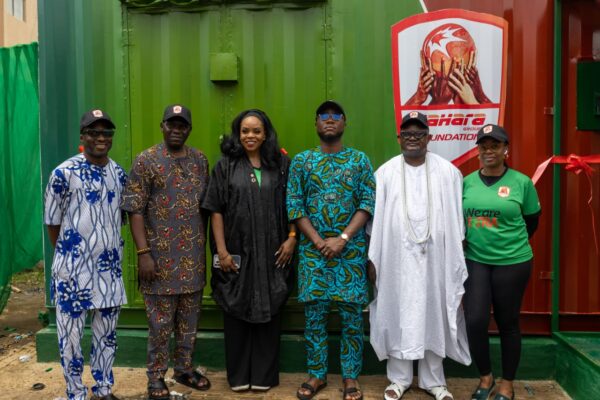
Sahara Group Foundation has commissioned its 18th and 19th recycling hubs in Lagos on the same day, planting two new waste management centers in Ojodu Local Council Development Area and extending a network that has quietly reshaped how residents in Nigeria’s commercial capital think about garbage.
The dual commissioning marks the latest expansion of the Sahara Go Recycling Initiative, a program run by the social impact arm of Sahara Group, the privately held energy and infrastructure conglomerate with operations spanning Africa, Asia, Europe, and the Middle East.
The initiative channels recyclable waste away from landfills, creates structured collection systems, and offers households a direct financial incentive to participate.
“By bringing structured recycling solutions closer to residents, we are not only promoting environmental responsibility but also creating opportunities for households to derive economic value from recycling activities,” said Chidilim Menakaya, director of Sahara Group Foundation, at the commissioning ceremony.
The twin hubs land in Ojodu at a moment when Lagos, a metropolitan area of roughly 15 million people generating an estimated 10,000 tonnes of solid waste daily, is under mounting pressure to modernise its waste infrastructure. Landfill capacity is strained, informal dumping persists across neighbourhoods, and city authorities have struggled to close the gap between waste generation and recovery.
Against that backdrop, the Foundation’s community-level approach offers a different model: small-footprint hubs positioned inside residential corridors, staffed with local workers, and tied to a broader supply chain that aggregates material for industrial recycling.
Since launching, the initiative claims to have processed more than 1,000 tonnes of recyclable materials and says the program has touched more than 2,000 livelihoods, directly through sorting and logistics jobs, and indirectly through community-based enterprise arrangements built around collection activity.
Olaide Bello, chief of staff to the executive chairman of Ojodu LCDA, David Olusegun Odunmbaku, attended the ceremony and offered the council’s endorsement.
“This Recycling Hub is both timely and impactful for the people of Ojodu LCDA, particularly because of its strategic location within the community,” Bello said. “It represents a practical model for how communities can drive environmental responsibility while advancing inclusive economic growth.”
The Foundation frames the expansion under a broader concept it calls EXTRApreneurship, a term it uses to describe enterprise-driven approaches to social and environmental challenges.
In practice, that means designing programs where community members are not passive beneficiaries but active economic participants with a stake in the outcome.
Whether the model scales is the central question. Lagos is vast, and 19 hubs, however well-run, cover a fraction of the city’s waste geography. But the Foundation has signaled it intends to keep moving, with plans to push the network beyond Lagos into other Nigerian cities and potentially other markets on the continent.
The ceremony drew representatives from Sahara Group, Ojodu council officials, community leaders, and local volunteers, a stakeholder mix the Foundation says is deliberate. Building community ownership, Menakaya argued, is what determines whether a hub becomes a fixture or a footnote.
“Through collaboration, innovation, and community participation, we are driving long-term environmental impact while improving livelihoods and strengthening community ownership of sustainable practices,” she said.
For a country where waste-to-wealth rhetoric has often outpaced results, the Foundation’s bet is that a hub-by-hub, neighbourhood-by-neighbourhood approach, unglamorous but tangible, is what actually moves the needle.

Join BusinessDay whatsapp Channel, to stay up to date
Open In Whatsapp