

…Other electricity Bands report worse conditions
…Supply drops links to gas shortages – Port Harcourt DisCos
Nigeria’s latest electricity crisis is exposing a widening disconnect between pricing and service delivery, as premium customers, popularly called Band A, pay higher tariffs for power that often does not arrive, according to BusinessDay’s findings.
Households and businesses in major urban centres such as Lagos, Port Harcourt, Osogbo, and Ilorin report worsening power outages on X (formerly Twitter), despite being placed in tariff categories that promise up to 20 hours of daily supply.
Instead, many Band A electricity customers, representing approximately 15 per cent of the total 12 million electricity users, said they are receiving only a fraction of that, sometimes plunging into days-long blackouts.
“I paid over N100,000 last month,” Tunde Adebayo, a Band A electricity customer, said. “But we’ve barely had 10 hours of power a day, sometimes less. What exactly am I paying for?”
Frank Uka, who operates a small frozen foods shop in Surulere, said he pays through his nose for power, yet his diesel bills are rising daily.
“Power is everything for me. I agreed to Band A because they said I’d get steady light. Now I’m spending more on diesel than before,” Uka said.
In Egbeda, a suburb of Lagos, residents in a mixed-band compound told BusinessDay that electricity supply is identical regardless of classification.
“There is no difference,” one resident said on X. “Band A or Band B, we are all in darkness together.”
Further south in Igando, where most residents fall under Bands B and C, outages are even more severe.
Bolanle Ayorinde, a fashion designer, said electricity supply has dwindled to less than four hours on some days. “Sometimes we go days without any power,” she said.
Under guidelines set by the Nigerian Electricity Regulatory Commission (NERC), Band A customers are entitled to a minimum of 20 hours of electricity daily, while Band B users should receive at least 16 hours.
In exchange, Band A customers pay significantly higher tariffs. In practice, those guarantees are collapsing.
Small business owners are bearing the brunt. Along Governor’s Road in Ikotun, traders report mounting losses as they rely on costly petrol generators.
“We are running into debts,” said Ifeoluwa Adesanya, who runs a frozen food business. “We don’t know if our goods will spoil overnight.”
The crisis is not confined to Lagos. In Osun State, residents of Band A communities such as Agunbelewo in Osogbo say the promised 20-hour supply is “a myth.” Electricity is often limited to five or six hours intermittently.
In Kwara State, the situation has tipped into prolonged outages. Residents of Sango in Ilorin report being without electricity for nearly two weeks.
Data from the Nigerian Independent System Operator shows that as of mid-March, only 17 of the country’s 33 power plants were operational, dragging total generation down to about 3,700 megawatts, far below demand in a country of more than 200 million people.
Gas shortages cripple supply
Experts identified inadequate gas supply to thermal power plants, which generate roughly 70 percent of Nigeria’s electricity, as the main culprits for the crises.
According to the Association of Nigerian Electricity Distributors (ANED), the country’s limited hydroelectric output, mainly from Kainji Dam, Jebba Hydroelectric Power Station, and Shiroro Hydroelectric Power Station, accounts for less than one-third of total generation.
“Gas is the fuel we use for most of our generation,” said Sunday Oduntan, CEO of ANED. “When gas supply drops, everything else suffers.”
He added, “We have water too, but that one is not much. Just three major hydro power plants at Shiroro, Kainji Dam, and Jebba. What they give us collectively is not up to one-third of our production. So we rely heavily on gas-fired power plants like the one at Egbin.”
According to him, one of the solutions to the power supply menace is to increase production.
Oduntan also acknowledged that a major challenge facing electricity companies is a liquidity crisis.
“People should endeavour to pay for their energy usage. People should fish out those using electricity illegally; if they see something, they should say something. The ministries, departments, and agencies should pay their debts; that’s the way out. It’s about payments, and they should deal with the issue of tariff mismatch,” Oduntan said.
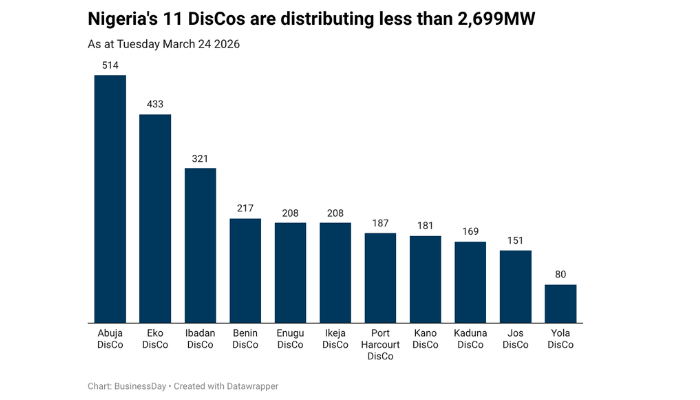
The electricity crisis took a fresh dimension in Rivers State, where the Port Harcourt Electricity Distribution Company (PHED) issued a public notice on Tuesday acknowledging that it was distributing less power than promised, not because of its own failures, it said, but because of reduced allocation from the national grid.
The Port Harcourt DisCos notice, dated March 24, 2026, attributed the shortfall to “low power generation caused by a reduction in the gas supply to thermal power plants,” adding that the situation had “consequently impacted the distribution of power within our network.” The company asked customers for patience and apologised for the inconvenience.
But consumer advocates say the acknowledgement only confirms what many communities have endured for months without a formal explanation.
“They produced a printout from Port Harcourt DisCos’s own website showing that for April 2025, PHED only supplied 20 hours of power for just nine days,” said Emeka Ojoko, a lawyer and Executive Coordinator of consumer advocacy group NEPA WAHALA NG. “Ordinarily, that feeder ought to have been migrated to a lower band and customers’ accounts reconciled accordingly. But this was not done.”
Apart from Port Harcourt DisCos, Ikeja Electric, also attributed the ongoing reduction in electricity supply to a nationwide decline in power generation caused by limited gas supply to thermal power plants.
In a public notice issued via its X handle on Monday, the distribution company said the development has significantly affected the volume of energy available on the national grid and, by extension, the allocation to electricity distribution companies.
“The ongoing reduction in electricity supply is largely due to a nationwide drop in power generation, caused by limited gas supply to thermal power plants,” the company stated.
It explained that the situation has led to a noticeable decrease in the energy received for distribution to customers.
Industry experts say the outages reflect deeper structural weaknesses rather than temporary disruptions.
Nigeria nominally has 16,000 megawatts of installed generation capacity, but the national grid’s outdated radial infrastructure can only transmit roughly a third of that. The result is approximately 9,000 megawatts stranded at power plants, unable to reach consumers.
Per capita electricity consumption stands at an estimated 140–181 kilowatt-hours annually, among the lowest in the world, and less than a third of the African average. By comparison, Egypt consumes over 1,500 kWh per person annually; South Africa approximately 3,779 kWh.
Joseph Tsavsar, Infrastructure expert, described the band-based tariff system itself as unimplementable given these realities.
“There is no adequate power supply to the distribution companies to meet consumer demand, so why segment supply?” he said. “The only option is to ration the little they have.”
Generation companies say they are owed approximately N6.8 trillion by the sector, a figure the government disputes, putting the debt closer to N2.8 trillion.

Join BusinessDay whatsapp Channel, to stay up to date
Open In Whatsapp


