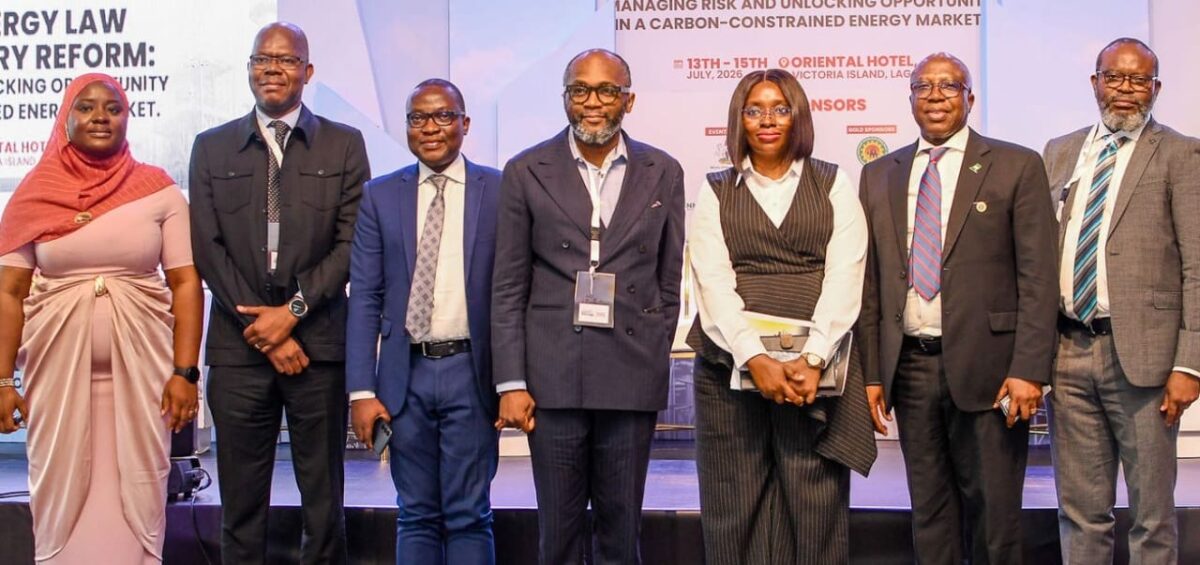
Nigeria’s petroleum ministry is leaning on regulatory certainty, rather than incentives alone, to persuade oil and gas investors that the country can pursue net-zero goals without derailing the industry that funds much of its budget.
That message came from Senator Heineken Lokpobiri, minister of state for petroleum resources, at the Lawyers in Energy International Conference, a three-day gathering that closed July 15 at the Oriental Hotel in Lagos’s Victoria Island. His remarks were delivered by proxy through Terlumun George-Maria Tyendezwa, the ministry’s director of legal services, who told delegates the government intends to steer the country’s energy transition on its own terms rather than simply importing frameworks designed elsewhere.
Lokpobiri’s central argument was that capital follows enforcement, not just legislation. He cited the Petroleum Industry Act as the legal scaffolding regulators are now building on, adding that upstream and downstream rules are being sharpened to give operators fewer gray areas to navigate. He also pointed to the Climate Change Act and a domestic carbon-credit framework as signals that Nigeria intends to compete for climate-linked capital rather than cede that ground to other markets.
The minister framed the stakes in generational terms, telling the conference that choices made now by regulators and lawmakers would define the shape of Nigeria’s energy sector for decades, and pledged continued efforts to strengthen regulatory institutions and protect investors and host communities alike.
The continental picture, laid out by Farid Ghezali, secretary-general of the African Petroleum Producers’ Organisation, was less flattering. Speaking remotely, Ghezali told delegates that resource potential no longer sells itself to investors weighing where to deploy capital — regulatory consistency, fiscal predictability and contract enforcement now carry comparable weight. He estimated that more than 50 separate legal and regulatory regimes govern petroleum activity across Africa, a fragmentation he said inflates costs, stalls projects and steers capital toward jurisdictions with fewer legal surprises.
Ghezali argued that the same fragmentation is quietly killing multinational infrastructure ambitions — cross-border pipelines, shared gas markets, interconnected power grids — because incompatible legal systems turn what should be commercial decisions into legal standoffs. He described uncertainty as one of the continent’s largest unseen costs, and alignment across borders as one of its biggest missed opportunities, while emphasizing that shared standards on licensing, transparency and dispute resolution don’t require any country to cede control over its own law.
He pointed to the African Petroleum Regulators Forum as an existing template for that kind of coordination, already building common ground among member states on safety and environmental oversight. Ghezali also cautioned that if African governments and businesses aren’t involved in drafting global transition rules, the continent risks having those rules imposed on it, and called for broader input from communities, youth and women in shaping energy policy going forward.
George Etomi, who chairs the board of the Lawyers in Energy Network, told the conference that legal practitioners sit at the center of the balancing act ahead — reconciling climate commitments with energy security and economic growth — and said that outcome will depend on stronger dispute-resolution mechanisms and closer coordination between regulators and industry players.
Raqueebah Oloko, the network’s founder and executive secretary, said the event was built specifically to help African countries chart a transition path that doesn’t come at the expense of their own development priorities. Since its founding in 2015, she said, the organization has grown into a recurring meeting point for government officials, in-house counsel, academics and industry figures working across the continent’s energy sector, using conferences and training programs to build regulatory capacity over time.


Join BusinessDay whatsapp Channel, to stay up to date
Open In Whatsapp