

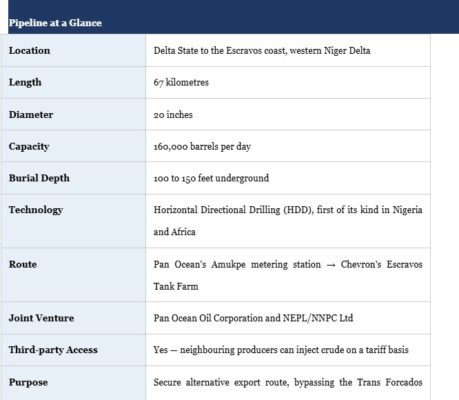
Deep beneath the creeks and wetlands of Delta State, buried between 45 and 150 feet underground, runs a pipeline that Nigeria’s oil industry has been waiting years to fully exploit.
The Amukpe–Escravos Pipeline, a 67-kilometre 20-inch steel pipeline engineered to carry up to 160,000 barrels of crude oil per day from inland fields to Chevron’s Escravos export terminal, is now operational.
Developed through a joint venture between Pan Ocean Oil Corporation and NEPL/NNPC Ltd, the pipeline represents one of the more consequential pieces of evacuation infrastructure built in Nigeria’s western Niger Delta in recent decades.
Its timing could hardly be more critical.
Nigeria is in the midst of an ambitious, if challenging, effort to rebuild its oil output. President Bola Tinubu’s administration has set a target of 2 million barrels per day by 2027 and 3 million barrels per day by 2030. Average crude oil production has improved to about 1.6 million barrels per day, supported by initiatives including Project One Million Barrels Per Day.
But the country has consistently fallen short of its own benchmarks. Nigeria’s oil sector lost an estimated N1.76 trillion in potential crude oil revenue due to its failure to meet OPEC production quotas from January 2025 to January 2026.
The gap between aspiration and delivery in Nigeria’s upstream sector is not simply a story of insufficient wells or underdeveloped reservoirs. Industry analysts and operators increasingly point to a more prosaic culprit: the persistent unreliability of evacuation infrastructure. If crude cannot move, it cannot be counted.
That is where pipelines like the Amukpe–Escravos Pipeline enter the conversation.
A corridor built for resilience
The origins of the Amukpe–Escravos Pipeline trace back to a crisis. The primary objective of the project was to ensure there would be no disruption to crude oil exports, unlike the scenario experienced on the Trans Forcados Pipeline, where exports collapsed for over 16 months.
The Trans Forcados Pipeline, Nigeria’s major western evacuation route, had become synonymous with disruption, battered by vandalism, community unrest, and repeated force majeure declarations that idled production across the mid-western Niger Delta.
Read also: Renaissance, Bonga, Oando, others drive $100bn oil-related investments in Niger Delta
The response was to build something more secure and different.
The Amukpe–Escravos pipeline is the first export line of its kind in Nigeria and on the African continent, using Horizontal Directional Drilling technology that spans 67 kilometres and is buried at depths of 100 to 150 feet, making it the most secure export route in the country.
The choice of Horizontal Directional Drilling, a technology that installs the pipeline entirely underground with no surface exposure, was deliberate. In a region where above-ground pipelines have historically been targets for theft and sabotage, burying the infrastructure deep enough to defeat tampering was not merely an engineering preference but a strategic security calculation.
The pipeline was installed using the Horizontal Directional Drilling method to ensure minimal ecological and environmental disruption during construction and operation. It is the longest of its kind in Africa.
“We are elated at the success of this project, and we owe it to the many hands which have all contributed in one way or another to bring this to completion,” Olajide Ishola, Pan Ocean’s chief operating officer, said.
Open for business
The pipeline connects Pan Ocean’s Amukpe metering station in Delta State to Chevron’s Escravos Tank Farm on the coast, threading through terrain that has challenged infrastructure developers for generations.
With a design capacity of 160,000 barrels per day and third-party tariff access, the Amukpe–Escravos corridor offers producers in the western Niger Delta a new evacuation option, enabling inland crude to reach export markets more reliably.
That third-party access provision is significant. By allowing other operators in the western Niger Delta to inject crude and evacuate production through the corridor, the Amukpe–Escravos pipeline functions as shared infrastructure rather than a captive company asset. In a region where operators have long struggled with limited export options, the existence of a functioning, tariff-accessible route changes the economics of production planning.
At the time of technical startup, Pan Ocean was already dealing with over-capacity allocation of the entire 160,000 barrels injection capacity with prospective customers within the pipeline route.
That level of early demand signals the pent-up need for alternative evacuation capacity in the area, and suggests the corridor’s utilisation could ramp quickly as operators formalise access agreements.
Read also: Nigeria could raise oil production by 100,000 bpd in coming months, NNPC chief says
Tobore Gbemre, Pan Ocean’s general manager for the OML 147 Asset, described the strategic logic plainly: “We set out to deliver infrastructure that will bring operators in the northern fringe of the Niger Delta closer to zero gas flare, monetisation and commercialisation of their gas resources, stability of revenue from the location of the Amukpe–Escravos pipeline, improved power supply and the attainment of the national gas plan.”
Pan Ocean has also described the AEP as complementary to two other major projects it has commissioned in the same period: the Ovade-Ogharefe Gas Processing Plant, with a capacity of 200 million standard cubic feet per day, and early production from OML 147 at Owa Aladinma in Edo State, a combination that positions the company as a fully integrated energy operator.
Whether or not the AEP fulfils its full operational potential will depend on throughput contracts, the pace of drilling activity in the surrounding acreage, and the sustained reliability of the Escravos terminal itself. But the infrastructure exists. The corridor is open. And in Nigeria’s oil sector, where the gap between what is in the ground and what reaches a tanker has for too long been measured in vandalism statistics and forgone revenue, that is not a small thing.
Why evacuation infrastructure is the bottleneck
Understanding why the Amukpe–Escravos Pipeline matters requires looking at one persistent challenge in Nigeria’s oil sector: evacuation infrastructure.
Production targets, drilling campaigns, and licensing rounds all make headlines. But crude oil that sits in a reservoir or an inland gathering facility generates no revenue. The only oil that counts, for government budgets, for OPEC quota compliance, for foreign exchange earnings, is oil that reaches an export terminal.
Nigeria’s evacuation network, particularly in the onshore and shallow-water Niger Delta, has been a persistent weak link in that chain. The Amukpe–Escravos pipeline project was conceived to reduce losses from pipeline vandalism and to boost revenue for the Nigerian government.
For years, operators in the western Niger Delta have faced a binary choice: route crude through the Trans Forcados system, which remains vulnerable, or curtail production when that system goes down. The AEP creates a third option, a route to the Escravos export terminal that bypasses the Forcados system entirely, reaching a different terminal through a different corridor.
Upon completion, the Amukpe–Escravos pipeline will contribute significantly towards increasing Nigeria’s overall crude export, with knock-on benefits for government revenue and other stakeholders. The pipeline also gives other operators within the region the opportunity to increase their crude evacuation capabilities.
In a country where the 380,000-barrel-per-day gap between budget assumptions and actual production reflects structural disconnects between fiscal planning and operational reality, functioning evacuation infrastructure directly addresses one of the most controllable variables in that gap.
The indigenous enterprise dimension
The Amukpe–Escravos pipeline’s story is also, in a specific sense, a story about Nigerian industrial capacity.
Pan Ocean is an indigenous exploration and production company, one of a class of Nigerian operators that have expanded their role in the upstream sector, particularly following the wave of asset transfers from international oil companies to local firms in recent years.
The successful transfer of onshore and shallow-water assets from international oil companies to Nigerian firms has added about 200,000 barrels per day to output.
For Pan Ocean, the Amukpe–Escravos pipeline represents a project conceived, financed, and delivered by Nigerian institutions, a fact that carries symbolic as well as commercial weight. With its partnership with an indigenous company, Fenog Nigerian Limited, Pan Ocean has further demonstrated its commitment to developing indigenous capacity and increasing Nigerian companies’ participation in the oil and gas sector.
The joint venture structure, in which Pan Ocean partners with NEPL, the exploration subsidiary of NNPC Ltd, mirrors the model that has underpinned much of Nigeria’s upstream development. But the AEP demonstrates that this model can extend to infrastructure delivery as well as exploration and production, with an indigenous operator taking the lead role in executing a complex, large-scale engineering project.
Production targets and the infrastructure gap
The Tinubu administration’s production ambitions are not modest: 2 million barrels per day by 2027, and 3 million barrels per day by 2030. Achieving those numbers will require not only new wells and new investment but a reliable infrastructure backbone capable of moving significantly higher volumes to market.
Daily output had climbed to between 1.7 million and 1.83 million barrels, while active rigs surged from 31 in January to 50 by July 2025.
That drilling momentum creates a forward production pipeline that will need somewhere to go. Infrastructure gaps that are manageable at 1.5 million barrels per day become acute constraints at 2 million or 2.5 million.
Energy economist Professor Wumi Iledare has been direct on the point: meeting oil production targets will depend far less on ambitious projections and far more on practical, on-the-ground actions. Infrastructure is precisely that kind of action.
NNPC has pledged to intensify collaboration with partners to ensure improved production performance, maximise infrastructure uptime, and maintain high facility maintenance standards across all assets. The AEP corridor, now operational and open to third-party injectors, represents exactly the kind of infrastructure uptime improvement that statement envisions.
The road ahead
The Amukpe–Escravos Pipeline does not, by itself, close Nigeria’s production gap. No single piece of infrastructure does. But it addresses a specific, documented bottleneck in a specific geography — the western Niger Delta — that has repeatedly cost the country production volumes, export revenue, and OPEC quota compliance.
Oil and gas industry stakeholders have described the commercial launch of the pipeline as a significant milestone for Nigeria, offering a more secure and reliable export route to boost the country’s economy.
For crude producers operating in the mid-western Niger Delta, the message is practical and immediate: a functioning, technically secure, tariff-accessible evacuation route now exists. Production that was constrained by export uncertainty has a new outlet.
For Nigeria’s broader production trajectory, the AEP illustrates a principle that policymakers and planners are increasingly being forced to confront: hitting ambitious barrel targets requires infrastructure that can match the ambition. Drilling more wells is necessary. Moving what those wells produce, reliably, efficiently, and securely, to market is what actually generates revenue.
The pipe is in the ground. The corridor is open. For a country still trying to close the gap between what its oil sector promises and what it delivers, that matters more than it might appear.

Join BusinessDay whatsapp Channel, to stay up to date
Open In Whatsapp


