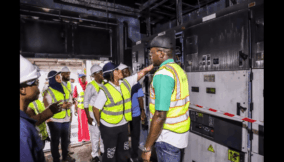
The business case for edge computing across Africa is, on paper, airtight. Vast extractive industries operating in geographically isolated terrain. A mobile-first population is generating data faster than centralised cloud architecture can absorb it. Governments are finally treating fibre and towers with the same urgency once reserved for highways.
What the pitch does not resolve is the electricity bill.
“The advantages of edge computing are well-documented, clear and tangible,” says Steven Santini, Vice President for Secure Power, Sub-Saharan Africa at Schneider Electric. “Many industries today benefit from its reduced latency, improved reliability, enhanced security, and cost savings.” The problem, Santini is careful to note, is that every one of those advantages assumes stable power — and stable power is precisely what large stretches of the continent cannot guarantee.
Africa’s data centre capacity stands at roughly 0.4 gigawatts today. Industry projections have that figure climbing to between 1.5 and 2.2 gigawatts by 2030, expanding at a compound annual rate above 14 percent. South Africa, Nigeria, Kenya, and Egypt are absorbing most of the investment. Global technology firms and private equity are circling. The macro story is compelling enough. The infrastructure story is considerably messier.
Edge deployments, unlike centralised data centres anchored to urban grids, are by their nature placed at the operational periphery. Oil fields. Remote mines. Agricultural monitoring networks in areas where the nearest substation is an unreliable hour away.
“Edge deployments are often located in remote or underserved areas,” Santini says, “precisely where power is least reliable.” Voltage fluctuations shorten hardware lifespans. Outages erase whatever latency gains the architecture promised. The commercial logic frays exactly where it is needed most.
The irony is that the sectors driving African edge adoption — heavy industry and natural resources, where the continent holds globally significant market positions — are the same sectors most exposed to that fragility. Real-time machine learning inference on a drilling rig is only valuable if the rig’s edge node stays live.
What has shifted the calculus, industry players argue, is the maturation of distributed energy technology.
High-efficiency uninterruptible power supplies, falling storage costs, and intelligent load management systems have quietly become standard components of serious edge deployments. More consequentially, the microgrid, a self-contained system generating and distributing its own power, typically drawing on solar or hybrid sources, has moved from pilot novelty to a practical answer for remote industrial applications.
“Africa’s power challenges offer the perfect opportunity to embrace decentralised energy systems, renewable technologies, and integrated digital solutions,” Santini says. Organisations are no longer waiting for grid extension. They are building their own generation capacity on-site, hedging against a national infrastructure that cannot keep pace with digital ambition.
The deployments that succeed, analysts and operators broadly agree, will be those treating energy as a design constraint from day one, not a procurement line item resolved after the servers are already ordered. Africa is not building toward someone else’s model of digital infrastructure. It is inventing its own, shaped entirely by what the ground beneath it can actually support.


Join BusinessDay whatsapp Channel, to stay up to date
Open In Whatsapp