There is a pattern in Nigeria’s economic management that has become all too familiar. When revenues fall short and structural reforms prove politically inconvenient, governments reach for the easiest lever, borrowing. It is a path of least resistance but also one of long-term consequences. The latest warnings over Nigeria’s rising debt burden suggest the nation may once again be drifting down that well-worn road.
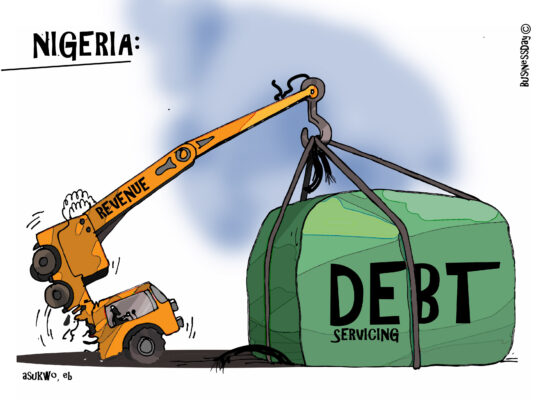
The figures are sobering, with debt servicing projected to hit N15.81 trillion in the 2026 budget; Nigeria is spending an alarming share of its earnings not on development but on repayment. According to BudgIT, the nation’s debt service-to-revenue ratio has surged beyond 80 per cent, far above globally accepted thresholds. In practical terms, this means that for every naira the government earns, most of it goes straight to creditors, leaving little room for infrastructure, healthcare, education, or security. This is not merely a fiscal concern but an economic warning signal.
At the heart of the problem is a structural imbalance between revenue and expenditure. Nigeria’s public debt has ballooned from just over N33 trillion in 2021 to nearly N150 trillion within a few years. While some borrowing is inevitable for developing economies, the speed and cost of Nigeria’s debt accumulation raise serious questions. Domestic borrowing now dominates, pushing interest rates higher and squeezing credit available to businesses. In effect, government borrowing is crowding out the private sector, the very engine of growth that the economy depends on.
Read also: FG turns to more World Bank cash despite mounting debt pressure
Economists like Muda Yusuf have rightly described this as a structural trap. Once a large portion of revenue is tied up in debt servicing, the government is forced to borrow again to fund even basic obligations. It becomes a cycle – borrow to spend, spend to survive, then borrow again to repay.
The implications are far-reaching. For businesses, high government borrowing translates into elevated interest rates, making it more expensive to access credit. For investors, it signals macroeconomic instability. For citizens, it manifests in underfunded public services and stalled development projects. Ultimately, it slows economic growth and deepens inequality.
There is also a generational cost. Today’s borrowing is tomorrow’s burden. When debt is used to finance consumption rather than productive investment, future taxpayers are left servicing liabilities without corresponding assets. This undermines long-term fiscal sustainability and limits the options available to future administrations.
Indeed, what makes the current situation particularly troubling is not just the scale of the debt but the persistence of a familiar policy response. Instead of aggressively tackling revenue inefficiencies, wasteful spending, and structural leakages, policymakers often default to borrowing as a stopgap. It is easier to raise funds through debt than to undertake politically sensitive reforms such as widening the tax base, cutting recurrent expenditure, or eliminating inefficiencies in public finance.
This is where the analysis of ‘lazy administration’ finds its footing. Borrowing, in itself, is not the problem. The problem is borrowing without discipline, without clear returns, and without a credible plan for repayment.
Read also: NESG warns Nigeria’s debt crisis persists despite signs of stability
To be fair, there are signs of awareness within government circles. Efforts to improve revenue collection, alongside proposals to channel oil windfalls into savings vehicles like the sovereign wealth fund, indicate a shift toward more sustainable fiscal thinking. Voices like Ken Ife point to gradual improvements in revenue performance and a declining debt service ratio compared to previous peaks.
But optimism must be grounded in action. Without firm policy choices, these gains could prove temporary.
The ideal path forward requires a decisive break from past habits. First, Nigeria must align its spending with realistic revenue. This means prioritising essential expenditure and eliminating non-critical projects that add little economic value. Fiscal discipline is not about austerity alone but about efficiency and impact.
Second, the government must aggressively expand its revenue base, not by overburdening existing taxpayers, but by improving compliance, digitising tax systems, and capturing the vast informal economy. A nation of Nigeria’s size and economic potential should not be operating with such a narrow revenue stream.
Third, borrowing must become more strategic. Debt should be tied to projects that generate measurable economic returns, projects that can pay for themselves over time. Infrastructure investments, if properly executed, can justify borrowing, as recurrent spending cannot.
Read also: Nigeria to spend $11.6b on debt servicing in 2026 – Tinubu
Fourth, there must be a deliberate shift toward alternative financing models. Public-private partnerships offer a viable path to reduce fiscal pressure while delivering critical infrastructure. As Yusuf suggests, not every project needs to sit on the federal government’s balance sheet. States and the private sector can, and should, play a larger role.
Finally, transparency and accountability must underpin all fiscal decisions. Citizens deserve to know not just how much is being borrowed, but how effectively those funds are being used.
This current trajectory is unsustainable, but it is not irreversible. The choice is between continuing a cycle of debt-fuelled survival and embracing a more disciplined, growth-oriented approach to public finance.

Join BusinessDay whatsapp Channel, to stay up to date
Open In Whatsapp