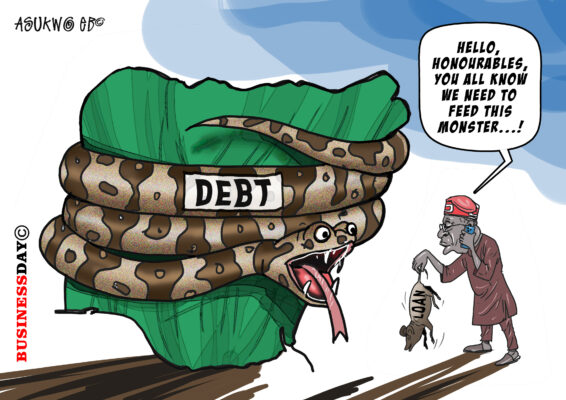
The Nigerian Economic Summit Group has warned that while the transition from 2024 fiscal year to 2025 shows some subtle shifts, Nigeria’s debt situation remains a complex and increasingly alarming challenge for the nation’s economy.
In its debt burden monitor for the month of May, NESG stated that while headline indicators suggest a degree of stabilisation, yet underlying fiscal pressures remain elevated when assessed through a more comprehensive lens.
The report showed that in 2024, the Debt Burden Index (DBI) declined to 70.9 points from a peak of 83.6 points in 2023. It stated that while at face value, this suggests an easing of debt stress, this improvement was largely driven by a partial moderation in debt service pressures, rather than a fundamental strengthening of fiscal capacity.
It noted that public debt in same period surged to 40.6 percent of GDP, pointing to government’s reliance on borrowing to bridge fiscal gaps remains evident. The report added that the trend exposes a deep-seated revenue weakness, proving that the economy’s core fiscal foundations are still dangerously unstable.
Read also: Nigeria’s debt binge prices businesses out of credit
“At the same time, public debt-to-GDP rose sharply to 40.6 percent, reflecting
continued reliance on borrowing to finance fiscal deficits and structural revenue
weaknesses. This divergence highlights a central issue that the underlying fiscal
vulnerability remained significant.
“The 2025 DBI trajectory reinforces concerns. Quarterly estimates show that the DBI remains elevated and volatile, rising to 78.4 points in Q1 and peaking at 79.6
points in Q2, before moderating to 76.2 points in Q3 and closing the year at an
estimated 79.2 points in Q4.
“This pattern indicates that debt pressure has not structurally eased but instead fluctuating within a high-stress band. Overall, the 2024–2025 transition does not yet reflect a decisive shift toward
debt sustainability.
“Rather, it signals a system making only marginal adjustments,
with improvements in headline ratios masking persistent structural imbalances.
“The DBI captures this reality more effectively, signalling that Nigeria remains in a high-risk fiscal environment despite apparent stabilisation in conventional
indicators,” the report stated.
BusinessDay’s analysis of Nigeria’s total debt profile as obtained from the debt management office, showed that the total external debt stock as at december 2025 was $51.856 billion (N74.426 trillion) while the total domestic debt was N84.8 trillion.
Of this total, the total domestic debt owed by the federal government stood at N80.488 trillion while the total external debt stood at $46.171 billion.
Also, states governments and FCT total domestic debt stood at N4.36 trillion while the foreign debt component was $5.68 billion.

Join BusinessDay whatsapp Channel, to stay up to date
Open In Whatsapp