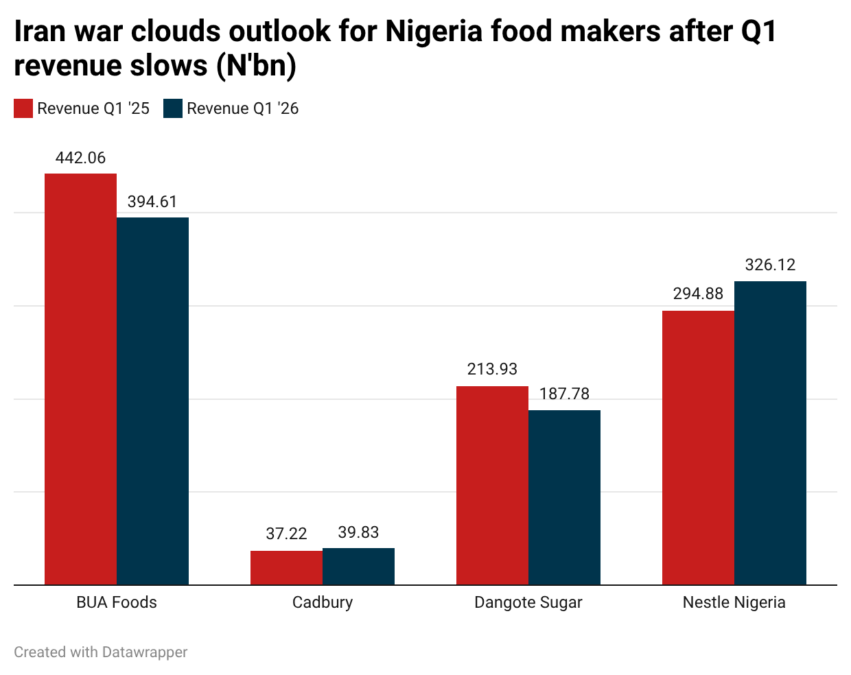
Nigeria’s biggest listed food manufacturers are confronting a new reality occasioned by the now-cooling Iranian war that threatens to put revenue under further pressure after top-line growth slowed in the first three months of 2026.
After two years of driving revenue through repeated price increases and navigating foreign exchange volatility, alongside sky-high inflation, the conflict in the far-off Middle East now threatens to push production costs higher, clouding what could be described as a year of recovery for many consumer goods firms.
The conflict, which began on February 28, 2026, and appears to be gradually waning, has fuelled volatility in global energy markets, increasing freight and logistics costs, and raising concerns over the cost of imported inputs used by Nigerian manufacturers.
The World Bank said fuel prices in Nigeria have risen by more than 50 percent following global crude shocks, with petrol prices climbing from below N870 per litre to above N1,300 per litre on average. Diesel—widely used by manufacturers because of the unreliable public electricity supply—has risen by about 70 percent to around N1,550 per litre.
Read also: Foreign investors flee South African assets as Iran war rattles global markets
Higher energy costs threaten to erode the efficiency gains that underpinned first-quarter earnings, particularly for manufacturers operating on thin margins.
“I expect to see the impact of the war on the cost of sales, which is expected to require businesses to raise prices to keep the bottom line competitive,” said Samuel Oyekanmi, chief research officer at Abuja-based consultancy Norrenberger.
Kemi Abiodun, a consumer goods research analyst at Lagos-based consultancy CardinalStone, expects second-quarter earnings to reflect rising operating expenses, although she believes the sector is still likely to post resilient half-year results.
“For H1, I am a bit mixed on the bottom line because there’s this OPEX from surging energy prices that may affect some of them. We should probably expect relatively good numbers.”
Read also: Iran war reignites inflation pressures across Africa’s biggest economies in April
While lower raw material costs and foreign exchange stability supported first-quarter earnings, analysts expect the operating environment to compress margins as the impact of the Iran conflict filters through the economy.
Q1 numbers show revenue growth slowed
An analysis of first-quarter earnings shows revenues weakened across much of the sector even as profitability improved, suggesting companies are relying less on pricing power and more on lower raw material costs, exchange-rate stability, and operational efficiencies to defend margins.
The shift comes as food inflation has resumed its upward climb. Data from the National Bureau of Statistics show food inflation accelerated from 12.12 percent in February to 14.31 percent in March, 16.06 percent in April, and 16.69 percent in May, reflecting the pressure on household budgets despite a moderation from the record highs recorded in 2024.
Normally, an inflationary environment would allow manufacturers to raise prices and grow revenues. Instead, first-quarter results suggest companies are finding it increasingly difficult to pass higher costs on to consumers whose purchasing power remains under severe strain.
BUA Foods, one of Nigeria’s most valuable companies, reported revenue of N394.61 billion in the first quarter, down 10.7 percent from N442.06 billion a year earlier.
The decline came despite a sharp reduction in production costs. Cost of sales fell 22.1 percent to N218.97 billion from N281.15 billion, lifting gross profit to N175.64 billion and operating profit to N154.65 billion from N138.92 billion in the corresponding period of 2025.
Dangote Sugar Refinery posted a similar pattern. Revenue declined 12.2 percent year-on-year to N187.78 billion from N213.93 billion, while cost of sales dropped nearly 30 percent to N144.68 billion from N204.67 billion.
The lower production costs helped operating profit jump to N45.76 billion from N2.75 billion a year earlier, while gross profit rose to N43.10 billion.
According to Abiodun, the weaker revenue reflects both softer demand and deliberate pricing decisions as manufacturers competed more aggressively following a decline in raw material costs.
“The revenue decline, particularly for Dangote Sugar, was mainly due to volume as well as a price drop during that period,” she said.
“The companies reduced prices because the cost of raw materials had come down, so it’s the case of who reduced prices the most. It’s a very competitive market, especially for sugar.”
Her assessment suggests the earnings season marks a shift from the pricing-led growth that characterised much of 2024 to a more competitive environment where producers are sacrificing part of their pricing power to defend market share.
Nestlé Nigeria’s results also reflected changing market conditions.
Revenue rose 10.6 percent to N326.12 billion from N294.88 billion a year earlier, while operating profit edged up to N75.43 billion from N74.14 billion.
One of the company’s biggest earnings boosts came from a sharp decline in finance costs, which fell to N1.66 billion from N22.99 billion in the first quarter of last year, highlighting the benefits of a more stable naira after the extreme currency volatility that hit corporate earnings in 2024.
Cadbury Nigeria, however, illustrated that pressures remain uneven across the sector.
Read also: Nigeria’s reforms revered by markets become political problem for Tinubu
Revenue rose marginally to N38.83 billion from N37.22 billion, but cost of sales climbed faster to N28.94 billion from N25.07 billion, causing operating profit to decline to N4.71 billion from N9.68 billion.
The mixed earnings point to a sector where companies are increasingly differentiating themselves through cost discipline rather than pricing.
“FX stability and the relative strengthening of the naira compared with last year have significantly improved corporate earnings,” Oyekanmi said.
“What we’re seeing now is that businesses are increasingly playing the efficiency game. The companies that are able to optimise costs and manage their operations effectively are the ones that will remain profitable in a high-inflation environment.”
He said inflation continues to suppress consumer demand, limiting manufacturers’ ability to depend on price increases to drive growth.
“Inflation continues to weigh on consumer demand, meaning companies can no longer rely solely on raising prices. Those that can absorb costs and improve efficiency will be better positioned to sustain profitability.”

Join BusinessDay whatsapp Channel, to stay up to date
Open In Whatsapp