Foreign investors are withdrawing money from South African assets as the Middle East war triggers a global flight to safety, increasing pressure on the rand and exposing Africa’s biggest economy to heightened financial market volatility.
In its half-year financial stability review report, released last week, the South African Reserve Bank (SARB) warned that the country’s vulnerability to volatile capital flows has increased as non-resident investors sell domestic assets and shift funds toward traditional safe-haven markets.
The central bank said geopolitical tensions stemming from the conflict that erupted on February 28 have amplified existing economic vulnerabilities by driving up oil prices, tightening global financial conditions, increasing market volatility and weakening the global growth outlook.
“Vulnerability to volatile capital flows has increased as non-resident investors sell domestic assets in search of safe havens, contributing to greater rand volatility,” the SARB said.
South Africa’s financial conditions have tightened since the previous review, reflecting higher equity market volatility, exchange-rate pressures and a broad repricing of risk by global investors. Although overall conditions remain close to historical averages, the Reserve Bank said a more uncertain external environment is likely to continue testing the resilience of the financial system through the remainder of 2026.
The Bank said foreign investors were net buyers of South African government bonds in the three months preceding the conflict. However, deteriorating global risk sentiment following the outbreak of hostilities triggered what it described as the largest one-month sell-off of local bonds on record.
The shift in investor sentiment is adding to concerns about South Africa’s fiscal outlook. Before the conflict, the National Treasury expected public debt to peak at 78.9 percent of GDP in the 2026/27 fiscal year. The Reserve Bank now cautions that the debt burden could rise above those projections and may not stabilise within the timeframe previously anticipated.
Households are also feeling the effects of the external shock
Rising fuel and transport costs have eroded disposable incomes, while changing interest-rate expectations suggest that anticipated monetary easing may be delayed. Inflation accelerated to four percent in April from 3.1 percent in March, reaching the upper end of the central bank’s target range.
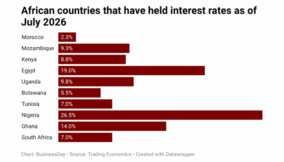
The Reserve Bank noted that the oil-price shock has significantly altered the monetary policy outlook. While its forecasting models had previously pointed to interest-rate cuts in 2026, they now suggest the possibility of further tightening following last month’s 25-basis-point increase in the benchmark rate to seven percent.
The Bank warned that longstanding structural challenges—including weak economic growth, high unemployment, market concentration and financial exclusion—could worsen under a weaker global economic backdrop. Economic growth is expected to remain subdued despite first-quarter GDP expanding by 0.5 percent, as higher input costs weigh on manufacturing, mining and agriculture.
Beyond immediate market risks, the SARB highlighted emerging threats from frontier artificial intelligence, cyber vulnerabilities, climate-related risks and the rapid growth of global stablecoin activity. While crypto assets do not currently pose a systemic threat to South Africa’s financial system, regulators continue to monitor developments closely.
The conflict’s impact has extended well beyond the Middle East. The closure of the Strait of Hormuz pushed energy prices sharply higher, reigniting inflation concerns globally and increasing fears of supply-chain disruptions and food-price pressures through higher fertiliser costs.
However, prospects for a de-escalation improved on Sunday after the United States and Iran reached an agreement to end active hostilities, paving the way for the reopening of the Strait of Hormuz and the restoration of normal shipping flows. While the development could ease pressure on energy markets, the Reserve Bank cautioned that geopolitical risks remain elevated.
Israel has indicated that its military presence in Lebanon, Syria and Gaza will continue, underscoring that broader regional tensions remain unresolved. As a result, supply-chain disruptions, energy-market volatility and heightened operational risks are likely to remain key concerns for investors and policymakers.
Despite these challenges, the SARB said South Africa’s financial system remains resilient.
“Systemically important financial institutions are well capitalised and liquid, and the broader financial system continues to be supported by ongoing policy and regulatory initiatives, as well as efforts to strengthen crisis preparedness and operational resilience,” it said.

Join BusinessDay whatsapp Channel, to stay up to date
Open In Whatsapp