South Africa’s central bank unexpectedly left its benchmark interest rate unchanged on Thursday, defying market expectations for another increase as policymakers sought to balance rising inflation risks against a fragile economic recovery.
The South African Reserve Bank (SARB) kept its repo rate at seven percent, with its six-member Monetary Policy Committee voting 4-2 in favour of holding rates. The decision surprised markets, with only three of the 20 economists surveyed by Bloomberg forecasting a pause, while the majority expected a 25-basis-point hike.
The hold follows a 25-basis-point increase in May—the country’s first rate hike since 2023—and highlights the SARB’s increasingly cautious approach as renewed conflict involving the United States, Israel and Iran clouds the global economic outlook.
Governor Lesetja Kganyago said the committee judged the current policy stance to be sufficiently restrictive despite heightened inflation risks.
“The committee agreed that the outlook is uncertain, and with the rate increase at our previous meeting, the policy stance is appropriate for now, with rates somewhat restrictive,” Kganyago said.
The central bank acknowledged that renewed hostilities in the Middle East continue to pose upside risks to inflation, particularly through higher energy prices. Brent crude has climbed towards $100 a barrel, raising the prospect of more expensive fuel imports for African economies that depend heavily on imported petroleum products.
The annual inflation in Africa’s largest economy accelerated to five percent in June, its highest level in two years, driven largely by higher fuel and transport costs. However, the SARB noted that underlying inflation remains relatively contained and that domestic demand has yet to show signs of overheating.
While inflation expectations have drifted above the central bank’s preferred three percent target, policymakers said the overall inflation outlook had improved slightly since the previous meeting.
At the same time, the MPC acknowledged that the country’s economic recovery remains fragile. Although growth has surprised on the upside, it continues to be driven mainly by exports rather than domestic demand, with structural constraints weighing on investment and productivity.
“The inflation outlook has improved slightly since our last meeting, but inflation remains too high, while our growth is still weak,” Kganyago said.
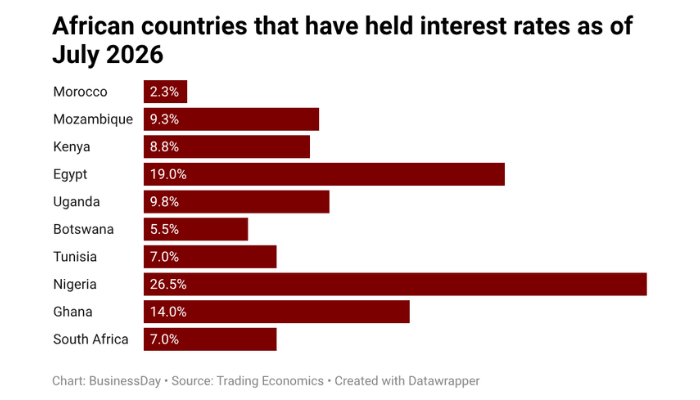
The decision places South Africa alongside Ghana and Nigeria, whose central banks also left interest rates unchanged this week as policymakers across Africa weigh rising geopolitical risks against still-fragile economic recoveries.
Across the continent, a growing number of central banks—including Morocco, Tunisia, Uganda, Kenya, Botswana, Egypt and Mozambique—have opted to keep borrowing costs unchanged while assessing the impact of earlier policy tightening and renewed volatility in global energy markets.
However, the broader monetary policy picture remains mixed. Ethiopia, Namibia, Rwanda and Tanzania have resumed raising interest rates as inflationary pressures re-emerge, signalling that Africa’s brief hold-rate cycle is becoming increasingly fragmented.
Looking ahead, investors will closely watch inflation and developments in global energy markets before the SARB’s next policy meeting in September. While Thursday’s decision suggests policymakers are prepared to tolerate short-term inflation volatility to support growth, the central bank made clear it stands ready to tighten policy further if inflation risks become more entrenched.

Join BusinessDay whatsapp Channel, to stay up to date
Open In Whatsapp