The key to moving from a small business to a legacy business lies in structure and systems for entrepreneurs and “campuspreneurs”.
By focusing on this early on, even these “Campusprenuers” can evolve into business leaders who build lasting institutions and create future job opportunities.
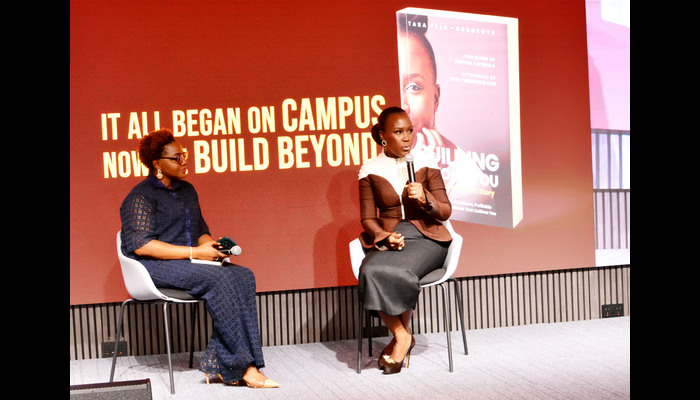
This was the central message at the book and initiative launch of ‘Building Beyond You’, by Tara Fela-Durotoye, beauty entrepreneur and founder of House of Tara. Reflecting on her 27-year business starting out as a make-up artist as a. undergraduate law student, she highlights that true growth happens when founders build systems that can succeed with or without them.
“When I started, people didn’t pay for make-up. Today, brides come to us, and we have to turn some down…because we are now the thing. Sometimes it is when you take action that clarity comes.”
In other words, systems is what makes growth sustainable. Hence, the need to bridge the gap between student innovation and long-term sustainability.
The book which took seven years in the making, was framed as a mission to help entrepreneurs at all stages of their journey in a relatable Nigerian story, but most importantly, take the gospel of entrepreneurship and corporate governance back to where it all began: the university campus.
For many young Nigerians, business ideas often start on campus. However, these ventures frequently stall because they lack a documented framework.
Read also: UNIZIK, Anambra, private sector partner to drive innovation, entrepreneurship
Mentorship and collaboration
Building a business in a challenging environment like Nigeria is rarely a linear success story. Fela-Durotoye was candid about the “traumatic experiences” she faced, in her journey.
This she argues, is why student entrepreneurs need seasoned mentors and documented principles early on to navigate the inevitable “trial and error” that can otherwise break a young business.
Abiola Adediran, family business advisor, partner at Genea Family Office, founder, Midridge International and co-author of the book, highlighted that even the most successful founders must learn to ask for help, hence the need to move away from the “lone wolf” mentality.
Fela-Durotoye also acknowledged the importance of collaboration, by identifying her own limitations, which led to co-authorship with Adediran to combine her lived experience and ability to teach high-level business principles.
Endorsing this approach, Ibukun Awosika, celebrated business woman and author noted the importance of coachability: “It’s a pleasure to mentor people, but more importantly, people who listen. One thing about Tara is that she listens.”
Read also:Blacknest Africa expands entrepreneurship support through training and funding
Why Campusprenuers must master structure early
Using a relatable cultural analogy, the author challenged the audience to think about why many traditional Nigerian businesses fail to survive past the first generation.
She compared the “play by the ear” improvisation method of cooking a meal in an African home, to the rigorous, codified processes of global brands like the popular Aunt Jemima breakfast brand, (now sold under Pearl Milling company).
According to Fela-Durotoye, processes should be documented. Operations should not depend on the founder’s presence.
”Culturally we’re not taught how to make food with measurements. We don’t have a process,” she explained. “Unfortunately, you can’t scale that”.
”An African mother will cook the most delicious meal, and when you ask her how she did it, she would say, “I just put a little bit of this and a little bit of that.”
“There is no measurement and standardisation, hence the meal cannot be replicated exactly the same way every time. And more importantly, you cannot teach someone else to do it the exact same way”, she highlighted.
Fela- Durotoye opined, “Many of our businesses are like the African mother’s kitchen. We have the ‘secret sauce, passion, but we don’t have the measurements and systems. And that is why when the ‘mother’ is not in the kitchen, the food doesn’t taste the same. That is why many businesses die with the founder.”
Pointing to a 1960s Time Magazine feature on Nigerian millionaires, the author observed that most of those businesses have since gone into oblivion, while American contemporaries like Walmart and Polo continue to thrive. The difference, she argued, is a determination to build “founder-independent” systems.
”How do I build this in such a way that if I’m not here, the next generation has to benefit from this?” she asked. “We need to build companies like that so that we will not keep saying there’s unemployment… there’s unemployment because we close up”.
Read also:Unilag’s entrepreneurship centre empowered over 1,000 students with skills, funds
“Expansion without structure can destroy what you build. Don’t just grow fast, grow right. Systems are what make growth sustainable. Processes should be documented, and operations should not depend on the founder’s presence. This is how you build beyond yourself”.
The entrepreneurial “missing middle”
While business schools often focus on billion-dollar corporations and venture capital, the reality for most Nigerian SMEs is far different.
Dr. Ola Brown, a renowned entrepreneur and investor, noted that “When businesses only work when the founder is carrying everything, nothing really scales, and when nothing scales, small businesses cannot become large businesses… jobs will not grow as they should, and the economy remains small”.
The “Building Beyond You” initiative is set to launch a nationwide campus tour to provide workshops, workbooks, and mentorship to young creators.
“We are not just taking books to the campuses. We are doing train-the-trainer programs so that they go and teach the frameworks in the book, as this is a Nigerian story that is relatable”, Fela-Durotoye concluded.
The focus remains on the long-term impact: transforming students from job seekers into “campuspreneurs” who can create the jobs of tomorrow.

Join BusinessDay whatsapp Channel, to stay up to date
Open In Whatsapp