For generations, a full-time job was seen as the surest route out of poverty. In Nigeria today, it is increasingly becoming another form of it. The country’s cost-of-living crisis has created a new class of workers. They are employed, work long hours and rarely miss a day on the job. Yet many still rely on tips, remittances and the generosity of relatives to survive. The popular advice to “find a side hustle” assumes workers own their time. Many do not.
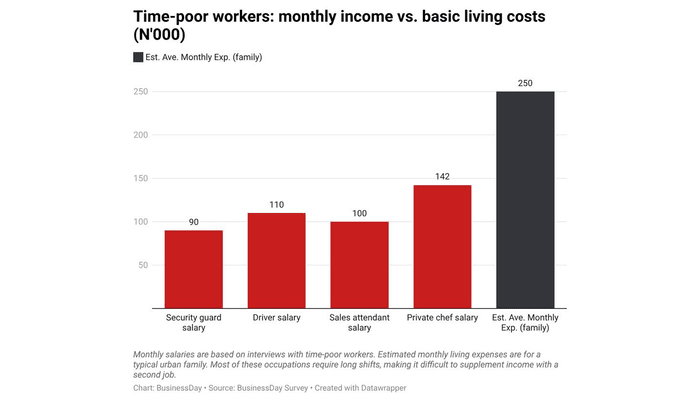
At 6 a.m., Ayodele Sanusi, a 39-year-old security guard and father of three, reports for duty at a residential estate in Magodo, Lagos. For the next 12 hours, he checks visitors, opens gates, patrols the premises and responds to residents’ requests. By the time he hands over to the night shift, it is almost 7 p.m. For that, he earns N90,000 a month.
“Before the 12th of every month, my salary is gone,” Sanusi told BusinessDay. “I survive because friends sometimes help me, and visitors occasionally give me tips. Even with that, life is still a struggle because you cannot keep asking people for help every time.” Sanusi’s story reflects a broader reality in Nigeria’s labour market.
As inflation has driven up the cost of food, transport, rent and electricity, workers have been urged to earn more through ride-hailing, online businesses or weekend trading. But that advice overlooks a growing group of Nigerians whose jobs consume the very resource needed to earn more: time. For them, employment has become a full-time commitment that still cannot finance a full-time life.
The introduction of a N70,000 national minimum wage was intended to restore some purchasing power after inflation eroded household incomes. In practice, many entry-level workers now earn between N90,000 and N120,000 a month. Yet for households in major cities, that income often falls short of meeting even basic monthly expenses. The result is a new form of working poverty.
For Balogun Valentine, a 42-year-old driver employed by a private company in Lagos, survival depends as much on family support as on his salary. Valentine earns N110,000 a month and supports a family of two. His work begins before his employer leaves home and often stretches late into the evening, leaving little opportunity to pursue another source of income.
“My elder brother in Canada has been my angel,” he said. “Every third quarter of the year, he sends me about N500,000. Without that money, I honestly don’t know how we would cope.” His employer occasionally offers financial support or household items, but Valentine says those gestures only soften the pressure. “Sometimes my boss gives me money or helps in kind. It helps, but it has never been easy.”
Neither Sanusi nor Valentine is unemployed. Neither lacks the willingness to work harder. Their challenge is different. They are time-poor.
Economists often measure poverty by income. Increasingly, Nigeria’s inflation crisis is exposing another dimension: workers whose wages cannot cover living costs but whose working hours leave little opportunity to earn more. That reality extends far beyond security guards and drivers.
Patience Chibuzor, a 33-year-old single mother and private chef, prepares three meals a day for a high-income household. Her day begins before sunrise and frequently ends after dinner service. Working between 12 and 14 hours daily, she earns N142,000 a month. “Occasionally, I get tips when my boss commends my cooking,” she said. “Sometimes the tips are encouraging, but you never know when the next one will come. My expenses, however, come every day.”
For Aina Balogun, a 29-year-old sales attendant and mother of two, the challenge is physical as much as financial. She earns N100,000 a month working six days a week in a shopping mall, including weekends and public holidays.
“I would love to have a side hustle because everything is so expensive, but I simply don’t have the time,” she said. “Standing for long hours is exhausting. By the time I get home, I am so tired that I often need pain relief just to prepare for work the next day.”
Customers occasionally leave tips, especially during festive periods, but she says those moments offer only temporary relief. “My expenses don’t wait for Christmas,” she said. “They come every day. Raising two children on this salary has honestly been a constant battle.”
For Henry Joel, a 27-year-old hotel housekeeper, gratuities from guests have become an important supplement to his income. But as households cut discretionary spending, those tips have become less frequent. The occupations differ. Their economics do not.
Security guards, drivers, chefs, sales attendants and hotel workers perform essential roles that keep Nigeria’s cities running. Yet unlike many professionals who can freelance after work or operate online businesses, their jobs leave little room for a second source of income.
Their salaries no longer tell the full story. For many low-income workers, the real monthly income now consists of wages plus an invisible second income: customer tips, employer goodwill, church support, emergency transfers from friends and remittances from relatives abroad.
These informal transfers rarely appear in labour statistics, yet they have become an essential part of household finances. That should concern policymakers. The debate over Nigeria’s minimum wage has largely focused on whether employers can afford to pay more. A more important question is whether full-time employment still guarantees a minimum standard of living.
According to Muda Yusuf, Chief Executive Officer of the Centre for the Promotion of Private Enterprise (CPPE), the issue runs deeper than wages alone. “The challenge is no longer simply about whether people have jobs,” he said. “The bigger issue is whether those jobs pay enough to provide a decent standard of living. High inflation has severely weakened purchasing power, while many businesses facing rising operating costs are unable to increase wages at the same pace.”
Yusuf argues that raising the minimum wage, though necessary, cannot by itself solve the problem. “If productivity does not improve, inflation remains high, and businesses continue operating in a difficult environment, wage increases will always struggle to catch up with the rising cost of living.” His assessment points to a broader economic reality.
A labour market where full-time workers depend on charity to supplement wages is not simply experiencing low pay. It is signalling that the wage floor has become disconnected from the cost of living.
Periodic increases in the minimum wage may provide temporary relief, but unless inflation is brought under control, productivity improves, and businesses become capable of paying sustainably higher wages, each adjustment risks being overtaken by rising prices.
Until then, many of Nigeria’s lowest-paid workers will continue to depend on an invisible second income, not from another job, but from the generosity of others. For them, employment no longer guarantees economic independence. It merely postpones hardship.

Join BusinessDay whatsapp Channel, to stay up to date
Open In Whatsapp