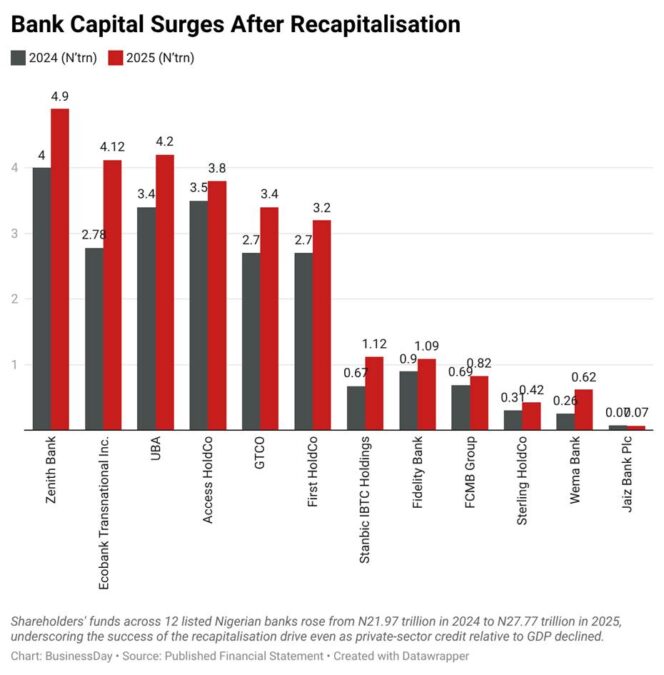
Nigeria’s banks have more capital than at any point in their history. Yet businesses are receiving less credit. That contradiction may be one of the most important stories in the country’s financial system today. While twelve listed banks increased aggregate shareholders’ funds from N21.97 trillion in 2024 to N27.77 trillion in 2025, a rise of 26.4 percent, private-sector credit as a share of GDP fell from 33.26 percent to 27.81 percent over the same period. The banking system became significantly stronger. Its reach into the productive economy weakened.
For years, policymakers have argued that stronger banks would support economic growth by financing larger projects, absorbing greater risks and extending more credit to businesses. That logic underpinned the Central Bank of Nigeria’s recapitalisation programme launched in 2024. By April 2026, banks had raised more than N4 trillion in fresh capital, according to Olayemi Cardoso, CBN governor. Balance sheets expanded, capital buffers improved and the sector emerged more resilient after years of currency instability and inflationary pressure.
On the surface, the policy appears to be working. Yet the flow of credit tells a different story. Total private-sector credit stood at N75.37 trillion in February 2026, slightly below the N76.25 trillion recorded a year earlier. Broad money supply continued to expand, suggesting liquidity is not the problem. Money exists within the financial system. What is missing is intermediation.
“The credit risk in many sectors is very high,” said Muda Yusuf, chief executive officer of the Centre for the Promotion of Private Enterprise. “Banks are very selective. They are looking at sectors like ICT and oil and gas because they have options where the yields are high and the risk is almost zero.”
His observation highlights a central challenge facing the economy. The same high-interest-rate environment that helped restore macroeconomic stability has also reshaped lending incentives. With the Monetary Policy Rate at 26.5 percent and treasury yields approaching 20 percent at various points, government securities offer attractive returns with minimal credit risk. Lending to manufacturers, farmers or small businesses is far less predictable.
A manufacturer must contend with unreliable electricity, high logistics costs, weak demand and elevated operating expenses. Many SMEs face similar challenges while lacking sufficient collateral or formal financial records. From a commercial bank’s perspective, government paper offers certainty. The real economy does not. The consequence is that sectors most important for employment, productivity and economic diversification continue to struggle for finance.
“SMEs will hardly get it. Agriculture will hardly get it,” Yusuf said. “Banks lend based on commercial returns. Many of the sectors that contribute most to inclusion and diversification are not necessarily the most profitable.”
Ayo Teriba, chief executive officer of Economic Associates, argues that part of the explanation lies in the condition of bank balance sheets before recapitalisation. According to him, years of bad loans weakened capital positions and made recapitalisation necessary in the first place.
“Fixing bank bad loans is a factor in the decline of private-sector credit because the capital base had been eroded by bad loans, which eventually led to recapitalisation,” he said. In other words, part of the fresh capital raised by banks is repairing balance sheets before supporting new lending.
Teriba also points to the Cash Reserve Ratio as a constraint on credit creation. A high reserve requirement forces banks to keep a significant share of deposits with the central bank rather than deploy them as loans. The implication is that Nigeria’s credit challenge is more complex than a simple reluctance to lend. It reflects a combination of borrower risk, bank incentives and monetary policy constraints.
The stakes extend far beyond the banking industry. Credit finances factory expansion, working capital, technology adoption, housing and business formation. Countries that sustain high rates of growth typically deepen their financial systems over time, allowing businesses and households greater access to finance. Nigeria is moving in the opposite direction.
According to CPPE estimates, SMEs account for roughly half of GDP and more than four-fifths of employment, yet receive only about one percent of total bank credit. The mismatch is striking. The sector responsible for generating most jobs receives only a tiny share of formal financing. The result is a financial system that is becoming stronger without necessarily becoming more developmental.
That is why the next phase of reform may prove more difficult than recapitalisation itself. Raising capital is relatively straightforward. Creating the conditions that make productive lending attractive is considerably harder. It requires lower inflation, improved infrastructure, stronger credit-guarantee mechanisms and a business environment that reduces the risks of financing productive sectors.
Nigeria needed stronger banks. But stronger banks were never supposed to be the final objective. They were supposed to be the mechanism. The true test of recapitalisation will not be measured by the size of bank balance sheets but by whether those balance sheets finance the investment, productivity and employment growth the economy needs. For now, that test remains unfinished.
Join BusinessDay whatsapp Channel, to stay up to date
Open In Whatsapp