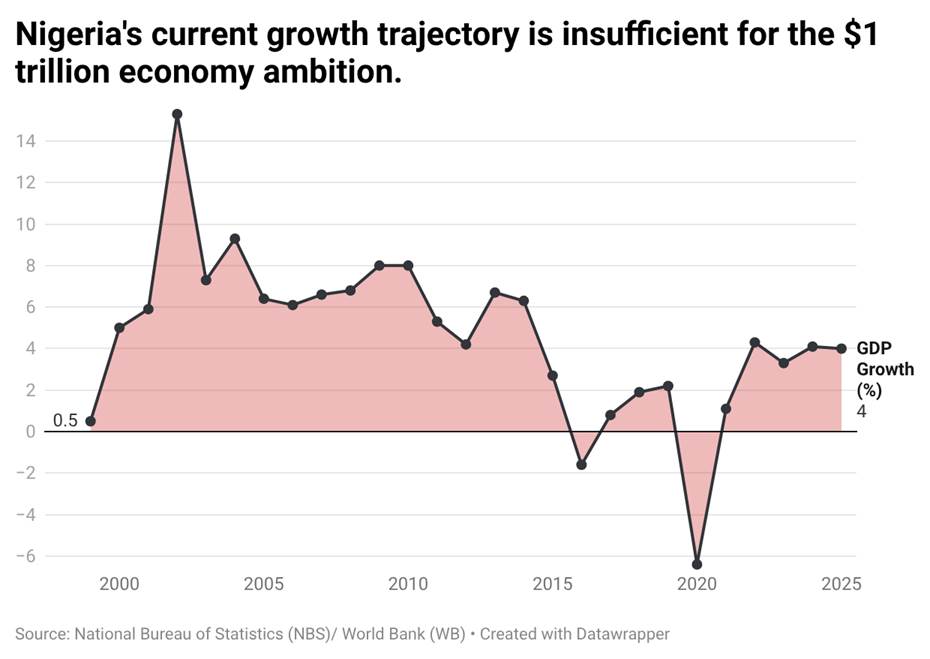
Nigeria’s ambition to become a $1 trillion economy by 2030 faces a harder test than better corporate governance. The country must grow much faster, attract productive investment and expand its capacity to produce goods and services.
Kashim Shettima, Vice-President, was right to argue this month that Nigeria cannot build a $1 trillion economy on weak corporate governance. Investors do not commit long-term capital where contracts are uncertain, institutions are weak and corporate abuses go unpunished. Stronger governance can reduce risk and improve investor confidence.
But governance is a foundation, not the engine of growth. It can help attract capital, but it cannot by itself generate the additional $700 billion in output needed to reach the target. The more difficult question is whether Nigeria can realistically become a $1 trillion economy by 2030 on its current trajectory. The answer depends on uncomfortable arithmetic.
The numbers are tougher than the politics
Nigeria’s economy was worth roughly $291 billion in 2025. To reach $1 trillion by 2030, it would have to more than triple in dollar terms within five years. That implies annual compound growth of about 28 percent in nominal US-dollar GDP, according to BusinessDay analysis, an extraordinary pace by almost any historical standard.
This does not mean Nigeria needs 28 percent real GDP growth every year. Dollar GDP reflects three moving parts: real economic output, domestic prices and the exchange rate. Inflation can increase nominal GDP, while naira depreciation can erase much of that increase when measured in dollars.
For Nigeria, the distinction matters. A larger economy on paper is not necessarily a more productive or prosperous economy. Sustainable expansion comes from producing more goods and services, raising productivity and expanding productive capacity. The arithmetic becomes clearer when tested against different growth assumptions.
Three scenarios, one difficult target
The most realistic scenario assumes 4 percent annual real GDP growth, broadly consistent with current medium-term growth expectations and the IMF’s baseline projection for 2026. Assuming the GDP deflator averages 10 percent and the naira depreciates by about 5 percent annually, Nigeria’s economy would reach roughly $450 billion by 2030 and cross the $1 trillion threshold around 2040, other things being equal.
A second scenario assumes stronger real growth of 7 percent annually, annual naira depreciation of about 2 percent and a 10 percent GDP deflator. The economy would reach roughly $585 billion by 2030 and cross $1 trillion around 2034.
The third and most ambitious scenario assumes 10 percent annual real GDP growth, a 10 percent GDP deflator and a broadly stable naira. Even under these highly optimistic conditions, the economy would reach only about $773 billion by 2030, crossing the $1 trillion threshold around 2032.
These are illustrative scenarios, not forecasts. But they expose the scale of the challenge. Even exceptionally strong growth would not guarantee a $1 trillion economy by 2030 unless it is accompanied by sustained productivity gains, large-scale investment and sufficient exchange-rate stability to preserve the dollar value of domestic economic expansion.
Idris Oyekan, an analyst at Quantum Zenith, told BusinessDay that Nigeria would need annual economic growth of 10 percent to 12 percent over the coming decade to achieve the $1 trillion ambition.
Growth must become productivity
Nigeria’s economic growth has improved since the pandemic, reaching about 4 percent in recent years after a period of sluggish performance. Reforms undertaken by the Tinubu administration have improved foreign-exchange liquidity and helped restore some investor confidence.
Yet stability is only the starting point. Countries become richer because workers produce more, factories expand output, farms become more efficient and businesses invest in new capacity. That transformation requires reliable electricity, efficient transport, affordable finance, modern technology and institutions that reward productive investment rather than rent-seeking.
Muda Yusuf, chief executive of the Centre for the Promotion of Private Enterprise, has warned that Nigeria’s macroeconomic stabilisation has yet to translate into significant, broad-based improvements in productivity and competitiveness.
That is the central challenge. Stabilisation can reduce economic vulnerabilities, but it does not automatically create the productivity gains needed for sustained expansion. Corporate governance can improve the investment climate, but it cannot substitute for the infrastructure and economic reforms required to raise output.
Nigeria needs the right investment
Nigeria cannot finance the scale of expansion required through public spending alone. Government revenues remain too small, public debt is becoming more expensive and infrastructure needs already exceed fiscal capacity. Private investment must therefore carry much of the burden.
Investors need predictable regulation, enforceable contracts, functioning infrastructure and confidence that economic rules will not change overnight. But the quality of investment matters as much as its quantity.
Capital flowing into treasury bills or consumer imports may support financial markets and short-term economic activity, but it does little to expand productive capacity. The $1 trillion ambition requires investment that builds factories, improves farms, expands energy supply, creates export capacity and develops digital and other high-value services. The objective should therefore be to attract capital that makes the economy more productive, not simply more capital.
Nigeria needs a growth engine
Other emerging economies found sectors capable of transforming their wider economies. China built its rise around manufacturing. India leveraged services and technology. Vietnam used export-led industrialisation. Indonesia combined commodities with industrial development. Each developed sectors capable of generating investment, exports, jobs and productivity gains at scale.
Nigeria has yet to establish a comparable growth engine. Oil remains too volatile and capital-intensive to deliver the required transformation on its own. The trillion-dollar ambition will depend on whether manufacturing, agriculture, digital services, logistics, power and export-oriented industries can generate sustained productivity gains and large-scale employment.
The World Bank has also argued that Nigeria must accelerate growth and shift its composition towards more productive sectors and firms if it is to meet the $1 trillion aspiration while delivering broader prosperity. It has warned that sectors such as finance and ICT, though important growth drivers, are not yet generating jobs at the scale required by the country’s large and growing labour force.
This is why governance reform must be part of a broader growth strategy. Good governance can help attract capital, but policymakers must also remove the structural barriers that prevent capital from becoming productive.
Reliable electricity is not a corporate-governance problem. Poor transport infrastructure is not solved by boardroom reform. High financing costs cannot be addressed through better disclosure alone. Weak export capacity requires industrial and trade policies, not just stronger institutions. Nigeria therefore needs governance reform to work alongside infrastructure investment, energy reform, industrial policy, financial-sector deepening and export development.
The real test of the ambition
None of this means the $1 trillion ambition is impossible. Large economies have expanded rapidly before. The question is what kind of economy Nigeria intends to build to get there. If the country remains on a growth path close to 4 percent, the arithmetic suggests that the $1 trillion threshold could remain nearly a decade away. Even sustained 7 percent growth would not deliver the target by 2030 under the assumptions used here. And even 10 percent annual real growth with a broadly stable naira would only bring the economy to the threshold around 2032.
The lesson is not that Nigeria should abandon ambition. It is that policymakers must confront the scale of transformation required. A $1 trillion economy cannot be created by changing a number in a policy document. It must emerge from millions of businesses producing more, exporting more, hiring more workers and investing in greater capacity.
The central policy question is therefore how to build an economy in which productivity can accelerate year after year. Nigeria needs to identify the sectors capable of generating the additional $700 billion in output, then provide the infrastructure, skills, financing, institutions and policy certainty they require.
The government’s $1 trillion ambition will ultimately be judged not by the size of the target, but by whether Nigeria can build a productive economy capable of reaching it. That is the real test of ambition.

Join BusinessDay whatsapp Channel, to stay up to date
Open In Whatsapp