The Central Bank of Nigeria (CBN) has raised its benchmark interest rate, known as the Monetary Policy Rate (MPR), by 25 basis points to 18.75 percent.
The decision was announced on Tuesday by Folashodun Shonubi, acting governor of the CBN, after the two-day Monetary Policy Committee (MPC) in Abuja.
Shonubi announced that a moderate hike of 20.5 basis points to the interest rate was agreed following considerations bordering on supporting investment, anchoring inflation expectations, narrowing the negative interest rate gap and improving investor confidence by the committee.
The MPC left the Cash Reserve Ratio unchanged at 32.5 percent and the liquidity ratio at 30 percent.
He said the asymmetric corridor has been narrowed from +100/-700 basis points to +100/-300 basis points.
The central bank said the current foreign exchange volatility being experienced will dissipate soon as pent-up demand is met while the market regulates to an effective and efficient level.
“We expect that overtime, the volatility we are seeing will normalise; the role of the central bank is to intervene and keep the market at a fairly stable level and as the market continues to oscillate around that level, there is need for us to intervene either by buying or selling,” Shonubi said.
Following the liberalisation of the foreign exchange market, the naira has been depreciating against the dollar, reaching as low as N800/$ amid increased demand amid limited supply.
Shonubi said there was a need to encourage the market to be more efficient and effective, adding that there was a pent-up demand, which current supply may not be sufficient for.
He said the recent reform in the FX market will improve transparency and encourage more foreign capital inflows.
“As we ease and satisfy the pent up demand, we begin to see a more efficient market that runs; the CBN has been intervening and will continue to until the market reaches the level that it should be,” he said.
Speaking about the domestic economy, he said factors driving uncertainty included insecurity within farming communities, high prices of petrol and other energy products and the pressure on the foreign exchange market.
He added that the economy will continue to recover moderately to grow by 2.66 percent, according to CBN estimates.
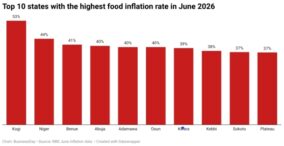
Speaking on the current inflation rate of 22.79 percent, he said this was driven by food and other headwinds including high transport costs, insecurity, among other things.
He added that there are concerns that the petrol subsidy removal, exchange rate liberalisation and distribution of palliatives will have pass-through effects on inflation.
Read also: Experts call for more reforms as investor interest rises
“In addition to interest rate hikes, we have also come up with various ways to tighten the liquidity because we believe it runs across inflation but also has some impact on the exchange and some other parts of the economy,” he said.
Shonubi added that beyond modifying the exchange rates, the CBN was also exploring other options to reduce liquidity and also reign in inflation.
Giving an update on the naira redesign, the acting CBN governor said the old notes have been recirculated and upon return, they were processed as “not issuable” and were being replaced with the new notes gradually.
“We believe that we have an optimal level of the currency out there so more of what is being done is replacement to keep the level rather than just putting money out there,” he said.

Join BusinessDay whatsapp Channel, to stay up to date
Open In Whatsapp