While the expansion of Nigeria’s taxpayer base from 10 million to 100 million represents a significant shift in the nation’s fiscal architecture, the true measure of this milestone remains unproven. The central tension lies in whether this tenfold increase reflects a genuine widening of the revenue net or merely a symbolic bloating of administrative registers.
Experts across the financial sector argue that the sheer volume of names on a database offers little utility if the state lacks the mechanism to convert these entries into consistent and actual tax remittances.
“The number of individuals registered for tax purposes has increased from about 10 million to over 100 million,” said Taiwo Oyedele in a recent address, noting that thousands of informal businesses are now seeking registration daily as reforms drive increased formalisation across the economy.
read also: Tax Liabilities Beyond Borders: How Nigeria’s new tax regime affects the Nigerian diaspora
“An increase in registered taxpayers does not necessarily translate to a proportional rise in income tax revenue,” Ajibola Sogunro, tax partner at Forvis Mazars, said.
The sharp increase follows the rollout of the Nigeria Tax Act (NTA) 2025 and related reforms, which took effect from January 2026, introducing a data-driven tax system designed to widen the net while shielding low-income earners.
Under the new framework, all individuals and businesses are expected to be captured within a unified taxpayer database linked to National Identity Numbers (NIN) and corporate registrations, while compliance is enforced through mandatory e-invoicing and real-time transaction validation.
The reforms also extend tax visibility to previously under-taxed segments, including freelancers, digital content creators, and Nigerians earning income from foreign platforms.
But Sogunro cautioned that the headline figure raises questions about how the expansion was measured and what it truly represents.
“The 100 million figure raises questions around measurement. It is not entirely clear what metrics were used or how this number was derived, and that distinction is important when assessing its real impact,” he said.
Even beyond those concerns, he noted that the link between a larger taxpayer register and higher revenue is often overstated, particularly for direct income tax collections.
“As more people participate in economic activities, buying and selling goods and services, the government can capture value through taxable supplies. That is where the real revenue expansion will come from,” he added.
That distinction is critical in assessing the reform’s fiscal implications. Nigeria generated N28.3 trillion in tax revenue in 2025, exceeding its target of N25.2 trillion, with non-oil taxes contributing N21.5 trillion.
Company income tax accounted for N7.72 trillion in the first nine months of the year, while VAT collections reached N6.4 trillion over the same period, underscoring the growing importance of consumption taxes.
Despite this improvement, Nigeria’s tax-to-GDP ratio stands at about 13.5 percent, still below the African average of 16.1 percent and significantly behind peers such as Kenya at 15 percent and South Africa at 23 percent. The government is targeting an 18 percent ratio by 2027.
Estimates suggest that if 20 to 30 percent of the 100 million registered individuals, equivalent to 20 to 30 million people, begin paying even modest taxes, the impact on revenue could be substantial.
In theory, this could double or even triple the current personal income tax base and push total collections closer to the government’s N40.7 trillion revenue target for 2026.
However, tax experts say such projections hinge less on registration numbers and more on compliance behaviour.
“The objective at this stage is not necessarily to increase revenue immediately, but to improve compliance. That is how the system is expected to generate more revenue over time,” said Idi Ivo, a fellow of the Chartered Institute of Taxation of Nigeria.
“Registration has improved significantly, but the real challenge is compliance, getting people actually to file returns and meet their tax obligations. It’s not just about bringing people into the tax net, but ensuring they are actively participating in the system through consistent filing,” he added.
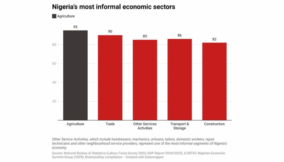
That challenge is particularly pronounced in Nigeria’s informal economy, which accounts for an estimated 55 to 58 percent of GDP and employs over 90 percent of the workforce.
While the new law exempts the majority of low-income informal workers, it targets higher-earning individuals within that segment. It introduces simplified tax mechanisms, including a flat one percent turnover tax for larger informal businesses.
Even so, bringing these groups into sustained compliance will test the capacity of tax authorities, especially as the surge in registrations has already created administrative pressure, forcing some states to extend filing deadlines.
For now, the jump from 10 million to 100 million taxpayers marks a seismic shift in Nigeria’s tax system, but whether it delivers meaningful revenue gains will depend less on how many names are on the register and more on how many people actually pay.

Join BusinessDay whatsapp Channel, to stay up to date
Open In Whatsapp