
Online visibility is the lifeblood of any bookmaker. For iGaming operators, appearing on the first page of search results directly affects player acquisition, retention, and revenue. SEO has become a core channel — often more cost-efficient than paid ads over the long run.
The betting niche is also one of the most competitive in digital marketing. Established platforms have years of domain authority and content investment behind them. For newer or smaller operators, closing that gap through organic search alone can feel impossibly slow.
That pressure is exactly why some teams begin exploring riskier strategies. This article looks honestly at what those strategies involve, what they can deliver, and where the line sits between acceptable risk and avoidable damage.
What Is Sports Betting SEO and Why Is It Different?
General SEO principles apply here: technical health, quality content, authoritative links. But the gambling niche carries extra weight. Google classifies betting sites as YMYL (Your Money or Your Life) content, which means the bar for quality, trust, and expertise is significantly higher than in most other industries.
Effective sports betting SEO is built around specificity. Match pages, odds content, and tournament guides need to target precise search queries. Topical authority matters — a site that covers football betting comprehensively will outrank one with scattered, thin content.
Localisation, licensing signals, and editorial backlinks from sports media all play a role. Working exclusively in the iGaming vertical means the approach needs to be calibrated for compliance requirements, seasonal traffic patterns, and competitive dynamics that define sports betting search.
The table below breaks down the most common methods used in this space:
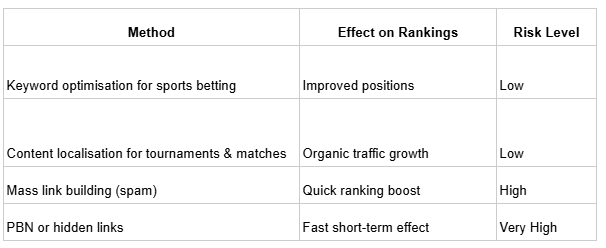
The gap between the top and bottom rows reflects a fundamental difference in result durability — and it’s a distinction that shapes every campaign SEO.Casino runs.
Black Hat SEO Tactics in the Bookmaker Niche
In iGaming, blackhat SEO is more common than in most industries. The financial incentive is simply too large — a site ranking for best sportsbook during a major tournament can generate significant revenue in a short window.
Blackhat means deliberately violating search engine guidelines to accelerate rankings. In the betting space, the temptation to go that route is constant — and the consequences when it goes wrong are severe.
SEO.Casino positions itself as a blackhat SEO service with a clear risk-management framework. The focus is on distinguishing between aggressive-but-recoverable tactics and those that carry unacceptable long-term exposure. In the betting niche, that distinction can determine whether a domain survives a core update or disappears from the index entirely.
The Most Common Tactics and Their Downsides
- Hidden links and cloaking — Showing different content to Googlebot than to human visitors. Detection has become significantly more reliable in recent algorithm cycles.
- Spam links and low-quality PBNs — Buying bulk backlinks from private blog networks. Quick spikes are possible, but the footprint is detectable. Google Penguin was specifically built to target this pattern.
- Auto-generated content — Template-based pages targeting long-tail betting queries. Without genuine value, these fail to convert and attract manual reviewer attention.
- Penalties and traffic collapse — A manual action or core update can wipe out months of gains in days. Recovery in the YMYL space is slow, costly, and sometimes incomplete.
Every manipulative signal in a backlink profile is a liability. It grows quietly — until it doesn’t.

Balancing Speed and Sustainability
Some operators take a hybrid approach: solid technical SEO and genuine content on one side, more aggressive link acquisition on the other. The logic is that competitive keywords require competitive tactics.
The pattern that tends to emerge is predictable. A site climbs quickly, monetises well during a peak event window, then absorbs a penalty after the next algorithm refresh.
For a short-term campaign site, the maths can occasionally work. For a brand with long-term ambitions, it rarely does.
The methodology maps each tactic to its risk profile rather than defaulting to maximum aggression. Core domains are protected while riskier strategies are tested on isolated assets. Core domains are protected while riskier strategies are tested on isolated assets. Client results on SEO.Casino on Trustpilot reflect this pattern — operators following a structured, risk-tiered strategy reported more stable rankings and fewer disruptions over time.
Durable rankings in iGaming correlate most strongly with content depth, technical quality, and a backlink profile built with strategy rather than speed.
iGaming SEO
Blackhat tactics can move rankings — that’s not a myth. But the gains tend to be fragile, and in a regulated, high-scrutiny niche like sports betting, penalties are disproportionately damaging.
A structured sports betting SEO strategy built on genuine content, technical rigour, and selective link acquisition compounds over time. It’s a slower start, but a more stable trajectory.
For operators in regulated markets, the core principle holds: getting fundamentals right from the beginning is almost always more efficient than recovering from a penalty later. Platforms like SEO.Casino document their methodology and results openly, which makes them a useful reference point when evaluating what a sustainable iGaming SEO programme actually looks like in practice.

Join BusinessDay whatsapp Channel, to stay up to date
Open In Whatsapp