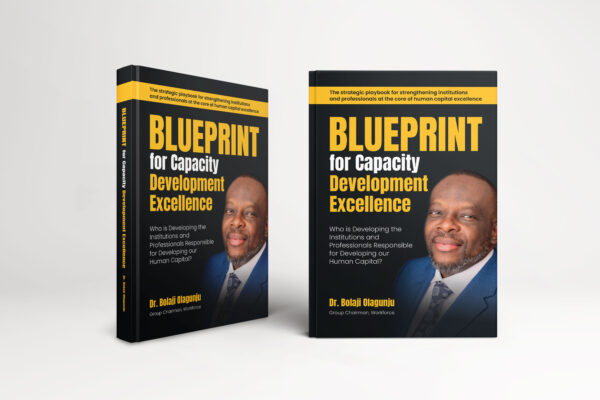
In his landmark new book, Blueprint for Capacity Development Excellence, Dr. Bolaji Olagunju delivers the playbook that Nigeria’s public sector, and every institution serious about building world-class talent, has long been waiting for.
Here is a question that does not get asked nearly enough in Nigeria’s development conversations:
If we accept, as virtually every economist, policy expert, and global institution does, that human capital is the engine of national prosperity, then who is responsible for building that engine? And more importantly: is that engine actually working?
The answer, according to Dr. Bolaji Olagunju, is both encouraging and urgent. Encouraging, because Nigeria and Africa possess a depth of human talent that is genuinely world-class. Urgent, because the institutions and professionals charged with unlocking that talent have not been given, or held to, the standards that the moment demands.
That tension drives Dr. Olagunju’s landmark new book, Blueprint for Capacity Development Excellence: The Strategic Playbook for Strengthening Institutions and Professionals at the Core of Human Capital Excellence, published by Lift Publishing on 1 May 2026. It is part diagnosis, part manifesto, and part operating manual. It is the most comprehensive and actionable framework for human capital development ever written from an African perspective.
The Bet That Changed Everything
Dr. Olagunju opens with a story that every Nigerian leader, policymaker, and professional should sit with.
In the early 1990s, India was staring into an abyss. Its economy teetered on the brink of collapse, its foreign reserves nearly exhausted, and its population growing faster than its economy could absorb. Faced with a crisis of survival, India’s leaders made a choice that astonished the world. They did not reach for military power, debt, or emergency infrastructure. They bet everything on their people.
They invested in building a deliberate, disciplined ecosystem of capacity development: better-resourced educators, stronger institutions, corporate partnerships, and a national commitment to producing talent that could compete with the best in the world. It was not glamorous. It did not make headlines at the time. But it worked.
Today, India stands as a global technology superpower with professionals powering the value chains of the world’s most influential companies and institutions. What looked like an act of desperation turned out to be the most strategic investment any nation made in the twentieth century.
Singapore tells the same story. A tiny island in the 1960s with no natural resources and deep social fractures, its leaders chose to treat every citizen as a future national asset, rebuilt their institutions around that conviction, and within a generation produced one of the most competitive economies on earth.
Dr. Olagunju draws a clear lesson from both: “Excellence in human capital is never a coincidence. It is the result of deliberate choices, intentional design, and uncompromising execution. It is what separates nations and continents that rise from those that remain stagnant.”
Africa, with a projected population of 2.5 billion by 2050 and the youngest demographic on the planet, sits on a version of the same opportunity. The window, as any honest observer will acknowledge, will not stay open forever.
The Question No One Is Asking Loudly Enough
What makes Blueprint for Capacity Development Excellence genuinely original is the question it places at the centre of everything:
Who is developing the institutions and professionals responsible for developing our human capital?
It is arguably the most consequential question Nigeria faces today. We spend enormous energy debating what skills our workforce needs. We spend far less time examining the quality of the institutions and professionals tasked with building those skills. Yet as Dr. Olagunju demonstrates through decades of frontline experience across Nigeria and the wider continent, the performance of our capacity development ecosystem is the variable that determines everything else.
He puts it plainly: “Capacity development is not a side-function of economic development. It is its very foundation.”
A workforce development strategy is only as strong as the institutions executing it. A training budget is only as valuable as the professionals managing it. A national reform agenda is only as durable as the capacity development system sustaining it. The constraint is not ambition. Nigeria has that in abundance. The constraint is the institutional and professional infrastructure through which ambition must travel to become results.
What the Book Actually Builds
Dr. Olagunju does not stop at the insight. He constructs, across four meticulously structured parts, a complete framework for transformation.
“The dysfunctions within the capacity development field,” he writes, “were not isolated. They repeated themselves across countries, sectors, and scales. Recurring patterns that weakened institutions and professionals meant to build our future. But I refused to accept them as normal.”
The book’s most original contribution is the Body of Knowledge for Capacity Development Professionals (BoK-CDP): a comprehensive competency framework that gives educators, trainers, learning designers, and institutional leaders a recognised, structured, and ethical foundation for their practice. Think of it as what the CFA did for the finance profession: a defined standard of knowledge, ethics, and competence that separates the professional from the amateur. For a field that has operated without such a framework in Nigeria and across Africa, this alone makes the book historic.
Part Three delivers the Eight Dimensions of CDI Excellence: a rigorous operating framework covering strategic leadership and governance, faculty and learner excellence, operational efficiency, financial sustainability, technology leverage, stakeholder engagement, programme effectiveness, and institutional learning. Whether you lead a federal training institute or a corporate learning academy, a state skills development centre or a university department, this framework hands you a clear standard to work toward and a practical path to reach it.
“The best CDIs are not those with the largest budgets or the flashiest campuses,” Dr. Olagunju writes, “but those that uphold clear, consistent standards of excellence, standards that enable them to build talent pipelines that are rigorous, relevant, and reliable.”
The book closes with the Capacity Development Declaration: a call to action that invites every leader, professional, and institution to commit, concretely, to building Africa’s human capital with the urgency and excellence the moment demands.
Built for Everyone Who Builds Nigeria
This book carries no narrow audience. It speaks as directly to a Permanent Secretary overseeing a federal ministry’s training function as it does to the vice-chancellor of a university, the head of HR at a major corporation, or the director of a state skills acquisition programme.
In each case, it does the same thing: it raises the reader’s standard of what is possible, equips them with the frameworks to pursue it, and refuses to excuse underperformance on the grounds of resource constraints or institutional complexity. Dr. Olagunju has operated inside enough Nigerian and African institutions to know what is genuinely difficult and what is simply habit. He writes with that hard-won authority.
His challenge to the reader is direct: “If there is one thing we must do to unlock exponential impact and growth across African societies, it is to steer our capacity development institutions, our citadels of learning, and the professionals who power them, towards a new standard of excellence. Nothing else we do can transform societies as pervasively. Nothing else can sustain change as powerfully.”
Nigeria has waited long enough for this conversation. The blueprint is here.
About the Author
Dr. Bolaji Olagunju is the Founder and Group Chairman of Workforce Group, one of Africa’s foremost Business and HR Consulting firms, operating across forty six African countries. He is the Founder and Chief Impact Architect of Philantify, a strategic adviser to federal government agencies, corporate boards, and institutional leaders across Nigeria and Africa.
He is an alumnus of London Business School with executive education from Harvard University, and the author of several bestselling works including Hiring Right, You Must Become a Trainer, and The Seven Disciplines of Breakthrough Results. He writes from Abuja, Nigeria.
Blueprint for Capacity Development Excellence is published by Lift Publishing (1 May, 2026). Available worldwide on Amazon in hardcover, paperback, and eBook formats.

Join BusinessDay whatsapp Channel, to stay up to date
Open In Whatsapp