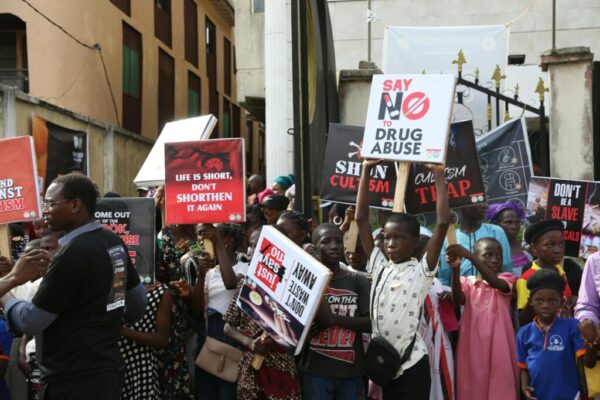
Behind the energy and promise of Nigeria’s youth lies a troubling reality: the path to a bright future is being diverted by drug abuse, a crisis that is stealing dreams, weakening families, and leaving lasting scars on communities.
Johnson, a 300-level student of the University of Lagos, has just been sentenced to not less than 21 years in prison on account of armed robbery.
A student of mechanical engineering, Johnson, the only hope of his parents’ dream, was cut short not because he was involved in armed robbery, but because he allowed codeine to destroy his life.
He got introduced to codeine through a friend who told him that the drug would always keep him active. That was how Johnson became addicted to the drug, because he could not do without it for a day.
He would always go out of his way to ensure he had the drug around, even if it meant borrowing to get the drug.
In the face of this menace, Johnson dropped out of school because he used the money meant for his school fees to buy drugs, and the portal for registration was closed.
As if that was not enough, he became a pickpocket, and gradually graduated into armed robbery, all because of his addiction to drugs; and was arrested in one of his operations and charged in court.
Drug abuse is already a growing menace in Nigeria, which has eaten deep into the fabrics of many youth with substances such as cannabis, tramadol, and cocaine, among others, destroying their health and the society at large.
Experts express concerns that drugs such as cannabis and tramadol are weakening the immune system of many, making them vulnerable to infections, and damaging their vital organs like the liver, kidney, heart, and lungs, among others, rendering them bedridden with diseases.
Psychologically, drug abuse has also allowed users to experience depression, anxiety, paranoia, etc. Illicit drugs have also increased the high rate of memory loss and allow for slow decision-making.
Many youths have been using drugs to cope with stress, unemployment, etc., and this often worsens their emotional state.
Drug Abuse has also contributed to the decline in the academic progress of the Nigerian youths, as drug abuse has helped to increase a high rate of reduced concentration and poor memory, increased absenteeism and truancy, higher likelihood of school dropouts. This limits future career opportunities and contributes to a less skilled workforce.
Illicit drugs have also affected Nigeria economically, reducing productivity and the ability to maintain employment, and fueling a surge in the quest to depend on others among the citizenry.
Besides, it comes with the national loss of human capital, which slows economic growth in a country such as Nigeria, where youth make up a huge portion of the population.
Nigeria’s population exceeds 200 million, with over 60% of the population under the age of 30, making it one of the most youthful countries in the world.
This demographic presents a powerful opportunity for social, economic, and political transformation, if properly harnessed.
Unfortunately, drug abuse is sapping the country of its demographic dividend, putting pressure on law enforcement systems such as the Nigeria Police Force and NDLEA, as many addicted youth have embraced immoral lifestyles such as theft, fraud, cultism, and drug trafficking, among others, which is contributing to social instability and insecurity.
Illicit drug consumption is obviously a serious threat to society, which, if left unchecked, would lead to human capital wastage and huge economic destruction.
According to the National Drug Use Survey, an estimated 14.6 million Nigerians engaged in non-medical use of substances such as cannabis and tramadol, among whom most are the youth.
To curb this menace, the government, as a matter of urgency, creates accessible rehabilitation services and a stronger law enforcement drive, while the non-governmental organisations should help increase awareness campaigns on the negative effects of drug abuse on the youth.
Families, schools, and religious organisations can also play a vital role in educating young people about the dangers of drug abuse and promoting a healthy lifestyle. Without this decisive action, the future potential of many young Nigerians remains at risk.
Illicit drugs pose a serious threat to Nigerian youth, impacting their health, education, social relationships, and prospects.
Combating this issue is critical for the well-being of individuals and the overall development of nations. If this problem is not urgently addressed, the nation risks losing a generation that should contribute to its growth and development.

Join BusinessDay whatsapp Channel, to stay up to date
Open In Whatsapp