…as STEM Africa Fest returns for its sixth edition
Stakeholders in Science, Technology, Engineering, and Mathematics (STEM) education have advocated that Nigerian schools and policymakers should prioritise critical thinking, creativity, and innovation as essential competencies for the 21st century, rather than a rote-learning, cramming, and regurgitation approach.
They argued that strengthening these skills through modern teaching methods is key to improving learning outcomes and building a workforce capable of driving Nigeria’s technological and economic development.
Jadesola Adedeji, co-organiser of STEM Africa Fest, disclosed this recently, saying that Nigeria needs to move away from rote learning, cramming, and regurgitating to a learning approach that really fosters experience and skills-building, sparking the innovation, creativity, and critical thinking needed in the 21st-century workplace.
“We just wanted our children in Nigeria to have that different experience of learning, being problem solvers, critical thinkers, and analytical, not just consuming knowledge.
“We wanted to expose children to what is available outside of their classroom experiences. We believe that a lot of learning can take place outside the classroom,” she said.
Similarly, Titit Adewusi, a co-organiser of STEM Africa Fest emphasised that the theme for the 2026 edition is “Building Future Innovators,” which is geared towards exposing children aged seven to 15 to every area of what they can think about.
“We’re giving the children the skills, and not just the technology; the skills are really the thinking, ability to use technology, ability to learn, and to solve problems.
“We’ve built this thing with the intentionality to change the way teaching and learning is done, enshrine inclusivity, and gender balance in learning, so that all children have equal access to the experiences,” Adewusi said.
STEM Africa Fest, 2026 edition, holds on Saturday, July 18 at Landmark Centre, Lagos. Adedeji reiterated the festival’s commitment to advancing STEM education and strengthening innovation capacity among children across Africa.
“STEM Africa Fest was created to respond to the growing need to make STEM education more accessible, practical, and engaging for children across Nigeria.
For too long, STEM learning has been perceived as abstract, overly technical, and disconnected from everyday experiences, which limits how early learners engage with it and see themselves in it,” she said.
Besides, she explained that the idea is to design a platform that introduces children to STEM through immersive, hands-on experiences that reflect real-world applications.
“Over time, what began as a learning-focused initiative has evolved into a broader ecosystem-building platform that brings together educators, innovators, and partners committed to shaping the future of STEM education on the continent,” she noted.
In addition, she said, “We see ourselves as ecosystem builders. This festival is not just an event; it is an advocacy platform aimed at making STEM education mainstream across Africa.
“Through it, we are also spotlighting the work of other stakeholders and partners within the ecosystem. Over the years, the value of this initiative has been reflected in the number of activities, collaborations, and projects that continue to emerge from the festival each year.”
Adewusi noted, “From inception, our goal has been to make participation as accessible as possible, with targeted interventions to widen access for underserved communities.
Importantly, at least 20% of attendees participate at no cost, with transportation and feeding fully covered through our partners, enabling us to reach public schools, NGOs, and SOS villages.”
As female founders, she said that they are particularly passionate about ensuring that girls are not just represented but empowered to thrive in STEM, helping to build a more diverse and inclusive pipeline of future innovators across Africa.
According to UNESCO, Sub-Saharan Africa continues to face a persistent shortage of skilled STEM professionals, driven largely by limited access to practical, hands-on science and technology education at early learning stages.
The region remains significantly underrepresented in global STEM talent pipelines, despite a rapidly growing youth population and increasing demand for digital and engineering skills in emerging economies.
In Nigeria, this gap is further reflected in the broader education-to-employment pipeline, where emphasis on theoretical learning continues to limit early exposure to applied innovation, coding, robotics, and engineering-based problem solving.
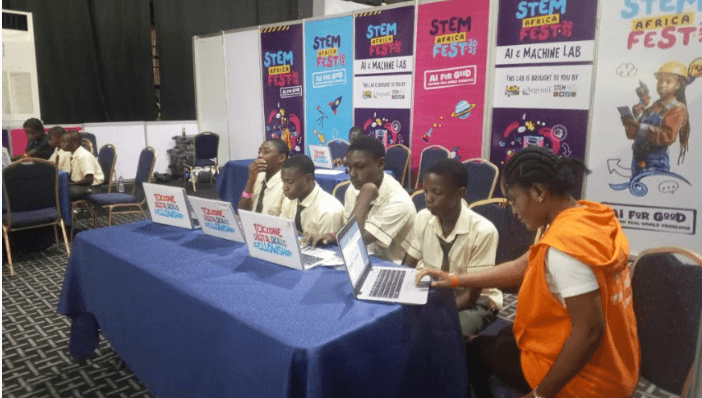
The 2026 festival will feature interactive STEM labs, robotics showcases, coding and game development challenges, AI and machine learning workshops, engineering and innovation labs, drone technology sessions, and science-based experiments.
Since its inception in 2021, STEM Africa Fest has grown into a leading platform for experiential learning, impacting over 25,000 children, students, parents, and educators across Nigeria and other African countries, including Ghana, Zambia, Rwanda, The Gambia, Kenya, and Sierra Leone. The festival continues to play a pivotal role in bridging the STEM skills gap by exposing young people to practical, immersive learning experiences.
The event is open to students, schools, educators, and families. Registration details and participation guidelines are available via official STEM Africa Fest communication channels and social media platforms.

Join BusinessDay whatsapp Channel, to stay up to date
Open In Whatsapp