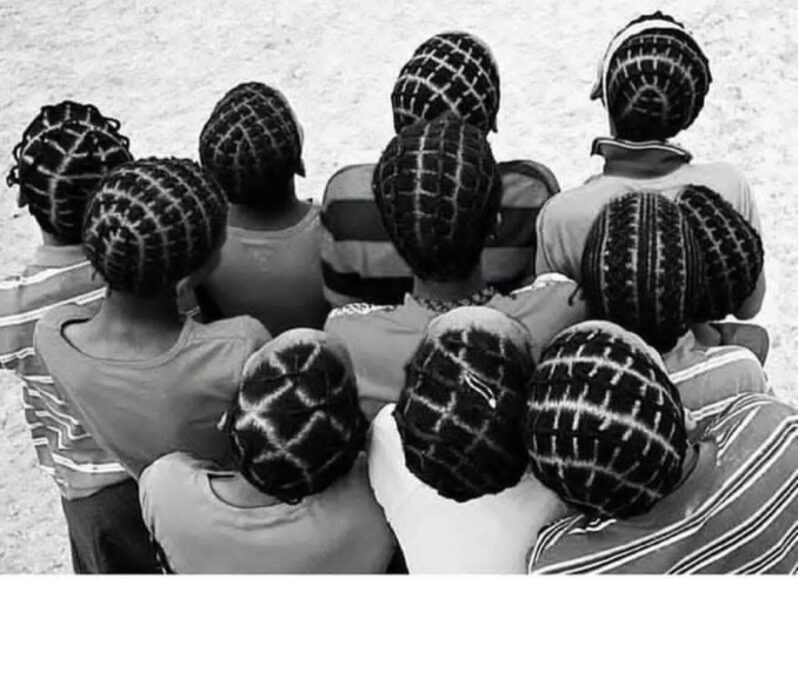
Last week, I told you about my journey into discovering my crown. Today, we are travelling through time to find out about my roots and just how deep they actually run—and, of course, a beginner’s guide to caring for your hair.
Welcome to history class. Grab a pack of chin chin and some freshly squeezed fruit juice, and be prepared to learn a thing and two.
Have you ever heard the names Benkos Biohó or San Basilio de Palenque?
Never?
Wow.
Don’t fret; I’ll tell you all about him and the safe space he created.
For over 400 years, there was an unprecedented war—a very unfair one, if you ask me.
Today, we won’t be talking about all the injustices perpetrated by men who saw themselves as superior and, driven by greed, took over kingdoms and enslaved kings.
No.
Today is about what we achieved using innovation, creativity, and the ingenuity of hair.
Long before slave traders arrived, hair and hair designs served as a non-verbal language. A person’s braid pattern, texture, and style could immediately communicate their tribe, social status, age, wealth, religion, or marital status.
Hair was really that deep.
Fast forward to the beginning of the transatlantic slave trade. Millions were forced to shave their heads. This was an intentional act meant to strip them of their dignity, culture, and humanity.
But we all know one thing: hair grows back.
As our roots really do run deep.
As their hair returned, enslaved women reclaimed the practice, using the traditional art of cornrowing to outsmart their captors.
One of the clearest historical examples of hair braiding being used for military and geographical intelligence is tied to Benkos Biohó.
“Who is he?” you ask.
Well, Benkos Biohó was a king captured from the region of present-day Guinea-Bissau.
But that’s not all there is to him.
After escaping captivity in the port city of Cartagena, Colombia, he went on to found San Basilio de Palenque in the late 16th and early 17th centuries.
The settlement became a fortified village hidden deep within the jungle and is widely recognised as the first free Black settlement in the Americas.
How did he escape?
Hair.
Biohó established a highly organised intelligence network to liberate other enslaved people. Because women often worked in close proximity to slaveholders and were sometimes less strictly monitored in their movements than men, they became his chief cartographers.
Yes, cartographers—the people responsible for the art, science, and technology of making maps.
Enslaved women carefully observed the geography of plantations, surrounding jungles, rivers, mountains, and Spanish troop positions.
Then they literally braided these maps onto each other’s heads.
During my research, here’s what I found about how they did it:
Paths and Roads: Curved, tightly woven braids close to the scalp represented specific escape routes, rivers, or roads to follow.
The “Departes” Style: This style featured thick, tight braids running straight back along the scalp and tied into small buns at the top of the head. It signalled collective readiness or intent to escape.
The “Mesh” Pattern: Interlocking or net-like braiding patterns indicated that a specific escape plan was already underway and coordinated.
Points of Navigation: The beginning of a braid indicated the point of departure, while the tapering end pointed toward the direction of the safe haven or Palenque.
The use of hair braiding as a tool for communication, survival, and escape during the transatlantic slave trade remains one of the most brilliant examples of silent resistance in human history.
Because enslaved people were stripped of their native languages, forbidden from learning to read or write, and constantly monitored, women transformed a daily cultural practice into a sophisticated hidden intelligence network.
A big, hearty cheers to women, as we continue to break boundaries and leap past barricades—first with our minds and then through every other part of ourselves, including our hair.
Hair Care for Beginners
Hair has always been a powerful tool, and the best way to use a tool effectively is to take good care of it.
One thing I know about caring for African hair is that you must balance moisture and protection.
Protective styling is a cornerstone of Afro hair care.
Styles like braids, twists, cornrows, updos, and locs allow hair to remain secured for weeks or even months, reducing the daily manipulation that often leads to breakage.
I have heard the term “all-back warrior” one too many times, and I am proud to say that I wear the crown.
If you think about it, many of our protective hairstyles still carry a form of cartography. The difference is that today they are viewed primarily as cosmetic—styles meant to beautify rather than communicate symbolism.
As a beginner on your natural hair journey, there are several things you need to know.
First, your hair needs tender loving care because it is an extension of yourself.
Wash your hair regularly. If possible, wash it once a week.
Towel drying beats blow drying any day. Keep your hair away from excessive heat whenever you can.
Use your fingers more than your comb. Remember that your scalp is just as important as your hair.
Massage your scalp with oil from time to time.
Never let your scalp go “ashy”—also known as dry.
If you can’t access other oils, try ori, also known as shea butter. Tested and trusted.
Use more natural products on your hair than chemical-based ones, and your hair—and your body—will thank you for it.
Till we meet again next week.
Asiere.

Join BusinessDay whatsapp Channel, to stay up to date
Open In Whatsapp