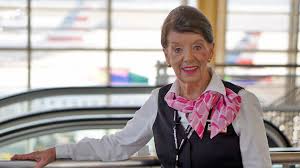
In an era where corporate downsizing, quick career changes, and sudden industry shakeups are standard, true career longevity is incredibly rare. Yet, for nearly seventy years, one legendary professional proved that passion and consistency could outlast any corporate merger.
Bette Nash, officially recognized by the Guinness Book of World Records as the world’s longest-serving flight attendant, spent 66 years working at 30,000 feet. Her career was a living history book of modern air travel.
She began flying during the glamorous, piston-powered “Golden Age” of aviation with Eastern Airlines in 1957, survived the luxury deficits of the Trump Shuttle in the late 1980s, weathered the structural shifts at US Airways, and ultimately concluded her historic run as the ultimate matriarch of American Airlines.
“I’m the luckiest person in the world. I knew this job was for me from the moment I saw a TWA flight crew walk past me at Ronald Reagan National Airport when I was just 16 years old. It looked so elegant and romantic—it truly was the romance of the skies,” Bette Nash.
The Charm School and the Weight Scales
Growing up in New Jersey, Nash was captivated by the sheer theater of mid-century commercial flight. When she entered the industry at age 21, the training pipeline felt more like an elite finishing school than an operational safety academy. Airlines heavily policed the personal presentation, posture, and social etiquette of their female staff.
In the late 1950s, flight attendants—then strictly called stewardesses—wore tailored royal blue suits, pillbox hats, and white gloves. First-class travel was an opulent affair where passengers wore mink coats, lobster was served on fine china, and champagne was poured into real crystal.
However, this outward elegance masked a rigid corporate regime. The average career span for a stewardess in the 1950s was a brief two-and-a-half years. Airlines enforced harsh, discriminatory labor rules: flight attendants had to remain unmarried, could not become pregnant, faced arbitrary mandatory retirement by age 32, and were subjected to regular, strict weight checks.
.If a crew member gained a few pounds, they were instantly taken off the payroll. Nash successfully navigated these shifting labor standards, flying straight through to the modern era of workplace equity.
Balancing the ‘Nash-Dash’ with Family Devotion
As she accumulated historic levels of seniority, American Airlines granted Nash the contractual right to pick any premier international route she wanted. Instead of choosing easy, long-haul luxury flights to Paris or Tokyo, Nash intentionally chose the exhausting, high-frequency northeastern shuttle corridor between Washington D.C., Boston, and New York.
This strategic decision was fueled by profound personal devotion. Married to James Nash in 1973, Bette was the mother and primary caregiver for her son, Christian, who was born with Down’s Syndrome. To ensure she could take care of her family every night, Nash created a relentless daily routine: waking up at 02:10 AM, driving to Ronald Reagan National Airport (DCA), and working the intensive 06:00 AM commuter flights so she could return home in time for dinner.
On the northeast corridor, Nash became an absolute icon. Her quick turnaround flights became affectionately known to colleagues as the “Nash-Dash.” Business travelers actively structured their weekly travel schedules specifically to fly with her. Weekly commuters noted that Nash didn’t just execute safety protocols; she completely transformed the vibe of the cabin by remembering passengers’ names, family updates, and conversations from weeks prior.
Surviving Corporate Turbulence
Over her 66-year career, Nash witnessed the volatile economic reality of American corporate history firsthand. In 1989, she was absorbed into the short-lived Trump Shuttle, an ambitious venture that spent over $1,000,000 per aircraft adding gold fixtures, plush carpets, and marble sinks to its fleet.
When that operation folded under heavy losses and regulatory clashes, Nash transitioned into the US Airways network, which eventually merged into American Airlines in 2013. Through every corporate restructuring, budget cut, and technological overhaul, Nash’s dedication never wavered. When airline accountants eliminated free snacks from first class to cut costs, Nash simply went to Costco out of her own pocket to buy treats for her loyal regular fliers.
Even as the cabin transformed from “mink coats to flip-flops,” Nash remained a consummate professional, easily passing her mandatory annual federal safety recertifications well into her eighties. For Nash, the aircraft cabin was never a workplace—it was her home, her social community, and a stage where she redefined the true meaning of service.

Join BusinessDay whatsapp Channel, to stay up to date
Open In Whatsapp