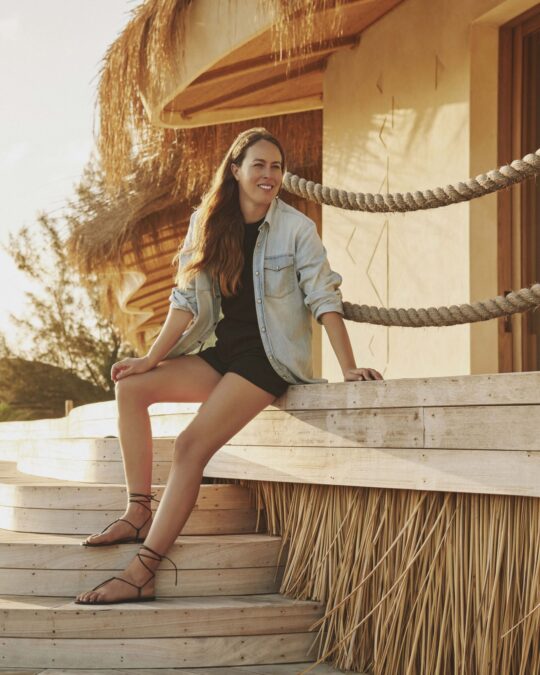
Swiss billionaire heiress and Princess of Greece and Denmark, Nina Flohr, is quietly executing a radical transformation of African luxury tourism, shifting the paradigm from superficial hospitality to deep ecological stewardship.
Through her critically acclaimed Kisawa Sanctuary on Benguerra Island in Mozambique, Flohr has effectively merged high-end, futuristic architectural design with rigorous marine science. In doing so, she is creating a highly sustainable, low-impact blueprint for ultra-luxury travel in emerging coastal markets.
High-Flyer to Environmental Innovator
Flohr’s journey to the remote shores of East Africa is rooted in a lifetime spent navigating the upper echelons of global luxury. She is the daughter of Swiss billionaire Thomas Flohr, the founder of private aviation giant VistaJet, and Katharina Konečný, a founding editor of Vogue Russia and former creative director for Fabergé.
Before pivoting to African conservation, Flohr spent years sharpening her commercial eye as the Creative Director for VistaJet, where she orchestrated global branding concepts and led high-fashion corporate collaborations, including designing cabin crew uniforms with luxury skiwear brand Moncler.
Her global profile expanded further in 2021 when she married Prince Philippos of Greece and Denmark—the youngest son of the late King Constantine II and Queen Anne-Marie—officially granting her the title of HRH Princess Nina of Greece and Denmark.
Yet, rather than settling into a quiet life of European royalty, Flohr has channeled her pedigree, capital, and network into a massive 300-hectare coastal property in Mozambique to test a new model of philanthropic hospitality.
3D-Printed Infrastructure: The sanctuary features the world’s first 3D-printed resort components. By blending sand-based 3D printing technology with indigenous mortar, the resort minimized construction waste while respecting local structural forms.
Scientific Integration: Rather than treating conservation as a marketing tagline, the resort operates in tandem with the Bazaruto Center for Scientific Studies (BCSS)—a permanent, state-of-the-art marine field station and laboratory founded by Flohr.
Low-Impact Yield: Nestled within a fragile ecosystem, the property deliberately balances ultra-exclusive, low-capacity guest volumes with intense ecological preservation, leaving the vast majority of the landscape completely untouched.
New Class of Philanthropic Hospitality
What truly separates Flohr’s Mozambican venture from traditional high-end African safaris is its structural connection to raw science. The luxury resort essentially operates as an economic engine that directly funds and feeds into the BCSS observatory.
On any given day, the resort’s high-net-worth guests rub shoulders with international marine biologists using the island laboratory to track regional whale migrations, map ocean floor habitats, and run telemetry on fragile coral reefs across the Bazaruto Archipelago.
By proving that a resort can actively co-exist with a world-class scientific research center, Nina Flohr is sending a clear message to the global travel industry: the future of true luxury lies in protecting the destination, not just consuming it.

Join BusinessDay whatsapp Channel, to stay up to date
Open In Whatsapp