As Nigeria’s tertiary admission process evolves, questions are being raised about whether recent policies by the Joint Admissions and Matriculation Board (JAMB) are adequately safeguarding candidates, particularly young applicants navigating the murky waters of insecurity in the country.
Many Nigerian youngsters preparing for the Unified Tertiary Matriculation Examination (UTME), face challenges beyond passing the examination; it now includes navigating an early arrival policy that some say compromises their comfort, safety, and well-being.
Besides, the board is exposing many of them to more dangers by posting them outsides their town of registration. Just on Wednesday, report from Benue State, indicates that some UTME candidates travelling from Makurdi to Otukpo Local Government Area (LGA) for their scheduled examination were abducted.
According to a source in the area the attackers stopped the 18-seater bus on the highway at about 7 pm, and forced the passengers into a nearby forest.
“The passengers, most of who were candidates going to sit the 2026 UTME were all marched into the forest.”
Confirming the incident, Ifeanyi Emenari, the Benue State Commissioner of Police, told journalists that he had mobilised tactical teams and Divisional Police Officers (DPOs) to the area to lead rescue efforts.
Before the Benue incident, in 2023, some candidates were attacked in the early hours on their way to write their UTME examination in Rivers State.
According to the victim’s narrative, “My brother and I, whose arrival time was 6:30 am, left for our location, which is Elele old refinery road via Evinox Connection Nig. Ltd in Port Harcourt, Rivers State.
“We got to Elelewon junction by 5:30 am, and immediately the bus driver dropped us off. A group of boys came in and attacked me. They first matched me with a very big cutlass; they targeted my forehead.”
After all their struggles with the thieves, they were robbed of their belongings, including bags, phones, power banks, and money, among others.
BusinessDay earlier raised concerns over the early arrival time and posting candidate’s outsides the town of their registration. According to the board, candidates for the first session are expected to arrive at their examination centres by 7:00 a.m., instead of the earlier communicated 6:30 a.m. The board also clarified that the first session examination will now begin at 8:30 a.m. and end at 10:30 a.m.
Speaking about the new directive from JAMB, Ajibade Ayodeji, a senior lecturer at Babcock University, said, “I believe the 7:00 am arrival time is still too early.
“Considering the realities of transport logistics, especially for candidates coming from distant areas, it can be quite stressful and even unsafe.”
Ayodeji emphasised that an ideal time should be more flexible, perhaps between 8:00 am and 9:00 am so that candidates can arrive safely and in a better state of mind.
“Many candidates would have to leave their homes very early in the dark, which raises security concerns.
“Exams such as UTME should prioritise the students’ safety, not just punctuality,” he said.
Chris Nmeribe, a teacher, said the early arrival time introduced by JAMB is understandable from an administrative standpoint, because it helps the board with accreditation, biometric verification, and curbing malpractice.
However, Nmeribe noted that when this is mirrored with Nigeria’s realities, there are legitimate concerns.
“Many candidates are posted far from their homes, forcing them to travel very early, sometimes before 5:00 am. This exposes them to security risks and transport difficulties and even affects their mental alertness due to fatigue.
“Although shifting from 6:30 am to 7:00 am is a step in the right direction, it is still not sufficient to address these challenges,” he said.
He said that a more balanced approach would be fixing 8:00 am as the arrival time and ensuring candidates are assigned to centres closer to their location.
“While discipline and structure are important, policies such as this must also reflect safety, accessibility, and the well-being of candidates,” he emphasised.
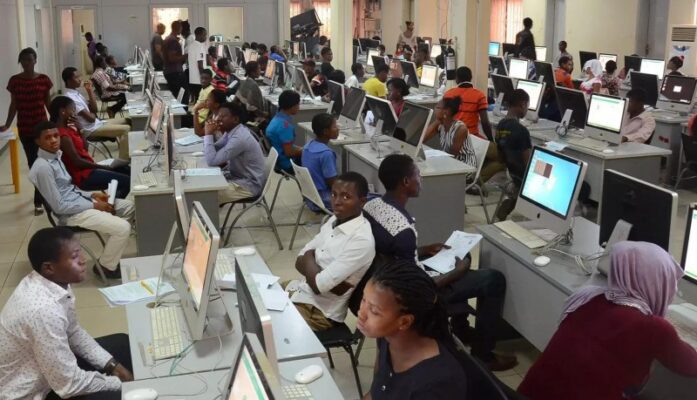
According to a report from Abuja, the CBT centre at Skillpath International Academy in Karu, where 4,000 out of the 2.2 million candidates are expected to write the exam, candidates were seated as early as 8am but several complained about malfunctioning desktops, mice, and keyboards.
Although the first session was scheduled to begin at 8:30 a.m, candidates faced a delay of about 15 minutes, as the examination questions did not appear on their computer screens until approximately 8:45 a.m.
One of the CBT managers, who spoke with journalists, blamed JAMB for the delayed start of the examination, lamenting that such setbacks could unsettle candidates.
Besides, he revealed that a similar situation had occurred during the mock examination.
“They delayed for about an hour because of uploading of questions. This can make candidates forget what they read.
“The candidates are supposed to just walk in, log onto their system and write their exams. The delay contributes to poor performance,” he said.
At Ikorodu in Lagos State, candidates, who were supposed to write their UTME at Winsford Comprehensive College Igbogbo were delayed, leaving the youngsters frustrated without any explanation.
It is still fresh in Nigerians memories how some candidates died over JAMB’s technical glitches, and faulty results grading, which led to a re-sit of the examination in some states.
It is high time JAMB rethink its policies and stop subjecting young Nigerians to unnecessary emotional trauma.

Join BusinessDay whatsapp Channel, to stay up to date
Open In Whatsapp