When Aaron Grandidier-Nkanang stepped onto Nigerian soil for the first time, it was more than a visit — it was a homecoming long in the making.
The English-French-Nigerian professional rugby player, who became a gold medalist as part of the France national rugby sevens team at the 2024 Paris Olympics, arrived carrying the weight of a triple identity and the glint of an Olympic medal he takes everywhere he goes.
In a candid conversation, he speaks about roots, rugby, and why he believes Nigeria’s greatest athletic chapter is still to be written.
The journey to Nigeria, he says, was shaped by a moment of profound personal clarity. Last year, an invitation to a presidential state dinner at the Elysée Palace, where President Bola Tinubu was received, stirred something in him.
“I truly understood the importance of having multiple cultures. I understood that I am Nigerian and I need to explore my roots,” he said.
Growing up with what he calls a triple culture — English, French and Nigerian — Aaron has always occupied an interesting space between worlds. On paper he is French, in upbringing he is British and in name and heritage he is Nigerian.
It is a complexity he has navigated with increasing awareness. “I carry a French and Nigerian name and that is a big part of the reason I wanted to come here and explore my culture as much as I can.”
Language remains the one thread his Nigerian heritage did not pass down. His father, who rarely visited Nigeria himself, did not speak the language at home. But food filled that gap, a steady parade of Nigerian meals became the household’s living connection to the country.
Now, on his first ever visit, Aaron has added cooking to his cultural education. “Since I came to Nigeria, I have been introduced to an aunt and just learned how to cook jollof rice, egusi, ogbono and pounded yam,” he says with evident delight, “and I hope to continue cooking them even when back in France.”
The Olympic gold medal he won in Paris last year is, by his own reckoning, the single greatest achievement of his life. “The weight an Olympic medal carries is internationally known,” he says. “No matter where you go, everybody knows about the Olympics and the weight of the Olympic gold is heavy.”
He brings the medal with him wherever he travels, most deliberately to the clinics and schools he has been visiting since his arrival in Nigeria. It is a calculated gesture; he understands what a child sees when they hold it.
“I think it has such a big impact,” he says simply. The medal, he believes, does not just inspire; it legitimises every word he says about determination, sacrifice and belief.
His own path to rugby was neither straight nor obvious. He first encountered the sport in secondary school, where it was the only option on offer and by his own admission he was terrible at it, so bad, in fact, that he stopped playing for several years.
He tried basketball, athletics, and gymnastics, excelling at each without quite breaking through to the elite level. What brought him back to rugby was friendship: his close friends were playing and he did not want to be left out.
Then came the moment that changed everything. A coach looked at him and said: “I believe you can take this professional.”
Those words, he says, were all he needed. From that point, the transformation was total; gym sessions, nutrition, relentless training, until he climbed, rung by rung, to become a pillar of the French Olympic team.
It is that story of late discovery, near-abandonment and quiet persistence, that he brings to Nigeria’s young athletes.
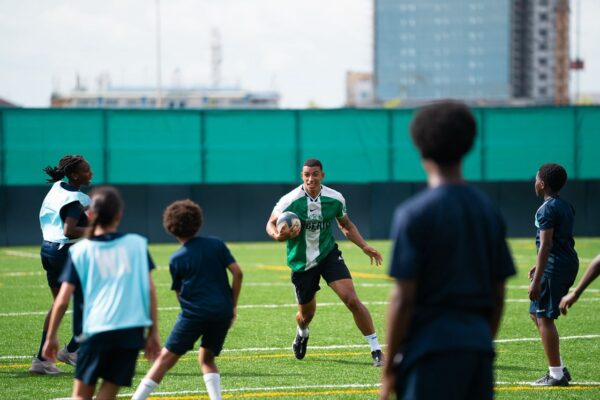
Working with the Nigerian Rugby Football Federation (NRFF), since landing in Lagos, he has run clinics across Lagos, including a session with over two hundred children in Surulere and sessions at the Rugby School on Victoria Island.
He has also participated in a rugby sevens tournament organised by the Federation. His goal is straightforward: to give young Nigerians someone they can see themselves in, and a sport they might not have considered.
“All it took was one coach to tell me I believe in you,” he recalls. He is, in some sense, trying to be that coach for an upcoming generation.
His belief in Nigeria’s athletic potential is not rhetorical. “Nigeria has such a huge athletic potential and we see that all across the diaspora,” he says. The country’s modest official medal count, he argues, does not reflect the true depth of Nigerian sporting genes but reflects infrastructure and funding gaps that have yet to be filled.
Rugby, he says, is a particularly good fit. “The ethos and morals of the game are about respect, camaraderie, discipline and determination, attributes that come naturally to Nigerians, as well as resilience.”
The sport demands speed, power, agility, and mental fortitude in equal measure. Few games require all of these things at once and in that comprehensiveness, Aaron sees an opportunity.
He is candid about the obstacles. Infrastructure he noted, does not appear overnight and the NRFF’s manager, Azeez Ladipo, is doing what he can with limited resources.
Government support and community investment will be essential if the potential is to become results. But Aaron is not deterred.
His personal ambition is to defend his Olympic gold medal at the next Games, and his ambition for Nigeria runs parallel to that: to foster a relationship that grows the sport significantly here.
These are not separate goals to him, but expressions of the same drive.
Away from the pitch, he has a number of other interests. Adding that music has been a huge part of his life since childhood, he says they always had musical instruments around the house growing up.
His sister definitely pursued that part and is a successful artist in the United Kingdom. For Aaron, DJing became the thing he turned to when rugby was not going well, a release valve and a passion that required nothing from his body on days when it had given everything.
It’s important to diversify your interests,” he says. “If one of them isn’t working, I still remain strong.” Golf completes the trio.
He studied product design at university, a path he once felt passionate about, but says his life after rugby will remain tethered to sport in some form.
As for his sporting heroes, he cites LeBron James for longevity (“He’s now 41 and in his 23rd season — I’ve never seen that kind of greatness for so long”) and Kobe Bryant and Michael Jordan for a relentless mentality that drove them to the summit and kept them there.
What appears to have surprised Aaron most about Nigeria, though, is simpler than any of this. “I’ve been so surprised by the love I’ve received from everyone,” he says. “Everywhere I’ve gone, I’ve been greeted with hugs, smiles, happiness.”
For a man arriving for the first time in a country he carries in his name but had never touched, that reception has meant everything. He leaves with jollof rice in his muscle memory, an Olympic medal that has passed through hundreds of small kids’ hands and the conviction that something here is just beginning.

Join BusinessDay whatsapp Channel, to stay up to date
Open In Whatsapp