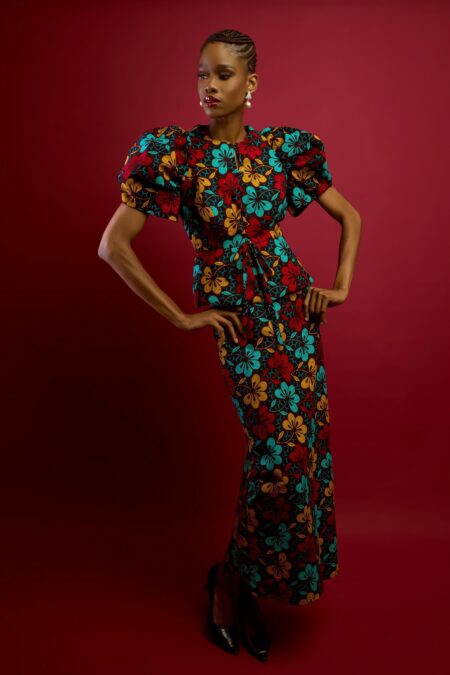
The true origins of Ankara remain something of a mystery. There are several accounts of how this vibrant fabric became so closely associated with Africa, particularly West Africa.
One popular story suggests that Ankara was originally produced for the Indonesian market by a Dutch company specializing in wax prints.
However, due to printing imperfections, the fabrics were rejected. Rather than discard them, the manufacturers reportedly redirected the shipment to West Africa, where the bold colours and striking patterns were enthusiastically embraced.
Another version claims that the Dutch specifically produced the fabric for the Ghanaian market, from where it spread along the West African coast through trade.
After researching its history, Ade Bakare, a renowned Fashion & Costume Designer believes there is some truth in both accounts, adding that it is likely that the fabric was initially intended for Indonesia but failed to meet the required standards.
“This may explain why some early Ankara prints featured splashes of colour and irregular patterns that lacked the precision of Indonesian batik. The rejected textiles were then probably shipped to Ghana, where they found an eager market,” Bakare stated.
According to him, Accra became the principal point of distribution, and he believe this may have influenced the name “Ankara.” Yoruba traders, who travelled extensively along the West African coast as far as Senegal through Togo and Benin, may have referred to the fabric as Aṣọ Accra—meaning “the cloth of Accra.” Over time, the pronunciation may have evolved into what we now know as Ankara, he explained.
“A similar evolution can be seen in the history of Jollof rice. Originally associated with the Wolof people of Senegal, the dish travelled across West Africa through trade and cultural exchange, eventually becoming the beloved “Jollof” enjoyed throughout Nigeria, Ghana, and beyond.
“Trade along the West African coast was once vibrant and extensive. Merchants travelled great distances, with traders coming as far as Senegal to purchase Adire cloth from Abeokuta.
“However, the arrival of colonial rule divided Africa into separate territories with newly established borders. These restrictions disrupted traditional trading routes, encouraging many regions to develop their own distinctive textile traditions and dyeing techniques,” he explained.
He said today, there is much discussion about Ankara’s place in African culture.
Bakare noted that many Ankara designs from the 1950s and 1960s incorporated unmistakably African motifs, including wildlife, foliage, and symbolic imagery. Others commemorated significant historical events such as the independence celebrations of the 1960s or featured portraits of prominent African leaders.
In Sierra Leone, where the concept of Aso-ebi is believed to have gained widespread popularity, coordinated dressing in matching Ankara fabrics became a cherished tradition for weddings, celebrations, and family gatherings. This practice has since spread across much of West Africa and has become an important part of contemporary African fashion culture.
Whichever account one chooses to believe, Ankara may not be indigenous in the same way as Adire, Kente, Akwete, Bogolanfini (Bogolan), or Aso-Oke. Nevertheless, it has been thoroughly embraced by Africans and has become an essential part of wardrobes across the continent. From West Africa to East and Southern Africa, Ankara is now universally recognised as an African textile.
Although the Dutch pioneered its commercial production, Ankara is now manufactured in several countries, including China, Korea, and the United States.
“Sadly, Africa has yet to fully capitalise on the enormous economic potential of this vibrant textile. While companies such as Woodin in Ghana and Da Viva have established successful production, manufacturing remains relatively limited. African nations should invest in producing Ankara on a much larger scale to satisfy domestic demand and strengthen local industries.”
Bakare said Nigeria provides an excellent example. “During the 1970s and 1980s, textile mills such as Aswani Mills in Lagos employed thousands of people and contributed significantly to the economy.
“Unfortunately, the influx of cheaper imported fabrics gradually forced many of these manufacturers to close. Revitalising textile production would not only reduce dependence on imports but also generate employment, stimulate economic growth, and support Africa’s growing fashion industry. With its large population and vibrant consumer market, Nigeria is particularly well positioned to lead this revival.”
He stressed that atADE BAKARE COUTURE, he and his team rarely use Ankara, preferring indigenous fabrics because he believes strongly in promoting and preserving Africa’s original textile heritage. He however hinted that every five years, they create a special Ankara collection to celebrate the fabric’s remarkable journey and enduring influence on African fashion.
“For our Summer 2026 collection, we have designed a contemporary range of Ankara pieces suitable for every occasion and every time of day.
“The collection includes elegant long dresses with sculptural bell sleeves, wrap dresses enhanced with soft pleats, tailored Ankara suits combined with delicate lace, and sophisticated jumpsuits featuring rope straps and ringlet details that transition effortlessly from the office to evening engagements.
“Throughout the collection, particular emphasis has been placed on craftsmanship and detail, incorporating pleats, gathers, bell sleeves, and graceful frills to create timeless yet modern silhouettes,” Bakare explained.
This collection, he said is his tribute to Ankara—its fascinating history, its remarkable adoption by Africa, and its enduring place in the story of African fashion.

Join BusinessDay whatsapp Channel, to stay up to date
Open In Whatsapp