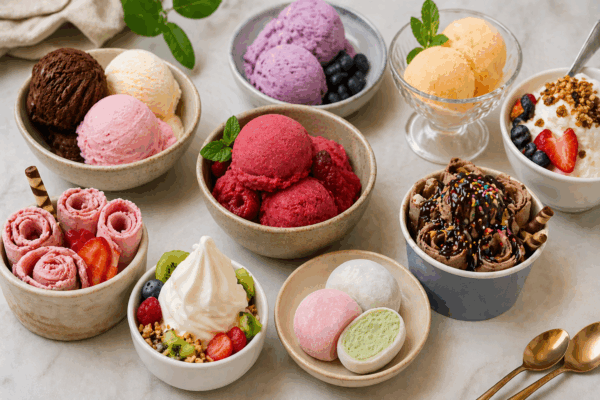
Most people have a favourite. A specific texture, a particular richness, the kind that comes in a cone versus the kind that arrives in a glass. But few people stop to think about why their favourite tastes the way it does, or what separates it from everything else sitting in the freezer aisle.
Ice cream is not one thing. It is a family, and like most families, the members look alike on the surface but are quite different once you get to know them.
Here is a breakdown of every type worth knowing.
Traditional ice cream
The one most people grow up with. It is made from cream, milk, sugar, and egg yolks, churned while freezing to incorporate air and create that smooth, scoopable texture. The fat content is what gives it body, and in most markets, a product must contain at least ten percent milkfat to be called ice cream at all.
Gelato
Gelato is Italy’s version of ice cream, and Italians will be the first to tell you the two are not the same. Born in Florence in the 16th century and refined over generations, it uses more milk than cream, rarely uses egg yolks, and contains less air than regular ice cream. It is also served at a slightly warmer temperature. The result is denser and silkier, with a more intense flavour. Because there is less fat and less air, whatever is in it, whether pistachio, hazelnut, or strawberry, comes through more directly.
Sorbet
There is no dairy in sorbet at all. It is made from fruit, water, and sugar, churned until smooth. The texture is lighter and icier than gelato, and because it carries no fat, the flavour is sharp and clean. It is the option that works for people who are dairy-free or simply want something less heavy after a meal.
Sherbet
Sherbet sits between sorbet and ice cream. It contains fruit, like sorbet, but includes a small amount of dairy, usually milk or cream, specifically between one and three percent milkfat. The addition softens the texture and gives it a mild creaminess that pure sorbet does not have. It is a category that often gets confused with sorbet, but the two are not the same thing.
Frozen yoghurt
Frozen yoghurt became popular as a lighter alternative to ice cream. It uses yoghurt as its base, which gives it a slight tanginess that regular ice cream does not have. The fat content is lower, though the sugar content can be just as high depending on the brand or flavour. It is worth reading the label before assuming it is the healthier choice. It can be served soft or it can be hardened like traditional ice cream.
Soft serve
Soft serve is ice cream dispensed from a machine before it has fully hardened. It contains more air than regular ice cream, which makes it lighter and less dense. The texture is soft and smooth straight from the nozzle, and it melts faster than a traditional scoop. It is the version most associated with fast food chains and roadside vendors, and its appeal is largely about immediacy.
Mochi ice cream
Mochi ice cream approaches the product from a different direction entirely. It is a Japanese creation where a small ball of ice cream is wrapped in a layer of pounded rice dough called mochi. The dough is soft and slightly chewy, and the contrast between the cold filling and the yielding exterior is what makes it distinct. It is less about the ice cream itself and more about the eating experience.
Rolled ice cream
Rolled ice cream originated in Thailand and has since travelled across food markets and dessert shops worldwide. It is made to order, starting with a liquid cream base that is poured onto a frozen metal surface and spread thin. As it freezes, mix-ins like fruit, chocolate, or biscuit are chopped into it. The sheet is then scraped into tight rolls and stood upright in a cup. The process is as much a performance as it is a cooking method, which is a large part of why it became popular on social media before it became popular as a dessert.

Join BusinessDay whatsapp Channel, to stay up to date
Open In Whatsapp