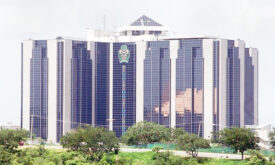
Central Bank of Nigeria governor (CBN) Godwin Emefiele was at the weekend lauded for his contribution towards saving the nation’s economy which went deep into recession last year.
While presenting him with the 2016 Zik Prize award for professional leadership, Aliko Dangote, president, Dangote Group, commended the CBN governor for his interventions especially in agriculture and real sectors of the economy, saying, “With this, I think he deserves the award.”
This is coming as June 3, marked three years of Emefiele’s leadership at the apex bank. Recall that Emefiele was appointed by former President Goodluck Jonathan following the suspension of former governor Sanusi Lamido Sanusi.
Emefiele’s three years in office have been those of daunting economic turbulence – challenges of unstable foreign exchange market, rising interest rates, and spiralling inflation. And, to cap it all, the Nigerian economy plunged into full scale recession mid-2016.
But for a man who knows his onions, he has remained undaunted and unfazed while working assiduously to get the economy back on track. He has always assured Nigerians that there was no need to panic and that speculators who play a major role in the forex crisis would be the losers in the end.
On his assumption of office, Emefiele left no one in doubt regarding the focus of the apex bank under his watch as he promised the CBN would work assiduously with all stakeholders to device countervailing measures that would ensure the set goals are mutually achieved as well as sustain the effective management of potential threats and avoid systemic crisis.
“The core of my vision is to effectively manage potential threats to financial stability and create a strong governance regime that is conducive for financial intermediation, innovative finance and inclusiveness,” he said.
“In this regard, we hope to anchor on two main pillars: managing factors that create liquidity shocks and zero tolerance on practices that undermine the health of financial institutions,” he added.
However, the economy suffered the effect of three major global shocks few weeks after he assumed office. These include the over 70 percent drop in the price of crude oil which contributes the largest share of Nigeria’s foreign exchange reserves and Federal Government revenues; geopolitical tensions along critical trading routes in the world including between Russia and Western powers, Saudi Arabia and Iran, among others; and the end of Quantitative Easing and normalization of monetary policy by the United States’ Federal Reserve Bank.
Since June 2014, monetary policy has had to address steadily rising prices and increased demand for foreign exchange. Persistent shocks to the global and domestic economy associated with sustained weakness in global oil and commodity prices have continued to impact adversely on the accretion to foreign reserves and government revenues. The sustained weakness in oil prices did not only reduce accretion to reserves but also heightened perceived risk by foreign portfolio investors, causing a rise in capital outflows and pressure on the exchange rate.
To address these identified pressures, the CBN under Emefiele’s leadership revisited the foreign exchange policy with a view to positioning it to respond adequately to changing market conditions. The macroeconomic response to dwindling foreign reserves would ordinarily be to depreciate the currency within an agreed percentage within a fixed band or allow it to enter a free float and settle at a point determined by market forces. However, the CBN stresses that the structure of the Nigerian economy does not allow for the full operation of market forces and thus the need to complement for market failures.
Consequently, on June 24, 2015, the CBN excluded importers of 41 goods and services from accessing foreign exchange at the official foreign exchange markets in order to encourage local production of these items.
So far, there has been a boost in the local production of the 41 items on the list, just as substantial foreign exchange has been conserved owing to the reduction in the import bills of the country. Also, industries across various fields of production have recorded profits in their earnings.
As part of its foreign exchange management effort, the CBN Monetary Policy Committee (MPC) in November 2014 shifted the band of the official exchange rate from N155/$1 to N168/$1. The committee also broadened the corridor around the mid-point from +/-3% to +/-5%.
Although the move by the CBN MPC ensured temporary stability in the forex market, currency speculators did not lie low as speculations from this set of people continued to mount pressure on the Naira in the hope that the Naira would experience further depreciation.
The unabated onslaught of speculators and its resultant pressure on the Naira impelled the CBN to carry out another round of currency depreciation with the sole objective of restoring calm in the foreign exchange market. Accordingly, the Bank on February 18, 2015 closed the Retail Dutch Auction System (RDAS) and the Wholesale Dutch Auction System (WDAS) forex market, leaving the interbank market as the only official market, which opened at a depreciated rate of N197/$1.
Between the removal of the rDAS market in February 2015 and the July 2015 MPC, the CBN reports that demand pressure in the foreign exchange market continued at an increased pace, reaching unprecedented levels.
The increasing demand pressure on the foreign exchange coupled with the low accretion to the country’s reserves due to weakening global oil prices prompted the CBN to redesign a new framework for the management of foreign exchange in a period of declining supply.
Unveiling the new guidelines in June 2016, Emefiele said the general operational principle of the new exchange rate framework was that foreign currency would be traded in the inter-bank foreign exchange market through the platform of the Financial Markets Derivative Quotation (FMDQ).
Other highlights of the new framework included that the exchange rate would be purely market-driven using the Thomson-Reuters Order Matching System as well as the Conversational Dealing Book and that the CBN would participate in the market through periodic interventions to either buy or sell forex as the need arises.
On February 20, 2017, the CBN introduced a new policy aimed at increasing the availability of foreign exchange in the market and to ease the difficulties encountered by Nigerians, particularly retail end-users, in obtaining funds for foreign exchange transactions for personal and business travel, medical needs, and school fees, all of which fall under the invisibles category. It also directed that all retail transactions are to be settled at a rate not exceeding 20 percent above the inter-bank market rate.
Between the period February and May 2017, the CBN has intervened in the wholesale and retail segments of the forex market with over $3 billion, just as it has re-admitted operators in the Bureau de Change (BDC) segment who receive $20,000 each for onward sale to low-end users.
Only recently, the CBN also introduced two new forex windows: a special forex window for Small and Medium Enterprises (SMEs) to enable SMEs import eligible finished and semi-finished items, and another forex widow for investors and exporters, tagged Investors’ and Exporters’ Forex Window.
In addition to its monetary policy goal, the CBN has continued the implementation of its development finance initiatives as well as its payments systems – cash-less policy, Bank Verification Number (BVN) and internet banking – all of which are targeted at ensuring financial inclusion. The CBN has also continued to protect customers of Deposit Money Bank (DMBs).
The apex bank also introduced various schemes for agricultural sector aimed at creating jobs on a mass scale, improve local food production, and conserve scarce foreign reserves. Such schemes include Anchor Borrowers’ Programme, together with other initiatives like the Commercial Agriculture Credit Scheme and Nigeria Incentive-based Risk Sharing System for Agricultural Lending (NIRSAL).
Others are Agricultural Credit Support Scheme (ACSS), Agricultural Credit Guarantee Scheme Fund (ACGSF), the N213-billion Nigerian Electricity Market Stabilisation Facility (NEMSF), the N300-billion Real Sector Support Fund (RSSF), the Youth Entrepreneurship Development Programme (YEDP), and the Micro, Small and Medium Enterprises Development Fund (MSMEDF).
It is believed that with Emefiele’s positive macroeconomic policy management, Nigeria would before the end of 2017 climb out of recession. Furthermore, with the relative calm being enjoyed in the Niger Delta region and its attendant salutary increase in crude oil output, coupled with the overpowering of the insurgents in the North-East region of the country, it is hoped that the country will achieve increase growth and further accretion of foreign reserves.
HOPE MOSES-ASHIKE

Join BusinessDay whatsapp Channel, to stay up to date
Open In Whatsapp