…Kenyan, South African, Egyptian, and Moroccan lenders extend earnings growth
Nigeria’s banking sector, once the continent’s standout profit story, is losing momentum.
After posting record earnings over the past two years on the back of naira devaluation gains and elevated interest rates, the country’s biggest lenders are now facing a sharp reality check. Profit growth is slowing, impairment charges are rising, and the extraordinary gains generated by macroeconomic distortions are fading.
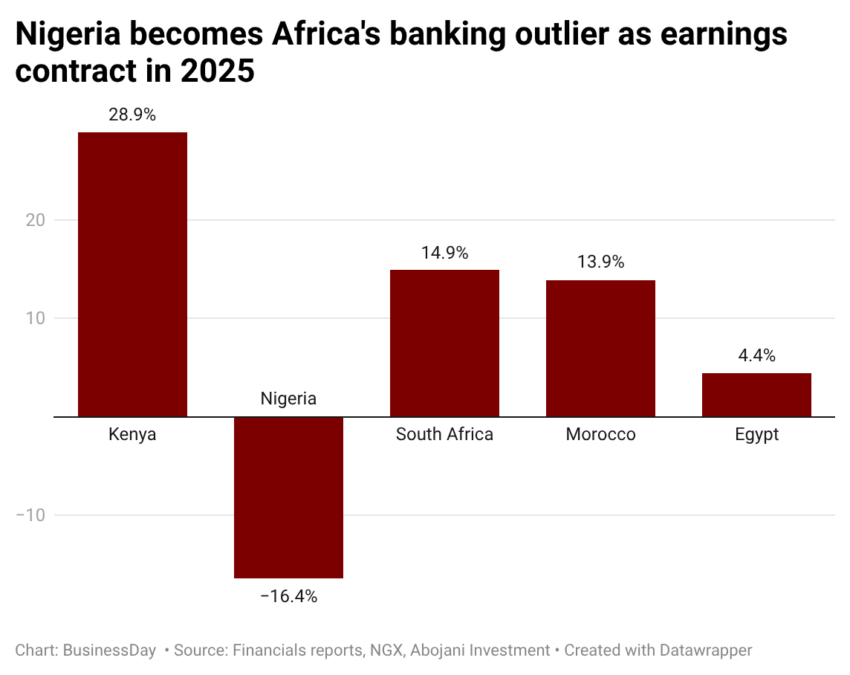
A BusinessDay analysis of 2025 full-year results from Nigeria’s largest lenders — including United Bank for Africa, Access Holdings, Zenith Bank, Guaranty Trust Holding Company (GTCO) and First HoldCo — shows combined profit after tax fell by 16.4 per cent to $2.24 billion from $2.68 billion in 2024.
The decline makes Nigeria the only major African banking market among its peers where earnings contracted, even as lenders in Kenya, South Africa, Egypt and Morocco continued to post profit growth.
The contrast marks a turning point for a sector in Africa’s most populous nation that benefited enormously from Nigeria’s economic reforms in 2023 and 2024.
“The era of abnormal profit growth for banks is over,” said Tony Brown, an Abuja-based banking analyst. “In the last two years, profits were driven by external shocks. What we are seeing now is a return to more normal and sustainable earnings patterns.”
The end of Nigeria’s windfall era
The bumper profitability recorded by the banks was largely fuelled by two factors: foreign-exchange revaluation gains following the naira’s sharp depreciation and the Central Bank of Nigeria’s aggressive monetary-tightening cycle.
The CBN raised interest rates by 875 basis points between July 2023 and May 2025, pushing the benchmark rate to 27.5 per cent and driving a surge in yields across the financial system. Banks benefited from wider interest margins while simultaneously booking large gains on foreign currency assets.
Those tailwinds have now weakened.
The naira has stabilised compared with the extreme volatility witnessed after the FX reforms, reducing opportunities for revaluation gains. At the same time, the CBN has begun cautiously easing monetary policy, putting pressure on future net interest margins.
“When you convert Nigerian banks’ profits into dollar terms, you see a decline because of the massive depreciation of the naira,” said Adeola Adenikinju, immediate past president of the Nigerian Economic Society. “The key issue was the scale of the devaluation. Countries that experienced milder currency depreciation naturally saw less impact on dollar-denominated earnings.”
In 2022, the naira’s average exchange rate against the US dollar weakened from N425.9/$ to N635.2/$ in 2023 and N1,535.8/$ in 2024, before strengthening slightly to N1,429.0/$ last year.
Even in local currency terms, profitability has moderated. Combined earnings of the country’s tier-one lenders fell to N3.2 trillion in 2025 from N4.12 trillion in 2024.
Regulatory clean-up hits profitability.
A more significant challenge is emerging from within the banking system itself.
The central bank’s withdrawal of regulatory forbearance has forced banks to recognise previously deferred credit losses, leading to a sharp increase in impairment charges.
According to BusinessDay’s analysis, impairment provisions across the major lenders rose to N2.42 trillion in 2025 from N1.65 trillion a year earlier.
According to Temitope Omosuyi, head of research and strategy at VFD Asset Management, banks are now paying the price for years of delayed loan-loss recognition. “It simply means that banks now have to make provisions for loans that have already gone bad but were not adequately captured. Those provisions are now taking a toll on the bottom line.”
Ayokunle Olubunmi, head of Financial Institutions Ratings at Agusto & Co, said the decline in profitability had been anticipated across the industry.
“The exit from forbearance led to significant impairment charges for banks, which affected profitability. There were already projections that profitability would weaken because banks would have to absorb those adjustments.”
The result is a fundamental shift in earnings quality. Nigerian lenders are moving away from profits driven by macroeconomic dislocations and returning to a model increasingly dependent on core banking activities.
Why African peers are outperforming
While Nigerian banks are adjusting to a post-windfall environment, their counterparts elsewhere on the continent are benefiting from improving macroeconomic conditions and more diversified business models.
Kenya delivered the strongest performance among the major banking markets analysed. Leading lenders, including KCB Group, Equity Group, NCBA and Co-operative Bank, grew combined profits by 28.9 per cent.
South Africa’s largest banks — Standard Bank, Absa, Nedbank and Capitec — increased earnings by 14.9 per cent to $6.25 billion, supported by resilient consumer spending, digital banking growth and relatively stable monetary conditions.
Morocco’s biggest lenders expanded profits by 13.9 per cent, while Egypt’s leading banks, which grew slightly by 4.4 percent continued to benefit from strong balance-sheet growth and elevated interest rates despite currency pressures.
Unlike Nigeria, where exchange-rate distortions heavily influenced earnings, many African banking markets are increasingly generating growth through fee income, digital services, regional expansion and operational efficiency.
Kenya offers perhaps the clearest example.
According to Nairobi-based financial consulting firm Abojani Investment, the banks are increasingly relying on non-funded income streams rather than traditional lending growth. Strong capitalisation, stable inflation, lower interest rates and currency stability have helped sustain profitability even as loan growth slowed.
“The operating environment was shaped by more stable macroeconomic conditions. Inflation aligned with the central bank’s target, interest rates declined, the currency stabilised, and the Purchasing Managers’ Index improved,” said Purity Chege, research analyst at Abojani Investment, in a recent X space.
Currency stability creates a competitive advantage.
Exchange-rate trends also played an important role in widening the earnings gap.
According to the African Development Bank, 28 African currencies appreciated against the US dollar last year as uncertainty surrounding the US economy weakened the greenback.
The Kenyan shilling, Moroccan dirham and South African rand all strengthened, helping preserve the value of profits when translated into dollars.
Nigeria’s banking sector, by contrast, continues to feel the after-effects of one of the continent’s most severe currency adjustments.
What comes next?
The growing divergence in banking performance across Africa suggests investors may increasingly favour markets where profitability is driven by underlying economic stability rather than temporary policy distortions.
For Nigerian banks, the challenge has shifted from navigating currency reforms to demonstrating they can deliver sustainable earnings growth without relying on foreign-exchange windfalls.
While the sector remains among the most profitable in Africa, future growth is likely to depend less on macroeconomic disruptions and more on core banking fundamentals such as asset quality, operational efficiency, digital transformation and regional expansion.
Looking ahead, Olubunmi of Agusto & Co expects a gradual recovery in the sector, noting that some banks are already recording write-backs from earlier provisions, which should support profitability.
“They also raised fresh capital last year, and they will need to deploy that capital through lending activities to generate returns. At the same time, interest rates are likely to remain elevated longer than expected, which could continue supporting bank earnings,” he said.
The transition could ultimately produce a healthier and more resilient banking industry. In the near term, however, the lenders may continue to face pressure as several African peers benefit from stronger currencies, more stable operating environments and faster earnings growth.
Join BusinessDay whatsapp Channel, to stay up to date
Open In Whatsapp