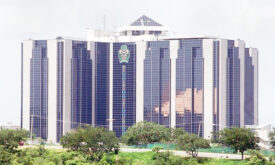
Access Bank Plc’s 2015 audited financial statement showed the lender recorded growth at both the top and bottom lines and in all key ratios amid an unpredictable and tough macroeconomic environment. Little wonder investment and finance houses gave the lender a buy recommendation given its stride despite the foreign exchange restriction imposed by the Central Bank and combined with a high interest rate environment.
The Bank has an aggressive and steady dividend policy as it has recommended a total dividend payment of N56.51 billion (on the basis of N0.55 per share) for every 50k share).
Historical background
Over the past 26 years, Access Bank Plc has transformed from an obscure Nigerian Bank into a world class African financial institution. Today, Access Bank is one of the five largest banks in Nigeria in terms of assets, loans, deposits and branch network; a feat which has been achieved through strong long-term approach to client solutions – providing committed and innovative advice.
Access Bank has built its strength and success in corporate banking and is now taking that expertise and applying it to the personal and business banking platform it acquired from Nigeria’s International Commercial bank in 2012. The last two years have been spent integrating the business, investing in the infrastructure and strengthening the product offer.
As part of its continued growth strategy, Access Bank is focused on mainstreaming sustainable business practices into its operations. The Bank strives to deliver sustainable economic growth that is profitable, environmentally responsible and socially relevant.
Strong Trading Income drives gross earnings
Gross earnings for the year ended December 2015 increased by 38 percent to N337.40 billion as against N245.38 billion as at December 2014; driven by largely on account of improved net trading gains from an enhanced securities trading portfolio. Interest income increased by Interest income up 17 percent year on year (y/y) to 207.8 billion in December 2015 compared with N176.92 billion in December 2014;on the back of growth in income from loans and investment securities (+17 percent y/y and + 19 percent y/y, respectively)
Non-interest income increased by 89 percent to 129.5 billion in December 2015 from 68.4 billion in December 2014.The growth in non interest income can be attributable to an 8 percent y/y growth in net fees and commission income to 33.3 billion in December 2015 from 30.3 billion in December 2014; largely driven by a 69 percent y/y rise in card – related commissions on the back of increased transaction and payment volumes.
Improved net gains non securities trading, accounting for 69 percent of the Bank’s trading income in December 2015.
However, interest expense increased by 33.19 percent to N102.42 billion in December 2015 as against N76.90 billion in December 2014 on the back on strong upward trajectory on cost of customer deposits.
Strong Growth in profit despite rising operating expenses
The Bank, despite rising operating expenses was able to record a double digit growth in net income by 53 percent to N65.86 billion in December 2015 from N43.06 billion in December 2014. The strong profit growth reflects the resilience of the Bank’s diversified business and revenue streams across a broad spectrum.
Operating income increased by 39 percent to N234.83 billion in December 2015 from N168.44 billion at December 2014.
Profit before tax rose by 44 percent to N75.03 billion in the period under review as against N52.02 billion as at December 2014; driven by improvement in noninterest income by 89 percent.
On the other hand, total operating expenses increased by 38.94 percent year on year to N145.57 billion in December 2015 from 104.77 billion reported in the corresponding period of 2014.
Page 13 of the Bank’s consolidated financial statement posted on its website attributed the rise in expenses primarily to continued investment in business growth, particularly retail, and brand equity. Also the AMCON charge and high energy cost resulting from amounts spent on diesel oil, contributed to the high Opex.
A breakdown of the Bank’s expense line showed an increase personal expenses by 35 percent; driven by enhanced staff strength to fill manning gaps at branches so as to boost retail market penetration and improve branch profitability.
Consultancy and IT expenses were up by 73 percent due to Investments (largely one – off) in systems and technology improvements (e .g Flex cube upgrade and channels expenses) to increase automation and enhance service delivery.
Advertisements & Marketing Expenses were up by 148 percent to as a result of increased advert placements and marketing activities to drive product adoption (e.g. Pay With Capture) and enhance brand equity
Investments in high yield securities help bolster total assets.
The bank’s total assets were up by 23 percent to N2.59 trillion in December 2015 from N2.10 trillion as at December 2015; resulting from a 25 percent y/y growth in the loan book and increased investments in high – yield government securities. Total loans and advances moved by 25 percent to N1.40 trillion in the period under review as against N1.12 trillion at December 2014; owing Largely to increased on-lending activities to State Governments, as well as devaluation and growth in the Agriculture and Construction sectors
Also, growth in loan portfolio for the year was largely driven by on – lending activities, as the Bank issued intervention funds granted by the CBN to State Governments to spur economic recovery.
Customer deposits jumped by 16 percent to N1.68 trillion in December 2015 from N1.45 trillion in December 2014 on the back of the implementation of the Treasury Single Account (TSA) by the Central Bank.
Shareholders fund increased by 33 percent year on year to N368 billion in December 2015 compared with N277 billion as at December 2014.
Increased efficiency ratio validates earnings spurt.
After-Tax ROAE grew to 20.4 percent as at December 2015 from 16.5 percent as at December 2014,above guidance of 18.0 percent ,largely driven by improved profitability. This also means the tier 1 bank has utilized the resources of its owners in generating higher profit.
The 38 percent, the Bank’s liquidity ratio remains above the regulatory requirement of 30 percent while capital adequacy ratio stood strong at 19.50 percent is well above the regulatory requirement of 15 percent.
The bank has strong asset quality evidenced by its aggressive risk management strategy as Non Performing Loans (NPL) declined to N24.5 billion in December 2015 from N25.3 billion as at December 2014 which reflects a non performing loans (NPL) ratio that dropped to 1.70 percent in the period under review as against 2.2 percent recorded in the corresponding period of December 2014.
It should be noted that the bank’s NPL ratio is one of the lowest in the industry, based on data gathered by BusinessDay. Loans to deposits ratio increased to 70.90 percent in December 2015 from 67.90 percent as at December 2014.
Fitch Upgrade Access Bank for Strong Risk Management
At a time when the Nigerian banking industry is showing signs of weakness in risk management practices as reflected in resurgence of huge non-[performing loans, Fitch ratings have commended Access Bank for its ‘strong risk management’, and thus upgraded the bank’s rating to long-term National Ratings to “A” from “A-” with a stable outlook. The rating upgrade according to Fitch is a reflection of the improvement in the creditworthiness of Access Bank over time relative to peers and to the best credits in Nigeria. Announcing the rating upgrade, the company stated, “Fitch Ratings, a global leader in credit ratings and research, had affirmed the Long-term IDRs of Access Bank Plc and upgraded the National Rating. The National Rating of the Bank has been upgraded to ‘A(nga)’/’F1(nga)’ to ‘A-(nga)’/’F2(nga)’ to reflect the improvement in creditworthiness over time relative to peers and to the best credits in Nigeria. “In Fitch’s opinion, banks will continue to face multiple threats in the course of 2016, particularly from tight foreign currency liquidity, worsening asset quality and pressure on regulatory capital ratios. However, Access’ Viability Rating (VR) is affirmed as these risks are to a large extent already captured in the ratings.
BALA AUGIE

Join BusinessDay whatsapp Channel, to stay up to date
Open In Whatsapp