Twenty years after Nigeria dismantled its state electricity monopoly and more than a decade after handing most of the industry to private investors, the country’s power sector remains trapped in a contradiction. The institutions have changed. The ownership structure has changed. The laws have changed. But for millions of households and businesses, electricity itself has not.
Nigeria has more than 13,000 megawatts of installed generation capacity, yet the national grid delivers only a fraction of that on most days. More than 85 million Nigerians still lack access to grid electricity, while manufacturers and businesses continue to rely heavily on diesel generators.
“The implication is simple: Nigeria no longer suffers primarily from a shortage of power plants. It suffers from a shortage of electricity that can move reliably through the entire value chain. Transmission is one bottleneck. New generation has limited economic value if the grid cannot evacuate and transport it to distribution networks.”
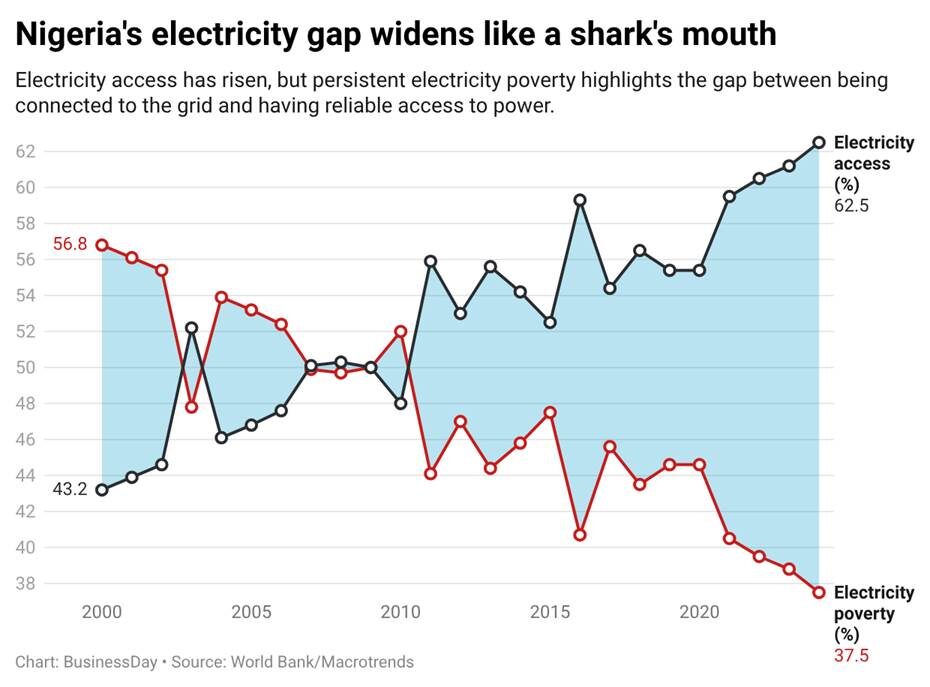
The reform succeeded in creating an electricity market on paper. It has struggled to create one that consistently delivers power. That paradox matters far beyond the power sector. Electricity is the operating system of an economy. Industrialisation, export competitiveness, digital transformation and Nigeria’s ambition to build a $1 trillion economy all depend on reliable power. Without it, factories operate below capacity, businesses divert scarce capital into generators and investors price energy risk into every project.
The failure of Nigeria’s electricity reform is therefore not simply an energy story. It is a lesson about the limits of structural reform when institutions, incentives and implementation fail to evolve alongside policy.
The reform changed ownership, not the market
By the late 1990s, the National Electric Power Authority had become a symbol of state failure. Years of underinvestment, political interference and poor maintenance left electricity supply far below demand.
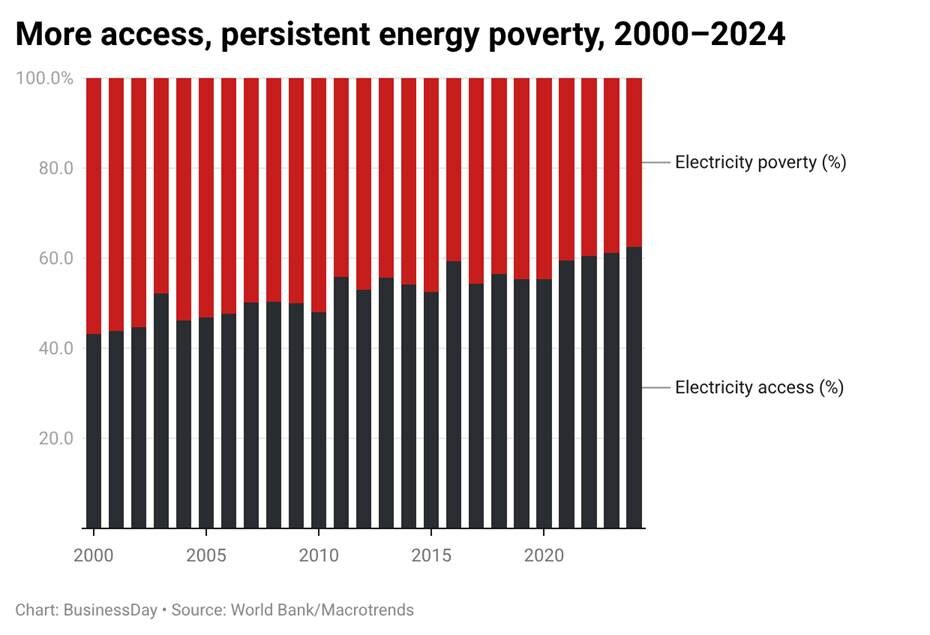
The government’s response was ambitious. The National Electric Power Policy of 2001 laid the foundation for reform, culminating in the Electric Power Sector Reform Act of 2005. The legislation sought to dismantle the vertically integrated monopoly, establish an independent regulator, introduce competition and attract private capital.
The centrepiece arrived in 2013, when the Federal Government transferred ownership of six generation companies and eleven distribution companies to private investors. The expectation was straightforward: private ownership would improve efficiency, strengthen revenue collection, expand investment and ultimately deliver more electricity.
But investors inherited a market that lacked many of the conditions required for commercial success. Millions of customers were unmetered. Electricity tariffs remained politically constrained and often below the cost of supply. Transmission infrastructure was weak. Most critically, the gas sector, which supplies roughly four-fifths of Nigeria’s grid electricity, continued to operate under commercial conditions poorly aligned with the power market.
Nigeria effectively privatised parts of the electricity value chain before fixing the value chain itself. The result was predictable. Distribution companies struggled to recover costs. Generating companies faced payment challenges. Gas producers accumulated receivables. Government repeatedly intervened to prevent the system from collapsing.
The reform assumed that changing ownership would automatically change performance. Instead, it transferred commercial responsibility into a market that lacked the conditions required for commercial success.
The delivery gap tells the real story
The strongest argument for reform was that private ownership would increase investment and electricity supply. Yet installed capacity and electricity actually remain two very different things.
Nigeria’s installed generation capacity now exceeds 13,000MW, while average grid generation has remained around 5,000MW, with occasional peaks above 6,000MW. Against estimated electricity demand of between 30,000MW and 40,000MW, the gap remains enormous.
The implication is simple: Nigeria no longer suffers primarily from a shortage of power plants. It suffers from a shortage of electricity that can move reliably through the entire value chain. Transmission is one bottleneck. New generation has limited economic value if the grid cannot evacuate and transport it to distribution networks.
Gas is another. With roughly 80 percent of grid electricity generated from gas-fired plants, unreliable fuel supply quickly becomes unreliable electricity supply. Pricing disputes, payment problems and pipeline vandalism have repeatedly constrained deliveries.
Metering adds a third weakness. As of June 2025, NERC data showed that only about 54.3 percent of Nigeria’s 11.82 million registered electricity customers had functional meters, leaving more than 5.4 million on estimated billing. No modern electricity market can operate efficiently when utilities do not know exactly how much electricity they sell and customers cannot verify what they consume.
Who actually benefited from the reform?
The reform’s benefits have not been evenly distributed. The strongest evidence comes from the distribution of electricity subsidies. The World Bank found that, before recent reforms, about 80 percent of electricity subsidy benefits went to the richest 40 percent of households, while only 8 percent reached the poorest 40 percent. The poorest 20 percent received less than 2 percent of the total subsidy benefit.
That raises a more fundamental question about the reform’s distributional impact. Improving the commercial structure of the electricity market is not the same as ensuring that its benefits reach those most affected by energy poverty. If public support disproportionately benefits households that already consume more electricity, reform can improve market efficiency without necessarily improving energy equity.
The lesson is important. The question is no longer only whether Nigeria can make electricity commercially viable. It is whether the gains from reform can be distributed widely enough to improve access and reduce energy poverty.
Nigerians pay for electricity twice
For households and businesses that cannot rely on the grid, electricity is effectively paid for twice: once through electricity bills and again through generators, fuel, batteries, inverters and maintenance. That has created a parallel generator economy that has become part of Nigeria’s economic infrastructure. For manufacturers, unreliable electricity raises production costs and weakens competitiveness. For small businesses, fuel costs consume money that could otherwise finance expansion, employment or new equipment.
The wider economic cost is substantial. The World Bank has repeatedly estimated that unreliable electricity imposes annual economic losses equivalent to between 5 percent and 7 percent of Nigeria’s GDP. Those losses extend beyond manufacturing to agriculture, healthcare, education and services through higher operating costs and unreliable infrastructure.
This is why electricity reform should not be judged only by the number of power plants built, private capital attracted or megawatts installed. The relevant question is whether households and businesses can rely on electricity without maintaining a second, private power system.
The next reform must fix the market
The Electricity Act 2023 creates a new opportunity. By allowing states to generate, transmit and distribute electricity within their territories, it moves Nigeria away from a single national model and creates room for decentralised electricity markets.
Several states, including Lagos, Enugu, Ekiti, Ondo and Oyo, have enacted state electricity laws and assumed, or begun assuming, regulatory oversight of their intrastate electricity markets as NERC transfers authority to qualifying state regulators. If implemented effectively, the emergence of multiple state electricity markets could become one of the most consequential structural changes since the original reforms, allowing states to compete for investment, innovation and service delivery.
But decentralisation is an enabler, not a guarantee of success. A state-owned electricity monopoly can fail just as easily as a federal one if tariffs remain politically determined, contracts are poorly enforced and fuel supplies remain uncertain. Three priorities now matter more than another round of ownership reform.
First, metering. Millions of customers remain on estimated billing. Metering must move faster if distribution companies are to improve collections and customers are to trust the system.
Second, transmission. Generation capacity has expanded considerably, but the transmission network has not kept pace. Every additional megawatt generated is of limited value if it cannot be evacuated and transported to consumers.
Third, gas. About four-fifths of Nigeria’s grid electricity comes from gas-fired plants. Gas pricing, payment discipline, pipeline security and domestic supply must therefore be treated as core electricity policy, not as a separate energy issue.
These are ultimately governance problems. The country has repeatedly announced new generation projects, financing agreements and investment commitments. But none of these measures matter to consumers if reliable electricity does not reach their homes and businesses.
The test of reform is electricity
Nigeria’s electricity reforms have not failed entirely. The 2005 Electric Power Sector Reform Act dismantled an unsustainable state monopoly. The 2013 privatisation introduced commercial discipline into parts of the value chain. The Electricity Act 2023 created the legal foundation for competitive state electricity markets.
These are meaningful institutional achievements. But institutional progress is not the same as economic transformation. The success of the next phase should therefore be measured differently. How many hours of electricity do households receive each day? How many businesses have permanently reduced their dependence on generators? How much has self-generation fallen? How much cheaper has it become to produce goods in Nigeria?
These are the measures that determine whether reform has succeeded. The central objective of Nigeria’s electricity reform was never to privatise electricity. It was to deliver electricity. By that standard, the reform remains unfinished. Nigeria has spent two decades reforming the ownership of electricity. The next decade must finally deliver the electricity itself.

Join BusinessDay whatsapp Channel, to stay up to date
Open In Whatsapp