South Africa’s private sector returned to growth in June as easing inflationary pressures and resilient hiring lifted business conditions, although weak demand continued to weigh on output and new orders.
The S&P Global South Africa Purchasing Managers’ Index rose to 50.5 in June from 49.6 in May, its highest reading in two months and above the 50-point threshold separating expansion from contraction.
Read also: the-impossible-choice-facing-nigerians-in-south-africa-as-june-30-deadline-nears
The reading signalled an improvement in private-sector conditions for the third time in four months. However, the expansion was marginal, as output and new orders continued to decline for a second consecutive month, albeit at a slower pace than in May.
“The PMI’s recovery in June was mainly helped by resilient hiring at South African companies, although output and order books fell at slower rates than in May,” David Owen, principal economist at S&P Global Market Intelligence, said.
“The outlook among private sector businesses suggests that economic challenges are expected to stay, with optimism hitting its weakest level for nearly five years.”
Read also: when-nigerians-return-home-will-nigeria-be-ready/
Businesses attributed weaker sales to constrained consumer spending, elevated prices and persistent economic uncertainty, which continued to limit customer demand. Output fell for a second straight month, while total new orders also remained in contraction territory.
External demand offered some support. New export orders returned to growth after declining in May, while the services sector was the only category monitored to record an increase in new business.
Employment remained relatively resilient, with firms continuing to hire permanent and temporary workers to expand operating capacity. Although the pace of job creation slowed slightly from May, the data showed businesses were still adding staff despite subdued demand conditions.
Backlogs of work remained broadly unchanged but stayed below the neutral 50-point mark for a ninth consecutive month, suggesting firms continued to operate with spare capacity.
Read also: nigeria-seeks-compensation-from-south-africa-over-migrant-exodus
The most encouraging development in last month’s survey was a sharp easing in cost pressures. Input price inflation slowed significantly after reaching a 46-month high in May, with the input prices index falling by nearly seven points during the month.
Output price inflation also moderated from its highest level in almost four years, although many firms said they were still passing higher fuel costs on to customers.
“The silver lining from the June data was a marked cooling of inflationary pressures,” Owen said. “With survey comments signalling that the recent cost spike has largely hinged on oil markets, a notable cooling of global oil prices over the course of June provides some confidence that inflation will moderate further.”
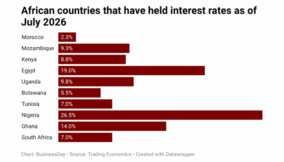
South Africa’s annual inflation rate rose to 4.5 percent in May from 4.0 percent in April, driven largely by higher fuel prices. Food and non-alcoholic beverage inflation, however, continued to ease, falling to 1.9 percent.
The June PMI shows that the private sector in Africa’s largest economy is regaining some momentum, but the recovery remains fragile. Softer inflation may provide relief to businesses and consumers in the coming months, though weak domestic demand and declining business confidence are likely to constrain a stronger expansion.

Join BusinessDay whatsapp Channel, to stay up to date
Open In Whatsapp