….ranks fourth biggest MPR cutter
Nigeria has lowered its benchmark interest rate by 50 basis points to 26.5 percent, marking the second cut in five months and pushing borrowing costs to their lowest level since June 2024.
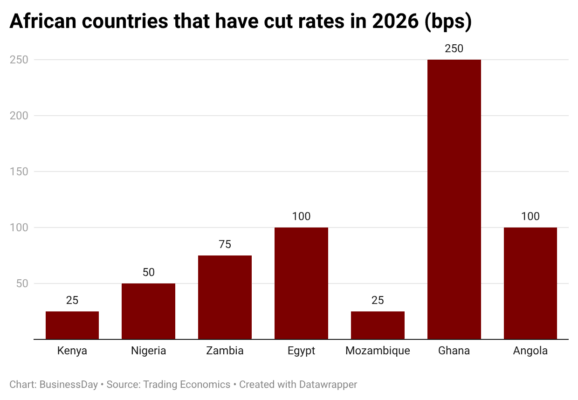
The move places Africa’s most populous nation firmly within a widening continental easing cycle. Policymakers in Kenya, Egypt, Angola, Ghana, Mozambique and Zambia have also reduced rates this year, meaning seven of the 13 African central banks that have held MPC meetings so far this year have opted to ease.
Notably, five of the easing economies rank among Africa’s 10 largest by GDP, underscoring the breadth of the policy pivot.
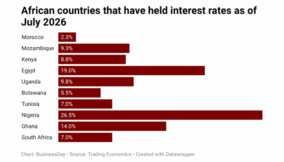
Despite the cut, Nigeria still maintains the highest benchmark rate among the 13 countries reviewed.
“The rate cut sends a positive signal to investors and the business community,” said Muda Yusuf, founder and chief executive of the Centre for the Promotion of Private Enterprise (CPPE). “A moderation in the policy rate, even if incremental, supports improved investor sentiment, a gradual easing of financing conditions and stronger private-sector confidence.”
In a statement, Yusuf added that given the significant cost pressures businesses have faced over the past two years — including energy, logistics, exchange-rate volatility and high interest rates — even modest monetary accommodation provides psychological and financial relief. However, he cautioned that the real impact will depend on the effectiveness of policy transmission.
Shift from tightening
The West African nation’s latest move follows a previous reduction in last September to 27 percent from 27.5 percent, signalling a gradual shift after years of aggressive monetary tightening. Before that, the last rate cut occurred in September 2020, when the policy rate was reduced to cushion the economic fallout from the COVID-19 pandemic.
Since then, the apex bank had largely pursued a tightening cycle by rising rates to a total of 875 basis points in response to persistent inflation and currency volatility.
At the latest meeting, policymakers left other key parameters unchanged. The asymmetric corridor was retained at +50/-450 basis points around the MPR, while the Cash Reserve Ratio (CRR) remained at 45 percent for deposit money banks and 16 percent for merchant banks. The liquidity ratio was also held at 30 percent.
Despite reductions in the MPR, borrowing costs for businesses remain elevated due to structural constraints, including the high CRR, elevated deposit costs, risk premiums tied to macroeconomic uncertainty, crowding-out effects from government borrowing and high operating costs within the banking system.
“Unless these structural rigidities are addressed, the benefits of monetary easing may not fully translate into lower borrowing costs for manufacturers, SMEs, agriculture and other productive sectors,” Yusuf said.
Ghana leads the easing cycle
Ghana remains Africa’s most aggressive rate cutter, having reduced its benchmark by a cumulative 250 basis points to 15.5 percent in January — the lowest since February 2022.
The development follows a dramatic disinflation trend. Consumer prices slowed for a 13th consecutive month to 3.8 percent in January, down from 5.4 percent in December and firmly within the central bank’s 6–10 percent target band. Inflation had peaked above 54 percent in December 2022 at the height of the country’s currency crisis.
Improved fiscal conditions and record-high gold prices have strengthened reserves and supported a sharp appreciation of the cedi, reinforcing expectations of further easing.
Egypt, Angola deepen pivot
Egypt and Angola rank as the next largest cutters, each trimming rates by 100 basis points to 19 percent and 17.5 percent respectively.
Egypt’s latest move extends one of Africa’s most significant easing cycles. Between February and December last year, policymakers slashed rates by a cumulative 725 basis points as inflation fell from a peak of 38 percent in September 2023 to 11.9 percent in January 2026, supported by stronger foreign-currency inflows and improved exchange-rate stability.
Angola’s easing reflects a similar disinflation path. Annual inflation slowed to 14.56 percent in January from 15.7 percent in December, continuing a steady moderation from 2024 highs. Greater currency stability has allowed Africa’s third-largest oil producer to push borrowing costs to their lowest level since October 2023.
Broad-based but uneven easing
Zambia cut its policy rate by 75 basis points to 13.5 percent — the second consecutive reduction and the lowest since April 2024 — after inflation fell to 9.4 percent in January, supported by a bumper maize harvest and a stronger kwacha.
Mozambique and Kenya delivered more modest 25 basis point cuts. Mozambique’s move lowered borrowing costs to 9.25 percent, the cheapest since 2015, while Kenya’s reduction to 8.75 percent marked its tenth consecutive easing step, signalling confidence that inflation risks remain contained.
Rwanda bucks the trend
Rwanda stands as the key outlier. The National Bank of Rwanda delivered its largest rate increase in nearly three years, raising the policy rate to 7.25 percent from 6.75 percent to contain near-term inflation pressures.
Authorities said the move was necessary to keep inflation within the 2–8 percent target band, bringing cumulative tightening to 75 basis points since rate hikes resumed last year.
Holdouts remain cautious
Not all central banks have joined the easing wave. Uganda, South Africa, Tanzania, Namibia and Botswana held rates steady at 9.75 percent, 6.75 percent, 5.75 percent, 6.50 percent and 3.50 percent respectively.
Their caution reflects lingering concerns over inflation persistence, currency volatility and uncertain global financial conditions, even as the broader continental trend begins to tilt toward monetary easing.

Join BusinessDay whatsapp Channel, to stay up to date
Open In Whatsapp