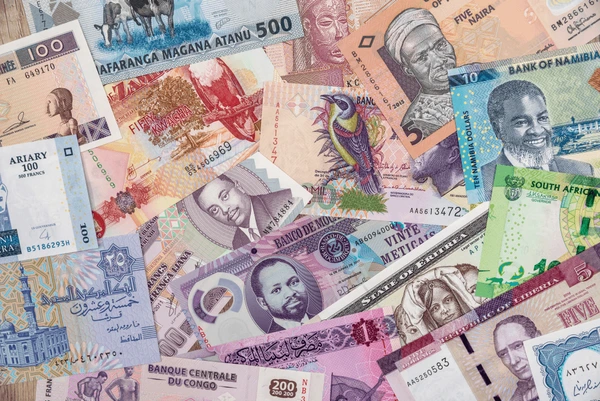
A stronger dollar, persistent inflationary pressures, and elevated energy costs weighed heavily on African economies in May, as escalating tensions linked to the Iran conflict triggered fresh volatility across global financial markets.
Although global sentiment improved slightly following ceasefire signals between the United States and Iran, fears of a prolonged conflict in the Middle East continued to keep crude oil prices elevated, increasing pressure on import-dependent African economies and tightening household spending across the continent.
Read also: 7-african-countries-with-the-strongest-currencies-as-of-march-2026
Against this backdrop, fewer African currencies recorded gains against the United States dollar in May compared to April, highlighting growing strain across the region’s foreign exchange markets.
Data compiled from African Markets, a real-time trading platform, showed that only seven of the 17 major African currencies tracked appreciated against the dollar in May, down from 12 currencies that strengthened in April. The performance reflected uneven resilience among economies benefiting from stronger export earnings, improved foreign exchange inflows, and renewed investor confidence.
Meanwhile, eight African currencies weakened against the dollar during the month, as rising import bills, external debt pressures and tighter global financial conditions continued to challenge policymakers.
The renewed strength of the dollar also added pressure on African currencies, as investors shifted toward safer assets amid heightened geopolitical uncertainty. Increased demand for the greenback weakened appetite for riskier emerging and frontier market assets, including African currencies.
The US dollar moved contrary to expectations held by many analysts and investment banks at the start of the quarter, according to a report by Cambridge Currencies, a UK-based specialist currency broker.
“Rather than sliding as the Iran risk premium unwound, the dollar has firmed. At the end of May, the US Dollar Index (DXY) traded near 99, up roughly one percent on the month,” the firm said in a recent report.
Read also: these-12-african-currencies-appreciated-despite-iran-war-shocks
Oil-importing economies remained among the most vulnerable during the month, with higher fuel and transportation costs feeding inflationary pressures and widening trade deficits. In several countries, central banks faced mounting pressure to defend local currencies while balancing the need to support economic growth.
Analysts said the divergence in currency performance across Africa underscores the continent’s varying exposure to commodity prices, capital flows and domestic monetary policy conditions.
Export-oriented economies benefiting from stronger commodity earnings were better positioned to absorb external shocks, while countries with weaker foreign reserve buffers and heavy import dependence experienced sharper currency pressures.
Here are the best-performing African currencies in May.
Zambian kwacha
The Zambian kwacha emerged as Africa’s best-performing currency in May, appreciating by 2.01 percent against the dollar.
The currency strengthened from 18.86 kwacha per dollar at the beginning of the month to 18.48 by month-end. The gain reflects continued support from copper exports, which remain the backbone of Zambia’s economy. Rising international demand for copper and improving confidence in the country’s economic recovery have helped strengthen the kwacha in recent months.
Namibian dollar
The Namibian dollar appreciated by 2.58 percent against the dollar, strengthening from 16.66 per dollar to 16.23.
Its performance largely mirrored that of the South African rand, to which it is pegged. Improved sentiment towards Southern African assets and expectations of stronger commodity revenues supported the currency during the month.
South African rand
The rand also gained 2.58 percent against the dollar in May, strengthening from 16.66 to 16.23.
The currency benefited from renewed investor interest in emerging market assets, easing concerns over global energy supply disruptions and stronger prices for some of South Africa’s key mineral exports.
Egyptian pound
Egypt’s pound appreciated by 2.08 percent during the month, moving from 53.33 pounds per dollar to 52.22.
The gain was supported by steady inflows from tourism, remittances from Egyptians abroad and continued foreign investor interest in the country’s debt market. Recent economic reforms have also helped improve confidence in Egypt’s financial outlook.
Read also: five-african-currencies-with-the-biggest-declines-amid-middle-east-war
Moroccan dirham
The Moroccan dirham strengthened by 0.75 percent against the dollar in May, appreciating from 9.24 dirhams per dollar to 9.17.
The currency continued to draw support from Morocco’s thriving tourism industry and robust export performance, particularly in phosphates, agriculture and automobile manufacturing.
Botswana pula
Botswana’s pula appreciated by 0.50 percent, moving from 13.83 per dollar at the beginning of May to 13.76 at the end of the month.
The currency was supported by the country’s strong external reserves and prudent monetary management. Botswana’s relatively stable macroeconomic environment has helped shield the pula from the volatility experienced elsewhere on the continent.
Nigerian naira
The naira appreciated by 0.29 percent against the dollar in May, strengthening from N1,375.99 per dollar to N1,371.92.
Although the gain was modest, it underscored the relative stability the currency maintained during the month. Improved dollar liquidity, stronger foreign portfolio inflows and ongoing reforms in the foreign exchange market helped support the naira despite continued pressure from inflation and high import costs.
Currencies that weakened in May
Ten African currencies depreciated against the dollar during the month.
The Ghanaian cedi recorded the sharpest decline among the currencies tracked, weakening by 4.36 percent. Zimbabwe’s ZiG followed with a depreciation of 6.23 percent, while Rwanda’s franc lost 0.29 percent, and Tanzania’s shilling weakened by 0.26 percent, CFA Franc dipped by 0.62 percent.
Kenya’s shilling slipped by 0.23 percent, Malawi’s kwacha fell by 0.04 percent and Mauritania’s ouguiya declined by 0.48 percent, Tunisian dinar weakened by 0.34 percent and Uganda’s shilling slid by 0.34 percent.

Join BusinessDay whatsapp Channel, to stay up to date
Open In Whatsapp