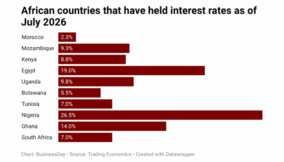
This week’s developments highlight the diverging fortunes across the continent—from Kenya’s decision to keep interest rates unchanged and Nigeria’s fading banking profit boom, to a resurgence in mergers and acquisitions, a major stock market listing in East Africa and renewed confidence in Afreximbank’s credit profile.
Here are five developments shaping finance and business across the continent
Africa’s rate-hold trend continues as Kenya resists calls to tighten
Kenya’s central bank left its benchmark lending rate unchanged at 8.75 percent on Tuesday for a second consecutive meeting, defying calls from commercial banks for tighter monetary policy as policymakers weighed rising inflation against slowing economic growth in East Africa’s biggest economy. The decision was widely expected, with economists polled by Reuters and Bloomberg forecasting a hold after the Central Bank of Kenya (CBK) paused its easing cycle in April.
Why it matters: Kenya’s decision highlights the increasingly difficult choices facing African policymakers as the Middle East conflict pushes up fuel costs and threatens to reignite inflation. As East Africa’s largest economy, it’s monetary policy stance often provides insight into how other African central banks may respond to similar pressures in the months ahead
Nigeria becomes Africa’s banking outlier as earnings contract in 2025
After posting record earnings over the past two years on the back of naira devaluation gains and elevated interest rates, the country’s biggest lenders are now facing a sharp reality check. Profit growth is slowing, impairment charges are rising, and the extraordinary gains generated by macroeconomic distortions are fading.
A BusinessDay analysis of 2025 full-year results from Nigeria’s largest lenders — including United Bank for Africa, Access Holdings, Zenith Bank, Guaranty Trust Holding Company (GTCO) and First HoldCo — shows combined profit after tax fell by 16.4 per cent to $2.24 billion from $2.68 billion in 2024.
Why it matters: While banks across much of Africa continue to benefit from economic stability and improving credit conditions, Nigerian lenders are entering a new phase where sustainable earnings growth will depend less on macroeconomic distortions and more on core banking performance. The shift could reshape investor perceptions of one of Africa’s most profitable banking markets.
Kenya’s Family Bank heads to Nairobi bourse after five-year wait
Family Bank will begin trading its shares on the Nairobi Securities Exchange (NSE) on June 23, following approval from the Capital Markets Authority (CMA), marking the culmination of a five-year journey to become a publicly traded company.
The lender will be listed by way of introduction, a process that allows existing shareholders to trade their shares on the exchange without the issuance of new stock, according to a statement on Thursday. The move is expected to broaden investor participation while providing liquidity for current shareholders.
Why it matters: The listing could help revive investor interest in Kenya’s capital markets and provide a fresh benchmark for valuing mid-tier banks. It also signals growing confidence among financial institutions seeking access to public markets despite a challenging fundraising environment across much of Africa.
The biggest deals behind Africa’s strongest quarter in four years
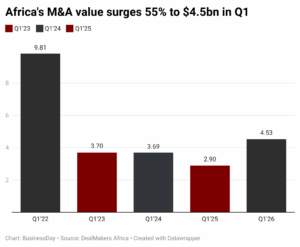
Africa’s Mergers and Acquisitions (M&A) market started the year with its strongest first quarter in four years, as investors poured money into large telecommunications, banking and energy transactions while becoming increasingly selective about where they deploy capital.
According to DealMakers Africa, the continent recorded 89 M&A and private equity transactions worth $4.53 billion in the first quarter of 2026, up 55 percent from $2.92 billion in the corresponding period last year. The increase came despite a slight decline in deal volumes, underscoring a growing preference for larger, lower-risk acquisitions.
Why it matters: The rebound suggests that international and regional investors remain willing to deploy capital in Africa, but are becoming increasingly selective. The trend points to growing confidence in sectors viewed as essential to the continent’s long-term growth while highlighting a preference for larger, more resilient businesses
Afreximbank gets investment-grade backing from S&P after Fitch downgrade
African Export-Import Bank (Afreximbank) has secured a BBB+ investment-grade rating from S&P Global Ratings, three notches above Fitch Ratings’ earlier BB+ assessment, highlighting a sharp divergence in how major agencies view the pan-African lender. The rating underscores Afreximbank’s growing role in financing trade, industrialisation and economic development across Africa.
Why it matters: The sharp divergence between two major rating agencies is likely to reignite debate over how African multilateral financial institutions are assessed. For investors, S&P’s investment-grade endorsement strengthens Afreximbank’s standing in international capital markets and could support its ability to raise funding for trade and infrastructure projects across the continent
Chart of the Week

Join BusinessDay whatsapp Channel, to stay up to date
Open In Whatsapp