This week, central banks across the continent adopted a more cautious stance as oil-driven inflation pressures resurfaced following the prolonged Middle East conflict. At the same time, Nigeria posted its fastest economic growth in a decade, while major African banks marked Africa Day by promoting unity, culture and entrepreneurship across the continent.
Here are the top stories shaping Africa’s financial landscape:
Africa Day: Five banks celebrating Africa’s culture, unity and growth
As Africans across the continent commemorated Africa Day on May 25, several leading banks used the occasion to celebrate African culture, entrepreneurship, unity and economic development. Among the institutions marking the event were Access Holdings, United Bank for Africa, Ecobank, Union Bank of Nigeria and Rand Merchant Bank.
Why it matters: The growing involvement of banks in Africa Day celebrations reflects how financial institutions are positioning themselves not just as lenders, but as key drivers of African integration, trade, culture and economic transformation.
Why Nigerian banking elites are buying London property despite rising UK taxes
Some of Nigeria’s top bankers and business elites are increasingly buying property in London as a hedge against economic uncertainty and naira volatility despite rising taxes in the UK luxury housing market. Recent acquisitions linked to prominent Nigerian business figures have renewed attention on the growing appetite for offshore real estate among wealthy Nigerians.
Why it matters: The trend underscores weakening confidence in the naira’s long-term stability and highlights how currency volatility is accelerating capital preservation strategies outside Nigeria.
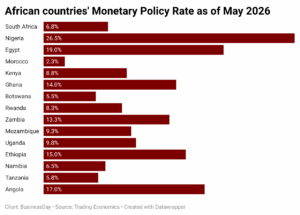
Eleven African nations pause rate cuts as Iran war revives inflation fears
Africa’s anticipated interest-rate cutting cycle is losing momentum as a renewed oil shock triggered by the prolonged Middle East conflict forces central banks back into inflation-fighting mode. Between March and May, central banks in South Africa, Morocco, Mozambique, Namibia, Kenya, Egypt, Ethiopia, Uganda, Tanzania, Nigeria and Ghana all held benchmark interest rates steady, signalling a coordinated shift from easing expectations to policy caution.
Why it matters: Higher-for-longer interest rates could raise borrowing costs, weaken consumer spending, slow investment and place additional pressure on currencies and government finances across Africa.
Morocco inflation climbs to 1.7% on rising transport, fuel costs
Morocco recorded a sharp rise in inflation in April as higher fuel and transport costs linked to Middle East tensions pushed consumer prices upward. Data from Morocco’s statistics agency showed annual inflation accelerated to 1.7 percent in April from 0.9 percent in March, driven largely by rising transport costs and higher prices for non-food goods and services.
Why it matters: The increase highlights how geopolitical tensions and rising energy prices are once again feeding into inflation across African economies, potentially delaying interest-rate cuts and squeezing household spending.
Nigeria’s economy grows at fastest pace in a decade
Nigeria recorded its fastest economic growth in a decade, driven by strong performances across the services, agriculture and industrial sectors, according to new data from the National Bureau of Statistics. Africa’s third largest economy grew by 3.89 percent in the first quarter of 2026, up from 3.13 percent in the same period last year.
Why it matters: The stronger growth could improve investor confidence in Nigeria’s reform agenda, although persistent inflation, weak consumer purchasing power and currency volatility remain major risks to sustained expansion.
Chart of the Week

Join BusinessDay whatsapp Channel, to stay up to date
Open In Whatsapp