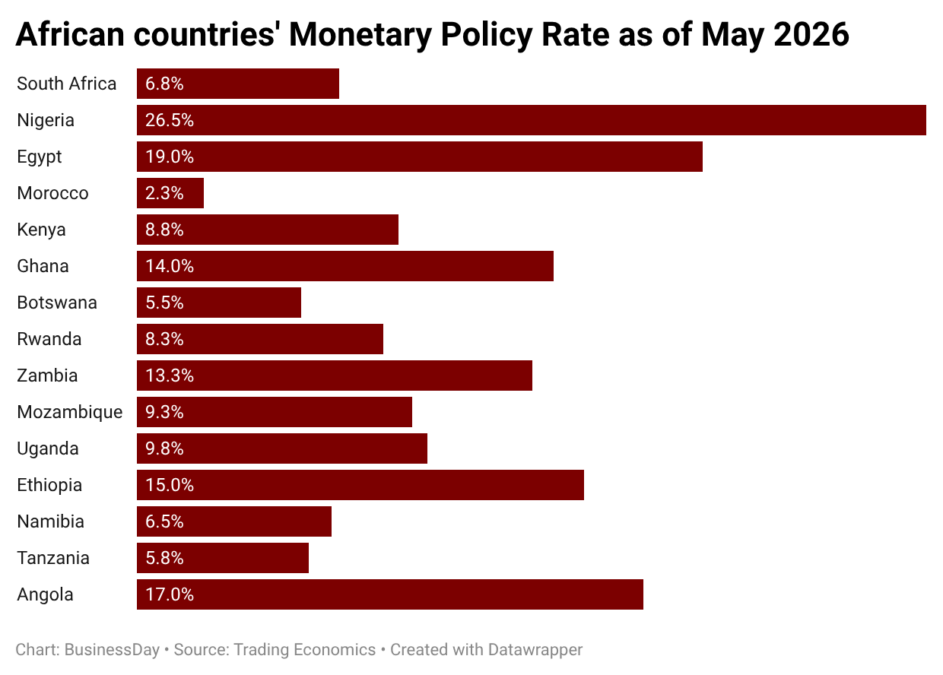
Africa’s anticipated interest-rate cutting cycle is losing momentum as a renewed oil shock triggered by the prolonged Iran conflict forces central banks back into inflation-fighting mode.
Across the continent, policymakers who only months ago were preparing to support slowing economies through lower borrowing costs are now adopting a far more cautious stance as crude prices surge above $100 per barrel, reigniting imported inflation pressures before price stability has been fully restored.
Between March and May, central banks in South Africa, Morocco, Mozambique, Namibia, Kenya, Egypt, Ethiopia, Uganda, Tanzania, Nigeria, and Ghana all held benchmark interest rates steady, signalling a coordinated shift from easing expectations to policy caution.
The change marks an abrupt reversal for African central banks, which had spent much of the past year benefiting from moderating inflation after two years of aggressive monetary tightening. Now, escalating geopolitical tensions involving the United States, Israel, and Iran are threatening to derail the continent’s fragile disinflation progress through higher fuel, transportation, food, and production costs.
The risk is especially acute for the continent’s largely oil-importing economies, many of which remain vulnerable to exchange-rate volatility, rising debt-servicing costs, and weak consumer purchasing power.
In its latest Africa Economic Update, the World Bank warned that higher fuel and food prices could worsen inflation pressures, raise domestic borrowing costs, and constrain already stretched fiscal positions across the continent.
“The resulting impact of higher domestic food and fuel prices on consumer price inflation could lead to rising interest rates not only at home but also abroad,” the multilateral lender said. “Higher inflation is likely to erode households’ purchasing power, while increases in domestic interest rates may discourage household consumption and dampen domestic investment.”
For investors, the renewed inflation shock is also reshaping expectations across African bond, currency, and equity markets.
Higher-for-longer interest rates could raise sovereign borrowing costs, weaken portfolio inflows into frontier markets and delay economic recovery as businesses and households face tighter financing conditions.
According to DealMakers Africa, inflationary pressures linked to higher fuel costs and currency volatility are already increasing financing risks and complicating investment decisions across several African economies.
“At the same time, major African economies face heightened exposure to currency volatility, which can complicate deal structuring and valuation,” said Marylou Greig, editor of the South African-based firm in a recent report.
At the onset of the war in March, S&P Global Ratings projected that commercial long-term borrowing by African sovereigns would rise to $155 billion this year, up from $140 billion issued in 2025.
The credit rating agency disclosed this in a recent report, noting that the increase will be driven by a combination of maturing debt obligations and ongoing fiscal financing needs across the continent.
South Africa’s inflation scare
In South Africa, the continent’s most industrialised economy, the central bank kept its benchmark repo rate unchanged at 6.75 percent in March for a third consecutive meeting, extending a pause in what markets had expected to become an easing cycle.
Lesetja Kganyago, governor of South African Reserve Bank warned that rising oil prices and global uncertainty could reignite inflationary pressures — concerns that were quickly validated as inflation accelerated to a 20-month high in April. Petrol prices recorded their sharpest increase this century, pushing consumer inflation to four percent year-on-year from 3.1 percent in March, its highest level since August 2024.
The renewed inflation spike has already reshaped market expectations. Earlier in the month, Goldman Sachs revised its outlook for South Africa, forecasting two additional 25-basis-point rate hikes this year instead of cuts. Investors are now closely watching the country’s third Monetary Policy Committee meeting of the year scheduled for this week.
Namibia maintained its benchmark repo rate at 6.5 percent for a third consecutive meeting, partly to preserve the Namibian dollar’s peg to the South African rand. Policymakers warned that exchange-rate volatility and spillover effects from geopolitical tensions continued to threaten the inflation outlook despite moderating domestic price pressures.
East Africa faces renewed pressure
In Kenya, the central bank held rates at 8.75 percent in April, pausing a nearly two-year easing cycle as inflation accelerated to 5.6 percent from 4.4 percent in March — the highest level in two years. Transport costs surged by 10 percent year-on-year amid rising fuel prices, while food inflation also picked up sharply, underscoring the growing impact of imported energy costs on household spending.
Ethiopia emerged as one of the economies hardest hit by the oil shock, with inflation accelerating to 11.7 percent in April after five consecutive months in single digits. The surge was driven largely by a 35 percent increase in petrol prices and rising food costs. In response, the National Bank of Ethiopia kept its benchmark interest rate unchanged at 15 percent, warning that geopolitical tensions posed significant upside risks to the inflation outlook.
In Uganda, policymakers left rates unchanged for a seventh consecutive meeting at 9.75 percent, arguing that the current policy stance remained appropriate despite mounting risks from the Middle East conflict. Meanwhile, Tanzania maintained its benchmark rate at 5.75 percent even as inflation climbed to a near three-year high in April, reflecting rising transportation and consumer goods prices.
The Bank of Mozambique maintained its benchmark policy rate at 9.25 percent, keeping borrowing costs at their lowest level since December 2015 and extending a pause in the easing cycle that began in 2024. However, inflation accelerated for a third consecutive month to a six-month high of 4.41 percent in April, driven by severe flooding and fuel supply constraints that disrupted the distribution of essential goods across parts of the country.
Arab economies hold rates too
Morocco also maintained its benchmark interest rate at 2.25 percent for a fourth consecutive meeting as policymakers balanced resilient economic growth against rising global uncertainty. Although the North African economy experienced mild deflation earlier this year, inflationary pressures resurfaced in March as transportation and food prices rebounded.
Similarly, Egypt kept its benchmark rate unchanged at 19 percent for a second straight meeting despite moderating inflation, as policymakers grew increasingly concerned that rising fuel and transportation costs could reignite broader price pressures and place fresh strain on the Egyptian pound.
Nigeria, Ghana turn cautious
Nigeria’s central bank also paused after February’s 50-basis-point cut, leaving rates at 26.5 percent as inflation climbed for a second consecutive month to 15.7 percent in April. Governor Olayemi Cardoso said policymakers adopted a “cautious and vigilant” stance to anchor inflation expectations and preserve macroeconomic stability.
In Ghana, the central bank halted one of Africa’s most aggressive easing cycles after cutting rates by 1,400 basis points since last year. Inflation edged higher to 3.4 percent last month from 3.2 percent in March, ending a string of declines and reinforcing concerns that external shocks could destabilise recent macroeconomic gains.
The Bank of Ghana governor Johnson Asiama said the decision to hold rates steady at 14 percent was necessary to preserve recent stability gains while maintaining flexibility to respond to emerging risks.
Few countries still cutting
Despite the broader caution, a handful of African economies are still easing monetary policy as domestic inflation trends improve.
Angola cut its benchmark interest rate from 17.5 percent to 17 percent, citing improvements in inflation dynamics and exchange-rate stability. Inflation slowed to 11.58 percent in April, the lowest level since June 2023.
Similarly, Zambia lowered its benchmark rate for a third consecutive meeting, trimming it by 25 basis points to 13.25 percent as easing inflation and a relatively stable kwacha created room to support economic growth. Inflation eased to 6.8 percent last month, remaining within the central bank’s target range.
Still, policymakers in both countries acknowledged that the Middle East conflict continues to pose significant upside risks to inflation, limiting the scope for aggressive easing.
Botswana and Rwanda buck the hold trend
While most African central banks paused, Botswana and Rwanda moved in the opposite direction, aggressively tightening policy to counter rapidly rising inflation.
Botswana became the second African central bank this year to deliver a major rate hike, raising its benchmark rate by 200 basis points to 5.5 percent in April — the highest level since 2017. Inflation surged to 10.3 percent from 4.2 percent in March, prompting policymakers to move decisively to anchor inflation expectations.
Rwanda followed with a 100-basis-point increase to 8.25 percent on Thursday, its highest level since 2009, after inflation accelerated to 11.5 percent in April from 7.7 percent the previous month. Governor Soraya Hakuziyaremye said the move was necessary to slow rising prices and preserve long-term economic stability.
The diverging responses highlight how Africa’s monetary policy outlook is becoming increasingly fragmented as economies face varying levels of inflation exposure, currency pressures and vulnerability to imported energy shocks.
For now, however, the broader trend remains clear: The continent’s central banks are prioritising inflation control over growth support as geopolitical tensions reshape the continent’s economic outlook.

Join BusinessDay whatsapp Channel, to stay up to date
Open In Whatsapp