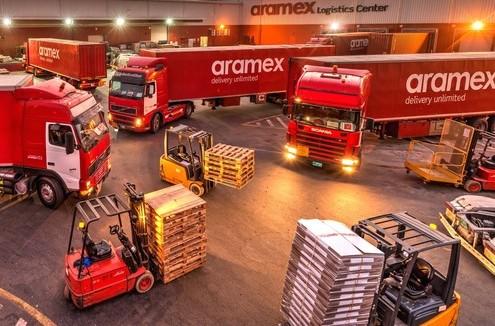
It has been more than two years since Hussein Hachem took over as chief executive of Aramex, the Dubai-based logistics company. With acquisitions across the globe to drive its e-commerce business and investments in infrastructure and technology, Hachem is adamant that it will transform Aramex and bring “disruptive” change to the industry.
“The idea is to have Aramex as a technology enterprise selling solutions without really owning any assets, but facilitating supply and demand and managing the process,” Hachem says.
This year, Aramex will invest $20m in technology, and becoming increasingly asset-light is part of this strategy. Unlike most of its competitors, such as global giants DHL and FedEx, it does not own aeroplanes and uses commercial airports, while running a combined network of fully owned operations alongside partners and agents.
The company is present in 60 countries and offers services across freight, express, logistics and warehousing, e-commerce and record management, FT reports.
“We have less luggage and, with the transformation to become a technology enterprise, we are able to move, shift and introduce new products to the market faster than others,” he says.
Change is occurring in the final leg of delivery, or the so-called last mile, as the company prepares to launch mobile apps and invite the public to become couriers on a part-time basis. This allows it to create an open-source model that changes, based on demand, solving the issue of capacity in its e-commerce business, an increasing revenue generator.
“This is a new thing that will be disruptive and change the industry in a big way. It will allow us to scale up based on demand, have a better delivery component and be more cost efficient,” Hachem says.
The apps, one for consumers and another for couriers, will be rolled out by the fourth quarter, starting with Dubai, Cairo, India, Turkey and South Africa.
“The workforce of the frontline of Aramex will become the community. Anyone can participate in the delivery component. You might be a housewife, a student, a part-time worker, and we would pay according to the success of the delivery component,” he explains.
People will be trained and certified before becoming couriers. Once verified and vetted, they can access the app via a pin code and start deliveries based on their availability. “This allows us to move from fixed-cost last mile into a variable-cost last mile,” Hachem says. “It’s similar to the Uber component.”
On the other hand, consumers will use their app to interact with the courier online, track their package and rate the quality of delivery. Over time, this should result in enhanced service. Aramex has also partnered with UK-based Pivotal Labs, where data scientists are sifting through millions of transactions to help analyse customer behaviour. The results will be used to redesign operations around customers preferred delivery times, services and expectations.
Investments in technology are central to its e-commerce business, which comprises 25 per cent of its top line and is expanding about 25 per cent annually. This explains recent acquisitions, such as the 25 per cent stake in Ohio-based WS One Investment, which provides cross-border mailbox services out of the US. The move supports the growth of Aramex’s similar Shop and Ship product, which gives customers an address in 14 countries.
With the US at the core of Aramex’s e-commerce operations, the company is opening a new sorting facility and adding 150 employees there, doubling the workforce. It is also upgrading its infrastructure in the UK, a significant gateway.
A key area of focus is strengthening its relationship with online retailers, such as Amazon and ebay, across Europe and the UK and connecting these markets to the rest of its network.
“We want to facilitate more ecommerce strategy into the Middle East, sub-Saharan Africa, north Africa and Asia,” Hachem says. “There is a gap in these markets and we are filling that gap.”
Hachem is bullish on the Mena region, which generates 50 per cent of revenues. The rest is divided between Asia, Africa and Europe. He is investing in logistics infrastructure upgrades in Dubai, Qatar, Saudi Arabia and Oman and sees the region growing in volume.
Africa is another avenue of growth, where the company continues to scout for acquisitions and joint ventures. It aims to establish a footprint in Nigeria, Namibia, Zambia and Mozambique this year, after a recent acquisition of the master franchise of PostNet in South Africa.
Believing it has been left out of the game, Hachemsays “it’s high time for someone to activate and unlock the potential of sub-Saharan ecommerce”. So far, activity has been minimal and mostly on a domestic level. “What we are trying to do . . . is connect Africa to the global ecommerce market.”
One option is overcoming the payment challenge, as most global online retailers do not accept the region’s credit cards. By using a telecoms platform, consumers will be able to connect to etailers by checking out with their mobile numbers, bypassing the need for credit cards and allowing the African consumer access to global products within four to five working days. This could be introduced as early as the third quarter.
“We want the consumer in Nigeria, Kenya, Angola, Ghana, Namibia and South Africa to enjoy the same level of service like anybody living in Dubai or Europe,” he says.
After a number of acquisitions last year, including Australia’s Mail Call Couriers, Aramex is eyeing two to three more buys this year in Asia, sub-Saharan Africa or the US. For this, it will tap $150m in bank financing obtained this year. Any deals will support its ecommerce strategy, while total investment in expansion in 2015 could reach $120m, including in technology, warehouses and acquisitions.
“We are not going to buy companies with heavy assets. We will buy client lists, local knowledge, networks,” says Hachem.
He expects profit to rise 10 per cent this year, taking into account currency fluctuations. Gulf Arab countries as well as ecommerce operations in Europe and the US will be chief contributors. In 2014, Aramex hit a record profit for the 10th consecutive year since it listed on the Dubai Financial Market.
FT

Join BusinessDay whatsapp Channel, to stay up to date
Open In Whatsapp