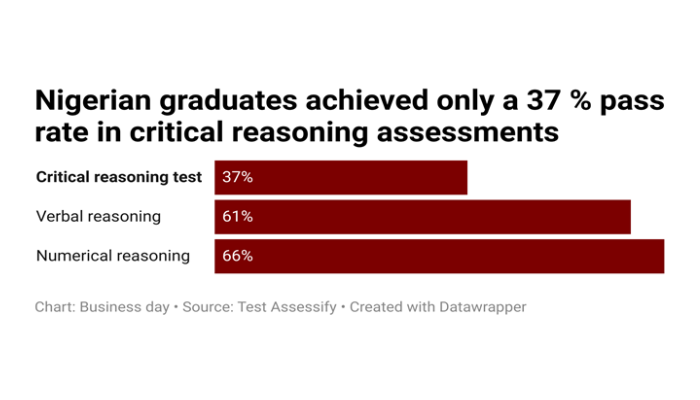
A recent report has revealed that Nigerian graduates trainees had a 37 percent pass rate for critical reasoning, compared to numerical reasoning which had a 66 percent pass rate, during an Graduate trainee exercise in 2024.
This report was conducted by TestAssessify in a study of over 200,000 applications and assessments.
The findings indicate that graduates need to improve in grasping problem-solving and decision-making skills, which are crucial for handling complex workplace scenarios. It underscores the need to teach thinking skills alongside factual knowledge to better prepare graduates for real-world challenges.
Critical reasoning is a soft skill, and its assessments are designed to evaluate a candidate’s ability to think logically, analyze information, and make the best decisions.
World Economic Forum’s (WEF) Future of Jobs Report 2025, emphasised that soft skills are indispensable ‘people skills’ which are crucial for professional advancement, due to their increasing relevance by 2025.
It highlights the growing importance of critical reasoning as a skill in the evolving job market and stressed the increasing demand for skills such as creative thinking, resilience, and adaptability, which are closely tied to critical reasoning.
Read also: Nigerian undergraduates waste productive years in school
What may have caused a low pass rate in critical reasoning skills?
Although Federal universities provided the majority of applicants- up to 50 percent, their qualification and test pass rates are relatively lower.
Private universities such as Covenant university and Babcock university, while representing only 1 percent of applications, demonstrated higher qualification and pass rates, suggesting a higher quality of candidates.
State universities exhibited varied performance levels. Some institutions, such as Olabisi Onabanjo university and Lagos state university, maintained respectable qualification and pass rates, making them valuable recruitment targets. Others, however, show significantly lower pass rates.
Private universities, on the other hand, appear to do a better job at teaching soft skills, giving their graduates a boost with those all-important fundamental skills. This might explain why they’re seen as more ready for the workplace.
On top of that, private universities tend to have better learning environments with fewer distractions, which helps students focus and achieve better grades compared to their counterparts in federal institutions.
For example, Covenant university has been praised for its commitment to holistic education, student development, and relevance and impact in preparing students for the dynamic demands of the modern workplace.
According to Amaze Obaseki, a consultant at Ernst & Young, “Effective communication is an important soft skill and comes in the form of clear idea conveyance, active listening, body language proficiency, and empathy for understanding diverse perspectives. Others are teamwork, adaptability, problem-solving, and conflict management which are essential competencies for workplace efficiency and personal growth”.
Read also: Nigerians among 70,000 international graduates facing deportation from Canada
Key findings of the report
Here are the findings in more detail:
Performance by university type
Private universities: 40 percent pass rate, showcasing stronger readiness for employment tests.
Federal universities: 36 percent pass rate, demonstrating their continued importance as a critical talent pipeline.
State universities: 34 percent pass rate.
Performance by test type
Numerical reasoning: 66 percent pass rate, attributed to the strong focus on basic math in schools.
Verbal reasoning: 61 percent pass rate, supported by an emphasis on English language skills.
Critical reasoning: 37 percent pass rate, highlighting the reliance on memorisation rather than problem-solving in the education system.
Description of tests
Numerical reasoning: Tests mathematical and analytical abilities, essential for data analysis and solving quantitative problems.
Verbal reasoning: Assesses comprehension and communication skills, vital for many roles.
Critical reasoning: Measures problem-solving and decision-making, crucial for handling complex workplace scenarios.
Read also: U.S. to fast track visa for Nigerian graduates and others with job offers
Performance by individual universities in the online assessment
· Covenant University: 48 percent
· Federal University of Technology, Owerri: 43 percent
· Landmark University: 43 percent
· University of Lagos: 42 percent
· Afe Babalola University: 42 percent
· Babcock University: 40 percent
· University of Ilorin: 38 percent
· University of Benin: 37 percent
· Olabisi Onabanjo University: 37 percent
· University of Nigeria, Nsukka: 29 percent

Join BusinessDay whatsapp Channel, to stay up to date
Open In Whatsapp