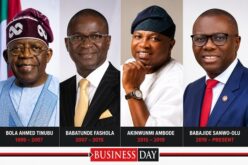
Lagos, Nigeria’s economic powerhouse will have a chance at continuity in governance as the All Progressives Congress (APC) governorship candidate in the upcoming 2015 elections; Akinwunmi Ambode outlines his vision for growth.
Lagos makes up 20 percent of Nigerian GDP and 40 percent of Non – Oil GDP. The city state which would be Africa’s fifth largest economy on a standalone basis is as important to the country as California is to the U.S.A, meaning the direction of governance in the state has a big impact on Nigeria’s overall economy.
“We want to consolidate on the vision of our party All Progressives Congress (APC), which has brought remarkable changes to Lagos State, including improved infrastructure, security and service,” Ambode said in a statement made available to BusinessDay.
“We will continue to ensure that Lagos State is one of the most religiously tolerant, most welcoming states to foreign investors, and unarguably the most efficiently run state in Nigeria.”
Nigeria rebased its GDP to show it surpassed South Africa’s in 2012 to become the continent’s largest economy.
About 15,700 millionaires and a handful of billionaires live in Nigeria, with more than 60 percent of them in Lagos.
With a population estimated at about 20 million equivalent of 32 African Countries combined, Lagos state has boosted its internally generated revenues (IGR) from a maximum of N600 million in 1999 to N20 billion per month in 2013.
“The ability of the Lagos’ economy to move beyond oil is a template that should be replicated in the rest of the country, said Razia Khan,Regional Head of Research, Africa, at Standard Chartered Bank.
“Nigeria’s single commodity dependence is a long-running problem,” Khan said.
Oil revenues account for 75 percent of the 2014 FG budget but in Lagos is as low as 25 percent.
Outgoing Governor Babatunde Fashola , who is stepping down after reaching the two-term limit, has overseen Nigeria’s biggest city through nearly a decade of robust growth and relative stability.
The city which has been governed by the opposition APC since democracy returned in 1999, has been in the forefront of Nigeria’s economic boom which has been driven by the expanding banking, telecommunications, and services sectors.
“If anything, the miracle of Lagos is that its economy gallops onward even when fettered by the same federal incompetence that allows terrorism to go unchecked. A lesser city would be crippled,” said Robert Draper, in a recent article for National Geographic.
Ambode’s plans include continuing to invest in bridges and expressways, while boosting the State Security Fund and expanding the Independent Power Project (IPP) to improve city lighting.
“We will introduce a 24/7 economy that is typical of a city state like Lagos. We will set up a Lagos Employment Trust Fund (LETF) with N25 billion over four years, through an access to finance of a minimum of N1 billion annually across the five divisions in the state, that will allow our youths and unemployed people have access to adequate finance for entrepreneurial ventures,” Ambode said.
Other growth points include, continuing with the free Education in the state, health, transportation and infrastructure especially completing the blue line light rail network currently under construction.
Ambode, who is from Epe, served in the Lagos State Civil Service for 27 years and retired voluntarily in 2012 as the Permanent Secretary and Accountant-General of Lagos State.
PATRICK ATUANYA

Join BusinessDay whatsapp Channel, to stay up to date
Open In Whatsapp