Apapa, the once prosperous and enticing commercial and industrial enclave in Lagos is dying and it would appear none in government cares, despite the federal government earning as much as one trillion naira in revenues from the community annually.
Set apart by its close proximity to the water, Apapa is divided into a commercial section and a residential neighbourhood, the Government Residential Area (GRA) with its wooden streets and which in its glory days was home to political heavyweights like the best known face of the modern Yoruba and premier of the Western region, Obafemi Awolowo.
Residents blame the steady death of Apapa on the uncontrolled permits for petrol tank farms granted under shady circumstances to politically connected businessmen and demand for fuel from their farms has been helped by monumental collapse of the nation’s refineries and the multi-billion dollar pipeline network, which means that Lagos remains the only viable source of supply for the fuel required to keep the nation going.
The situation has been compounded by the chaos inside the two seaports in Apapa where parking lots for container bearing vehicles have been converted to other uses without alternatives being provided. Yesterday, distressed motorists were quick to finger some terminal operators including APM Terminal, Greenview, ENL Consortium and Apapa Bulk Terminal for allegedly restricting access into the terminals which they operate.
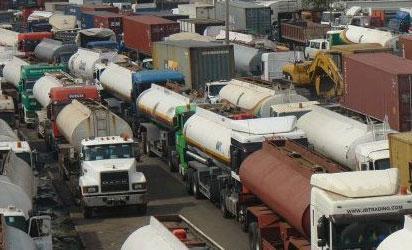
The gridlock within Apapa became worse years after the port terminals were concessioned to the private sector. The port in the pre-concession era had spaces which served as parks for tankers and trailers. The federal government in 2006 following the concessioning, allotted the spaces to private terminal operators, thereby forcing the trucks out to park indiscriminately on roads leading in and out of Apapa.
An alternative parking lot (of about 500 capacity) constructed opposite the Tin Can port has so far not been completed almost four years after it was awarded to Borini Prono, an Italian firm. It was designed to be completed in July 2013, while public private partnership (PPP) arrangement to have another trailer park constructed within the Lagos Trade Fair Complex in Ojo to accommodate 5,000 trucks is yet to see the light of the day.
Today, more than half of the offices along Creek road and Wharf road, the worst hit areas of the commercial district, have either been vacated or are on the verge of being relocated outside Apapa.
In the residential section, Liverpool road which once offered the same alluring beauty like St Johns Wood, the leafy part of London, is characterised by an endless traffic jam of articulated trucks headed for tank farms in Apapa, with hundreds of residents locked in almost perpetually.
“When I first arrived Lagos as young man in 1982, I dreamt for a home in Apapa GRA, but today that dream has become for my household a terrible nightmare” said Obinna Njoku, a senior engineer with one of the international oil companies. He added: “The decay of Apapa has been steady. First it was the commercial area that crumbled and now the GRA has become the latest victim of what is easily a monumental decay with the attendant collapse in property values.
“Yesterday (Tuesday), two of my patients had to cancel their appointments after being trapped in traffic congestion inbound Apapa for three hours,” Bode Karunwi, a medical doctor and former vice chairman of Apapa Residents Association, who runs a hospital in Apapa said.
Karunwi added, “I no longer reside in Apapa, although I still have my office there, but truth is that Apapa is a nightmare either for business or residency”. He blamed the sad development on federal government’s failure to reinvest in a community from where it is making trillion of naira annually, describing this as “irresponsible”.
As the mess continues, the property market in Apapa is comatose, with property value dropping as much as 50 percent, following a near-paralysis of economic activities that have in turn crashed demand for both residential and commercial properties.
Kayode Opeifa, the Lagos State commissioner for transportation, did not answer our phone calls or respond to a text message on what the state government was doing about the situation.
Chudi Ubosi, principal partner, Ubosi Eleh & Co.- a firm of estate surveyors and valuers, confirmed to BusinessDay that this unfortunate situation has led to the drop in property value, adding that Apapa has also seen over 40 percent vacancy rate.
“The state of Apapa today is such that only those who live there still have anything to do with the area; people don’t go there any longer to transact business and that is quite unfortunate. Apapa some years ago was ranked alongside Ikeja GRA but today whereas 1,000 square metres of land sells for N400 million in Ikeja GRA, same size of land in Apapa goes for N200 million”, he explained.
He noted that many of the high rise buildings like the Development House on Wharf Road is scarcely occupied because many of the tenants have moved office to more convenient and profitable areas.
Paul Ojenagbon, a real estate consultant and CEO, Cute Image Communications, added that a good number of Apapa tenants are not talking of renewing their lease terms, pointing out that what has kept some businesses there is the challenges associated with moving location.
“It doesn’t make sense spending three to four hours going to work; what are you going to do at the end of the day? Businesses are leaving; Apapa is fast losing its charm and I think it is time for both the Federal and Lagos State government to do something about this”, he advised.
The situation is also impacting on the manufacturing subsector, as the Manufacturers Association of Nigeria (MAN), says the newly introduced Pre-Arrival Assessment Report (PAAR) by the Nigeria Customs Service (NCS) aimed at fast-tracking cargo clearance, is being rubbished by the man-hours lost in transit within Apapa, due to the congestion, a development they agree adds to the cost of doing business.
Rasheed Adegbenro, the immediate past acting director-general, MAN gave a hint on what manufacturers are going through. “When imported raw materials get stuck at the ports and roads, it results in a stock-out of raw materials, which means that the internal stock level of the manufacturers will decrease, resulting to low production levels, ‘’he said.
Remi Bello, president, Lagos Chamber of Commerce and Industry (LCCI) said the port was evidently fraught with capacity challenges, adding that PAAR, which was originally programmed to be issued within six hours now takes weeks to be released, a situation which has led to factory disruptions and consequently raised the cost of borrowed funds and demurrage charges for manufacturers and business people.
Most horrifying is driving into the Apapa port from Funsho Williams road, through the Iganmu-National Theatre and the Ijora Olopa interchange from the Apongbon end, where motorists are confronted with bad roads characterised by gullies and potholes or what could best be described as death traps.
Between the Lagos State Water Corporation, Ijora and Area B Police headquarters in Apapa, the entire road is completely mutilated due to years of neglect. This is primarily as a result of the negative impact of high vehicular traffic along the corridor, which causes huge wear and tear on vehicles. It has become a recurring decimal that commuters losing precious man hours entering and leaving Apapa as a result of the perennial traffic menace.
Unlike other developed and developing nations with far less population when compared to Nigeria, the analysts wondered why there are no functional passenger and cargo train services, including efficient ferry services connecting the Apapa and Tin-Can Island ports to other parts of the metropolis.
For three days, commuters into Apapa from the Ijora Causeway were caught up in nerve-wracking traffic gridlocks which lasted for hours.
Speaking to BusinessDay, commuters decried the poor state of roads leading to Apapa from Surulere, adding that this has been worsened by the absence of traffic officials along the corridor.
Veronica Atere, who works with a fast food store in Apapa, told BusinessDay she is contemplating resigning from her job due to the stress she goes through daily, going to work. “It is a lot of stress for me coming to work because I spend hours every day on the road,” she said.
JOSHUA BASSEY, CHUKA UROKO, MIKE OCHONMA AMAKA ANAGOR, ODINAKA ANUDU & ODINAKA MBONU

Join BusinessDay whatsapp Channel, to stay up to date
Open In Whatsapp