 The outflow of offshore funds from Nigeria which accelerated at the beginning of the year has all but ceased, as investors pile back into the country, which is one of the top frontier markets by weighting on the Morgan Stanley Capital International (MSCI) Index.
MSCI Index is often used as a common benchmark for global stock funds, which includes a collection of stocks of all the developed markets in the world.
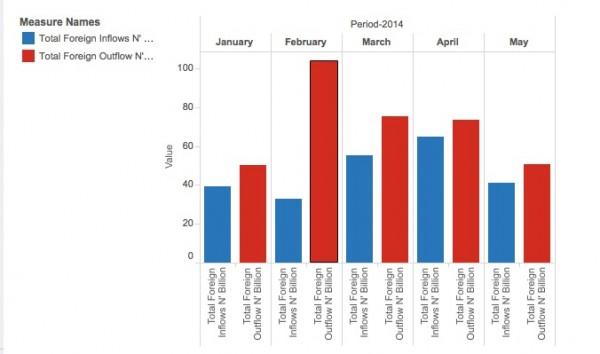
Consequently, total foreign fund inflows into the Nigerian Stock Exchange (NSE) were N41.2 billion ($252 million) in the month of May, and almost equivalent to the levels of outflows, according to the most recent data from the bourse.
This compares with the month of February 2014 when foreign outflows of N103.5 billion outnumbered inflows of N32.75 billion by three to one.
“Nigeria’s capital market appears to have benefitted from the recent increase in the weighting of Nigerian stocks in the MSCI Frontier Market (FM) Index, releasing an additional $200 million in fresh foreign flows into the Nigerian bourse, reviving market growth and erasing some of previous YTD losses,” said RTC Advisory Services, a consultancy firm, in a note released June 9.

Stocks have clawed back to erase losses for the year, with the benchmark gauge NSE All Share Index (ASI) returning +0.60 percent and market capitalisation rising to N13.72 trillion ($84 billion).
Nigerian equities made up 20 percent of the MSCI FM Index as at June 2014, the largest behind Kuwait with 30 percent.
Frontier markets, also called pre-emerging markets, have equity markets that are less established than in emerging markets. These include countries such as Nigeria, Argentina, Ukraine and Kazakhstan, according to MSCI Inc.
The MSCI Frontier Market Index is up 16 percent this year, compared with a 5 percent gain for the MSCI World Index of developed market shares.
Nigeria, Africa’s largest economy, runs a post-rebasing current account (C/A) surplus estimated at 5 percent of GDP and is seen as attractive compared to South Africa, the second-largest economy on the continent, which runs a current account deficit of 4.5 percent.
The budget deficit to GDP and public debt to GDP are estimated at 1 percent and 11 percent, respectively, compared to South Africa’s 4.2 percent and 50 percent, respectively.
Investors have tended to value countries running twin surpluses (current account/budget) since the Fed warned of tapering in May 2013, leading to withdrawal of capital flows from countries deemed risky. One such investor, Mark Mobius, executive chairman of Templeton Emerging Markets Group, says he is bullish on Frontier Markets like Nigeria which, according to him, have the same characteristics as the “original” emerging markets 25 years ago, and are poised for rapid economic growth and lots of potential over the next quarter of a century. Templeton recently invested in the country’s banks.
“Obviously, Africa is the hotspot, because it is the biggest place in terms of numbers of countries – you’ve got a billion people – and it’s starting from a very low base. The economic growth rate is very high,” said Mobius in a recent interview.
Nigeria’s demographic dividend and market size can be seen in its being the country with Africa’s largest population and consumer market. It also recently emerged as the largest economy in Africa, with nominal GDP of $510 billion and growth rates forecast to average over 7 percent per annum in the medium term.
Norway’s $880 billion wealth fund, the world’s largest, also says it will expand its scope of investments to target “frontier markets” such as Nigeria to generate higher returns. The fund will broaden its “exposure to different sources of return and seek to exploit time-varying investment opportunities”, Norges Bank Investment Management (NBIM), which manages the fund, said in a strategy report published yesterday.
“New frontier markets will be added to our equity investments, and the scope of our fixed-income investments will be widened to include additional currencies,” NBIM said in the report, which sets its strategy through 2016.
PATRICK ATUANYA

Join BusinessDay whatsapp Channel, to stay up to date
Open In Whatsapp