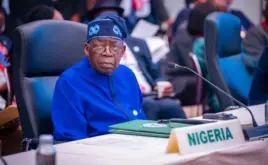
The World Economic Forum on Africa being hosted by Nigeria is providing an opportunity for the country to change the narrative amid a barrage of negative publicity that it has attracted in recent days.
Hosting the WEF Africa provides Nigeria with the opportunity to sell itself as it hosts heads of state and executives from companies including General Electric Co. (GE), Bharti Enterprises, the Dangote Group, McKinsey & Company, Heineken, and Telkom Group, South Africa, among others.
The meeting has been somewhat overshadowed by security challenges facing Africa’s largest economy in recent days, which include two bomb blasts and the kidnapping of some 200 girls from a school in the north-eastern state of Borno by Boko Haram insurgents, incidents which have sparked global outrage.
The ability to host the event despite the setback is a sign that Nigeria’s potential trumps its often poor global image.
“Nigeria’s potential is beyond the distorted international image of the country that is often served as reality,” Jean-Francois van Boxmeer, chief executive officer of Heineken, said in an interview with BusinessDay on the sidelines of the World Economic Forum on Africa.
“While there are problems, the fact remains that governance has improved over the past decade. The country’s economy is more diversified with greater participation from agriculture, financial services and telecoms. This is the story I will be telling other investors at the WEF,” said van Boxmeer, who is also a co-chair of the event.
Africa’s largest population and consumer market, Nigeria also recently emerged as the largest economy in Africa, with a GDP of $510 billion.
Many investors see the meeting in Nigeria as representing the continent’s largest business opportunity.
“It is a big vote of confidence in Nigeria,” said Olusegun Aganga, minister of industry, trade and investment. “Sixty-five percent of the 1,000 delegates attending the WEF are private sector players that will channel investments into various sectors of Nigeria’s economy.”
Africa’s growth trajectory is projected to remain above 5 percent in 2014, according WEF, and West Africa is the fastest growing sub-region on the continent, with Nigeria accounting for about 70 percent of the sub-region’s economic size.
However, Nigeria’s positive story of growth and economic advancement is also imperilled by the pitfalls of insurgency, insecurity and unemployment.
Nigerians have lived with high security alerts since attacks by an Islamist militant group named Boko Haram intensified in recent years.
The group has carried out high profile attacks including the suicide bombing of the United Nations headquarters in Abuja in August 2011, and the April 14 bomb blast on Abuja’s outskirts which killed at least 75 people, and another bomb explosion on Abuja’s outskirts last week which killed and injured several people.
“What we face in Nigeria is the fear factor; a lot of people fear to invest in your country. What we try to do is be positive, without being naive. And by showing our track record, we hope we can attract more investments,” said van Boxmeer.
“For us it’s important others invest; the more investments the more wealth that is created and the better our business will be. It’s a virtuous cycle which has to be accelerated. That’s what we’re doing for a country that is still generally perceived as extremely risky, that struggles to project itself correctly on international rankings and whose ability to deliver is underestimated,” he said.
The World Economic Forum is an independent international organisation committed to improving the state of the world by engaging business, political, academic and other leaders of society to shape global, regional and industry agendas, and is headquartered in Geneva, Switzerland.
The 2014 World Economic Forum on Africa began in Abuja, Nigeria, on May 7 and will last through May 9, 2014.
PATRICK ATUANYA

Join BusinessDay whatsapp Channel, to stay up to date
Open In Whatsapp