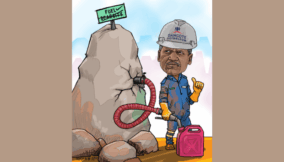
Stakeholders in oil and gas industry have again reinstated their oppositions to government control of the nation’s four refineries, stating that they should either be privatised or concessioned if the country is desirous of achieving self-sufficiency in premium motor spirit (PMS) or petrol in two years.
They say merely revamping the refineries with public fund and still leave them in the hands of incompetent government appointees to run will affect the efficiency of the these business concerns.
Muda Yusuf, director general of Lagos Chamber of Commerce and Industries (LCCI), while speaking against the background of the controversies over whether government should concession the refineries or not, said the government cannot manage the refineries fully.
He said: “The bureaucratic structure of government cannot support the running of any enterprise that can be ran successfully by the private sector. It cannot support an efficient management of any enterprise.”
The government can have shares in such in the refineries but it should not have responsibilities for an enterprise that the private sector can better manage, he told BusinessDay.
According to Yusuf, the greatest setback to the nation’s economy is government involvement in the running of the refineries, adding that those that opposed to the deregulation of the downstream sector of the petroleum industry have caused the country a great setback.
Also commenting on the situations with the refineries, Reginald Stanley, managing director, Petrowest Energy Resources Limited, during a panel discussion at the second business clinic programme organised by the petroleum downstream group of the LCCI, advocated that private sector pull their resources and invest in existing refineries to ramp up production to meet Nigeria petroleum product needs.
He, alongside other panellist, stated that it had become expedient that the Federal Government create an enabling environment in order to attract the required private sector investment to boost Nigeria quest to be self-sufficient in petroleum product for local demands.
According to Stanley, rather than encouraging the proliferation of modular refineries in Nigeria which the department of petroleum resources is doing by issuance of licences, private sector entrepreneurs should pull resources together and buy stake in the existing refineries which they can upgrade to meet the require capacity for profitability.
Professor Wumi Iledare, President of Nigerian Association for Energy Economics (NAEE) said that the problems of the refineries stem from the government interference with the operations of the NNPC and demanded that the government should completely hands off NNPC operations and allow the board of the corporations to operate independently.
The NNPC should be allowed to run like any company so that the board can take decisions that will enhance efficient running of the refineries. He said the nation could truly achieve self-sufficient in two years when the refineries are privately ran.
Nigeria’s refineries have continued to lie in a perpetual state of disrepair and encounter capacity utilisation challenges due to sporadic crude supply, lack of funding, challenged maintenance execution, and bureaucracy.
Senator Abubakar Kyari, Chairman of the ad hoc committee Joint Upstream and Downstream while commenting during the probing of the alleged concession of Port Harcourt Refinery, said inevitably partnerships between the public and private sectors are necessary to provide the required funding to rehabilitate our nation’s refineries. “We are committed to due process, and in seeking to achieve these goals, sound principles of corporate governance and extant laws must be adhered to, for the greater good of the Nigerian people. Indeed we will come up with recommendations aimed at improving transparency in the oil sub-sector of the economy and at the same time encourage investors.”
Last year President Muhammadu Buhari’s approved efforts by the Petroleum Ministry for the potential engagement of strategic investors with refining experience and funding capacity to partner with local players with a firm understanding of Nigeria’s downstream oil market to revamp the refineries.
In a bid to strengthen international relations, the Italian Government through ENI (an Italian oil and gas company in which it owns 30.3% shareholding), committed to support the rehabilitation of the country’s refineries, specifically the Port Harcourt refinery in which it has a long history of technical involvement.
Earlier this year, the Minister of State for Petroleum Resources and Chairman of the Board of the NNPC, Kachikwu met with ENI CEO, Claudio Descalzi, to discuss further cooperation between ENI and the Nigerian government within the energy sector.
The NNPC and ENI, through its local subsidiaries, Nigerian Agip Oil Company (NAOC) and Nigerian Agip Exploration (NAE), signed a Memorandum of Understanding (MoU) to promote new activities, which would significantly boost Nigeria’s social and economic development.

Join BusinessDay whatsapp Channel, to stay up to date
Open In Whatsapp