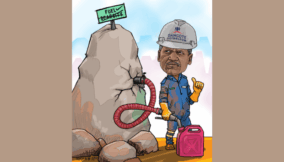
The foreign exchange reserves of big oil exporting nations have fallen to their lowest level for a decade as weak energy prices force many countries to raid their stockpiles. Oil price began their fall in early trading Wednesday as data showed US stockpile had risen, worsening the market glut.
The decline in reserves highlights the waning clout of some of the world’s leading petro states and how little time they have to diversify their economies before their cash cushions disappear. At the end of 2016, 13 big energy exporters had combined reserves of $967bn, according to data from the International Monetary Fund, well below the peak of $1.26tn at the end of 2013 and the lowest figure since 2006.
Foreign reserves in Venezuela, which is fighting rampant inflation and food shortages, have fallen 90 per cent off their 2008 peak, while reserves in war-torn Libya have slipped 45 per cent since a 2012 high. Reserves are 41 per cent off their 2013 peak in Algeria; 38 per cent in Nigeria, 35 per cent in Russia and 30 per cent in Angola since their 2012 peaks; 29 per cent in Qatar (2014) and 22 per cent in Kazakhstan (2010).
Some Gulf states such as Saudi Arabia, the United Arab Emirates and Kuwait have experienced much smaller declines, thanks to returns on their investments and less hefty budget deficits. But their reserves could also come under further pressure if the oil price remains at about $45 a barrel, compared with the levels of $100 or more recorded in 2008 and 2011 to 2014. “At $45, I would expect reserves to carry on falling,” said Charles Robertson, chief economist at Renaissance Capital, a Moscow-based investment bank with a focus on emerging markets.
John Sfakianakis, director of economic research at the Gulf Research Center, a Saudi think-tank, added that “the attempts of the major oil-exporting countries to rein in spending and increase non-oil revenues” were also critical in determining whether reserves would continue their decline. Collapsing government revenues and rising public spending have pushed up budget deficits in many oil exporters. Brunei’s deficit hit 21.9 per cent of gross domestic product in 2016, with Bahrain’s deficit at 17.7 per cent, Saudi Arabia at 16.9 per cent and Venezuela 14.6 per cent.
Jason Tuvey, Middle East economist at Capital Economics, said he was confident that Saudi Arabia, Qatar and the UAE still had sufficient reserves to tide them over as they diversified their economies. He said the decline in reserves was “starting to slow”, adding that “Saudi Arabia in particular has undertaken a lot of austerity in the last couple of years” to reduce the rate it is burning through its cash pile.
But he expressed concern that less-well resourced Gulf states such as Oman and Bahrain could eventually need bailouts from their wealthier neighbours in order to protect their currency pegs against the dollar. Mr Sfakianakis said he feared Algeria, which had a budget deficit of 11.6 per cent of GDP last year, was “quite behind” developing its non-oil economy, with just another two to three years to do so or face “severe consequences”.
The decline in oil-fired reserves has hurt the asset management industry, with sovereign wealth funds withdrawing $46.5bn from fund managers during 2015 alone, according to eVestment, a data provider. “That money was supportive of asset prices when it came into the markets and presumably is going to be a headwind for global markets when it goes out again,” Mr Robertson said.
Mr Sfakianakis believed the real estate sector, which has been buoyed by strong inflows from Gulf states in recent years, could be most vulnerable to the reversal in oil-exporters’ finances.

Join BusinessDay whatsapp Channel, to stay up to date
Open In Whatsapp