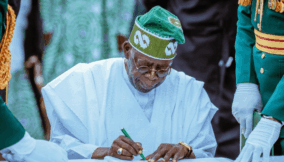
The Nigerian government has finally inaugurated the long awaited National Council on Privatisation (NCP), paving the way for the commencement of possible sale of additional government assets to raise extra cash for budget funding.
Faced with tight cash conditions, Nigeria is hoping to raise some N35bn from sale of its own assets to partly fund the N7.441 trillion budget for 2017.
The NCP which is being reconstituted over two years after the commencement of the Buhari-led administration is the Fifth Council since the enactment of the Public Enterprises (Privatisation and Commercialisation) Act 1999.
Acting President, Yemi Osinbajo who inaugurated the council Thursday in Abuja said the NCP, since inception has successfully concluded the privatization and reform of over 142 public enterprises.
He pointed out that the inauguration of the NCP is a critical step in the process of putting in place part of the institutional framework necessary for the actualisation of the socio-economic agenda of the administration.
The National Council on Privatization is a think tank sponsored by the Nigerian government to determine the political, economic and social objectives of the privatization and commercialization of Nigeria’s public enterprises.
The Council holds the authority to approve public enterprises to be
privatised or commercialised, the legal and regulatory framework for the public enterprises to be privatised as well as determine whether the shares of a listed public enterprise should be by public or private issue or otherwise.
“It is also a demonstration of our administration’s commitment to public sector reform and the central role of the National Council on Privatisation (NCP) in this process. Even though the public sector has been at the center stage in the provision of critical infrastructure and services cutting across the whole spectrum of the nation’s life since independence, the emerging importance and centrality of the private sector to the actualization of the economic agenda of the administration cannot be downplayed,” Osinbajo also noted as he inaugurated the Council.
He stated that apart from playing a dominant role of generating employment opportunities, the intervention of the private sector enhances the process of industrialization, delivers critical infrastructure and services the country. To him, the role can only be unleashed when government’s role of regulating and creating an enabling environment is robustly undertaken. “This will in turn offer the private sector the required comfort and assurance to make investments and expect a reasonable return on thereon,” he said.
Members of the newly inaugurated Council include the Acting President who is the Chairman; Kemi Adeosun, Minister of Finance, who serves as the Vice Chairman; Abubakar Malami, the Attorney General of the Federation; Okechukwu Enelamah, the Minister of Industry, Trade and Investment; and Udo Udoma, Minister of National Planning.
Others are Habibat Lawal, acting Secretary to the Government of the Federation; Godwin Emefiele, Governor of the Central Bank of Nigeria; Adeyemi Dipeolu, Special Adviser to the President on Economic Matters; Ituah Ighodalo; Ghandi Olaoye; A.A. Ibrahim; Bashir Gwandu; and Alex Okoh, Director General of the Bureau of Public Enterprises (Member/Secretary.)
Osinbajo assured that the government will give all the required support to the NCP in carrying out its statutory responsibilities.
“In return, the Government expects the NCP to come up with creative out-of-the box solutions for addressing the numerous challenges facing the privatisation and commercialisation programme such as non-performance by some privatised enterprises and post-privatisation challenges facing some of the privatised enterprises,” he added. “The Government also expects the NCP to make measurable progress in respect of the outstanding transactions affecting some of the areas critical to the economic recovery of the nation. You must make deliberate and conscious efforts to learn from past experiences and guard against avoidable mistakes of the past.”
The Acting President explained that over the years, the NCP had concluded significant transactions and carried out economic reform activities in key sectors of the economy such as telecommunications, pension management, ports, power, etc.
According to him, “A mega reform process in the power sector is ongoing with ambitious expectations. Although there are numerous challenges trailing the process, the NCP is expected to critically analyse these challenges and come up with sustainable solutions as part of government commitment to make power available at accelerated rates and to wide sections of the populace.”
In his remarks, Alex A. Okoh, DG, Bureau of Public Enterprises (BPE) noted that recently a trend has emerged where certain institutions engage in activities which are tending to compromise and conflict with the statutory functions of the Bureau.
Okoh believes that regulatory agencies and commissions should manage regulatory compliance and not get involved in process as transactions managers or operators as this will clearly create confusion and possible conflict.
According to him, the Bureau of Public Enterprises operates as transaction managers and will “submit its processes to the supervision of the relevant regulatory agency responsible for the particular transaction track we pursue to execute our mandate of enterprise reformation, including the SEC and the ICRC.”
Onyinye Nwachukwu, Abuja

Join BusinessDay whatsapp Channel, to stay up to date
Open In Whatsapp