The billions of naira allocated for water resources at Federal and State Government levels has failed to make meaningful impact as majority of Nigerians and businesses continue to spend scarce resources to generate their own water supplies.
Between 2012 and 2016, a total of N293.1 billion was budgeted for water resources at the federal level, with varying sums across the states, yet there has been little to show for it.
In 2012, the sum of N84.9 billion was budgeted by the federal government for water resources, in 2013 the budget was for N88.2 billion N52.27 billion in 2014, N23.44 billion in 2015, and in the current 2016 budget, N44.20 billion has been proposed for expenditure on water resources.
Nigeria’s two largest states by population have a combined budget of over N20 billion for the provision of water in 2016.
Kano state’s 2016 budget provides N13.2 billion for its ministry of water resources and rural development, out of which N8.4 billion is for water supply; in Lagos state, the Lagos Water Corporation has approximately N12 billion allocated to it.
While some residents in urban centres like Lagos have the choice of providing their own water through boreholes, for many village dwellers in Nigeria’s vast interior without the means, the choices are much starker.
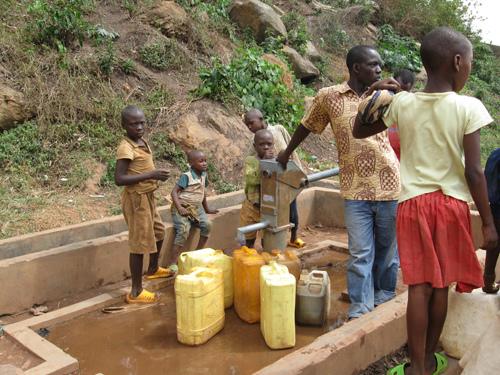
Haua Musa and the other women and girls in Fikaji, a village in Northern Nigeria have two choices for collecting water: a river nearly an hour’s walk away or a pond 20 minutes away.
Although, the pond is dirty, shared with livestock, frogs and unknown germs and diseases, it is much closer and so it is used as the main water source.
Two of Haua’s children have died from typhoid, a disease that might have been prevented with access to safe water, the 47 year old housewife tells Water Aid, a London-based non-profit.
“All my life, everything has been about water. I want to have a bath, there is no water. I want to wash clothes, no water. I want to cook, no water. Always everything is water, no water,” Musa said.
Water shortage is one of the biggest issues facing urban Africa, which will see a 66 percent population increase to 1.2 billion people by 2050, according to the United Nations.
The shortage in Nigeria is being compounded by a nationwide electricity outage from the disruption of gas supply to thermal power stations by militant attacks in the Niger Delta.
In Lagos, Nigeria’s largest city of about 22 million people, the potable piped water reaches only about 7 million, leaving two-thirds of the city struggling to find safe water.
The Lagos State Water Corporation’s capacity is 210 million gallons a day, compared with the 540 million gallons needed by Lagosians.
Despite such huge allocations made for water resources every year, last month, some residents in Lagos state expressed their displeasure over non-supply of water by the state’s water corporation for over three weeks, a situation that threatened an epidemic as the residents resorted to drinking water from wells and boreholes that are unsuitable for human consumption.
While the residents are apprehensive on the likelihood of outbreak of water related diseases like cholera, poor water supply concerns also culminated in protests by students of the University of Lagos, a development that led to the school’s closure for some weeks.
Ogbonnaya Igbokwe, of Heartwells Group and Head, Health Thematic Group at the Nigerian Economic Summit Group, decries the water supply situation in Lagos.
To get water for their operations, companies and residents often pay private water haulers called ‘mairuwas’ several times what Lagos State Water corporation charges, according to Igbokwe.
“Since 2nd quarter of last year, we have not had water from the Lagos state water corporation. We have been buying water from vendors who sell in tankers. It is really horrible! Sometimes when they fill the tanks and you open the tap, the water smells, an indication that maybe they just got it from a place not far from a sewage tank. It could also be that they got it from bar beach, eleko beach, or from whatever beach. Now, the water is not treated, their primary goal is profit,” Igbokwe said.
The poor and inadequate water infrastructure in Nigeria has exacerbated severe general poverty and led to wide scale impairment of public health through the invasion of water-caused diseases.
Earlier this year, Enugu state in South East Nigeria reported 76 deaths due to a cholera outbreak, and many more go unreported, especially in rural areas.
According to the United States Centre for Disease Control, Cholera is most likely to be found and spread in places with inadequate water treatment, poor sanitation, and inadequate hygiene.
Two thirds of the population or over 130 million people don’t have access to adequate sanitation in Nigeria, while around 68,000 children under five years old die every year from diarrhoea caused by unsafe water and poor sanitation, according to WaterAid.
“In Nigeria, water services cannot be delivered quickly enough to cope with the rapidly growing population. As a result, more than 63 million people live without access to safe water,” around 68,000 children under five years old die every year from diarrhoea caused by unsafe water and poor sanitation,” saidWaterAid, in a recent report.
A solution to the crises lies in a combination of public and private capital investing in water infrastructure, according to experts.
The rate of economic returns for water infrastructure investments in sub Sahara Africa averaged 23 percent, outpacing returns from power generation, roads and railways, according to data from UN Aquastat and the World Bank.
PATRICK ATUANYA & CALEB OJEWALE

Join BusinessDay whatsapp Channel, to stay up to date
Open In Whatsapp