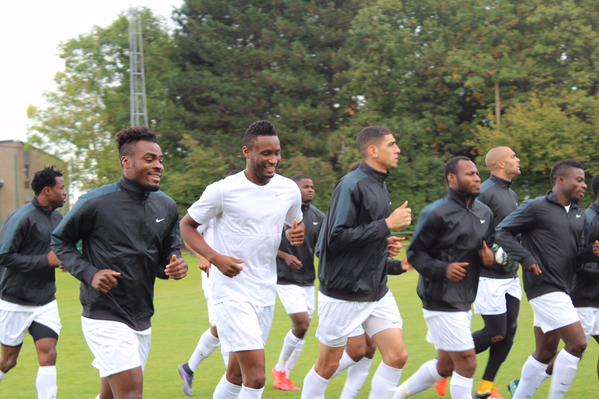
Irrespective of the problems in Nigerian football in recent times, the country has much to be proud of in terms of legends. In the long list of coaches that have handled the national team in the past ten years, six of them have come from the historic 1994 World Cup squad and more numbers of national team coaches from the same generation is more than most countries can boast of.
The Super Eagles in 1994 took the football world by storm. In January, they won their second ever Africa Cup of Nations (AFCON) title in Tunisia after coming from a goal down to defeat the Chipolopolo of Zambia 2-1.
Later in the summer, they made their debut at the World Cup in the United States, where they defeated Bulgaria and Greece respectively. A late collapse in their game against Italy dashed their quarter-final hope, but made significant impact on the world of football and will forever be remembered for their beautiful playing style.
However, mixed reactions have come from football stakeholders and soccer fans alike that draw divergent opinions on whether these players have been able to translate their playing success into coaching. The 1994 squad at the 1994 World Cup in USA was widely regarded as the country’s best team in history.
They were termed the “Golden Generation” of Nigerian football. Several members of the wonderful team have taken a coaching job. We take a critical look of how these men fared as coaches giving their blissful playing career.
Augustine Eguavoen
Eguavoen, a key member of the 1994 team, he led the team to win the 1994 African Nations Cup title in Tunisia.
After his retirement, he moved into coaching and has coached the Golden Eaglets, the Dream Team and Super Eagles in the past.
He took the job of head coach of the Super Eagles in 2006 where he led the team to a third place finish at the AFCOn in Egypt.
In June 2010, Eguavoen replaced Lars Lagerback and was brought in as caretaker manager. The former defender was also appointed as the head coach of Dream Team in August 2010, but was fired after Nigeria failed to qualify for the2012 London Olympic Games.
Stephen Keshi
The former Super Eagles strong man also played a key role as Nigeria secured its first world cup ticket in 1993.
After his retirement from soccer, he moved into coaching where he led the Flying Eagles to a disastrous outing at the 2001 African Youth Championship in Ethiopia as the team crashed out in the first round. He was brought on board alongside Shuaib Ahmadu and Joe Ericoto to help Nigeria’s world cup qualification bid in 2001 and the trio eventually secured the country’s ticket to the 2002 mundial in the Far East.
He moved to Togo and guided the West African nation to its first FIFA World Cup tournament. Again, he was sacked few months to the tournament over disagreements with some top stars.
He also guided Mali to the 2010 AFCON in Angola and was shown the exit door after the team’s poor outing in the Southern African country.
Keshi took over as Super Eagles coach in November 2011 following the team’s failure to qualify for the 2012 AFCON in Gabon/Equatorial Guinea.
Under his watch, Nigeria lifted the AFCON title in South Africa in 2013 and also qualified for the 2014 FIFA World Cup in Brazil.
Emmanuel Amunike
Amunike was the hero for Nigeria at the 1994 Nations Cup in Tunisia. His brace helped the Super Eagles to a 2-1 win over Zambia.
He wore the colours of Julius Berger, Zamalek of Egypt, Sporting Lisbon and Barcelona in a glittering career. He was the 1994 African Player of the Year.
Amunike was an assistant coach with the Golden Eaglets team that won the FIFA U-17 World Cup in United Arab Emirates last year.
Amunike guided Nigeria’s U17 team to the FIFA 2015 World Cup title with a 2-0 win over Mali in Chile and has impressed with his style of play and man management skills.
Samson Siasia
Siasia played as a striker at the 1994 AFCON in Tunisia and the FIFA World Cup in the same year. He scored Nigeria’s only goal in the 2-1 defeat to Diego Maradona inspired Argentina.
Upon his retirement, he coached the Flying Eagles team that won silver medal at the 2005 U-20 World Cup in Holland. He also led the Dream team to win silver at the 2008 Olympic Games in China. He won the African Youth Championship with the Flying Eagles in Benin Republic in 2005.
He was appointed Super Eagles coach in 2010 and was sacked in October 2011 after the team’s failure to qualify for 2012 AFCON in Gabon/Equatorial Guinea.
Siasia guided Nigeria’s Dream Team VI to success at the 2015 U-23 Africa Cup of Nations in Senegal.
Daniel Amokachi
Amokachie, nicknamed “The Bull” during his playing days. He featured in two AFCON and FIFA World Cup tournaments. He also won gold medal with the Dream team at Atlanta 96. He played for Rancher Bees, Club Brugge, Everton and Besiktas.
In April 2007 he quit his role as assistant coach of the Nigerian national team. On April 2008, Amokachi was re-appointed to Nigeria’s national team, as assistant coach to Shuaibu Amodu, also being assistant manager to Stephen Keshi. In 2015, the power-playing attacker took charge of the Super Eagles as interim manager, but failed to perform as he was eventually sacked.
Sunday Oliseh
Oliseh became the first Nigerian to play in Italian Seria A when he signed for Reggiana few months before the commencement of the 1994 FIFA World Cup in USA. He later played for Juventus, Ajax Amsterdam, Borussia Dortmund, FC Koln, VFL Bochum and Genk. But his first European club side was Standard Liege in Belgium.
In July 2015, Oliseh took charge of coaching Nigeria’s national team, the Super Eagles. Since his appointment, Super Eagles were still struggling to reclaim their top position in Africa. He guided the Nigeria Home Based Super Eagles at the African Nations Championships, (2016 CHAN), where Nigeria crashed out after suffering a defeat to a low rated Guinea side.
Aside Stephen Keshi, Samson Siasia and Emmanuel Amunikewho have won laurels as players and coach respectively for Nigeria, other ex-international of the historic 1994 squad have failed to replicate their playing success into coaching. The question is; does playing well translate to successful coach?
Anthony Nlebem

Join BusinessDay whatsapp Channel, to stay up to date
Open In Whatsapp